Confined Space Entry Logs, What Location Data Adds When the Attendant Cannot See Inside
2026-09-28
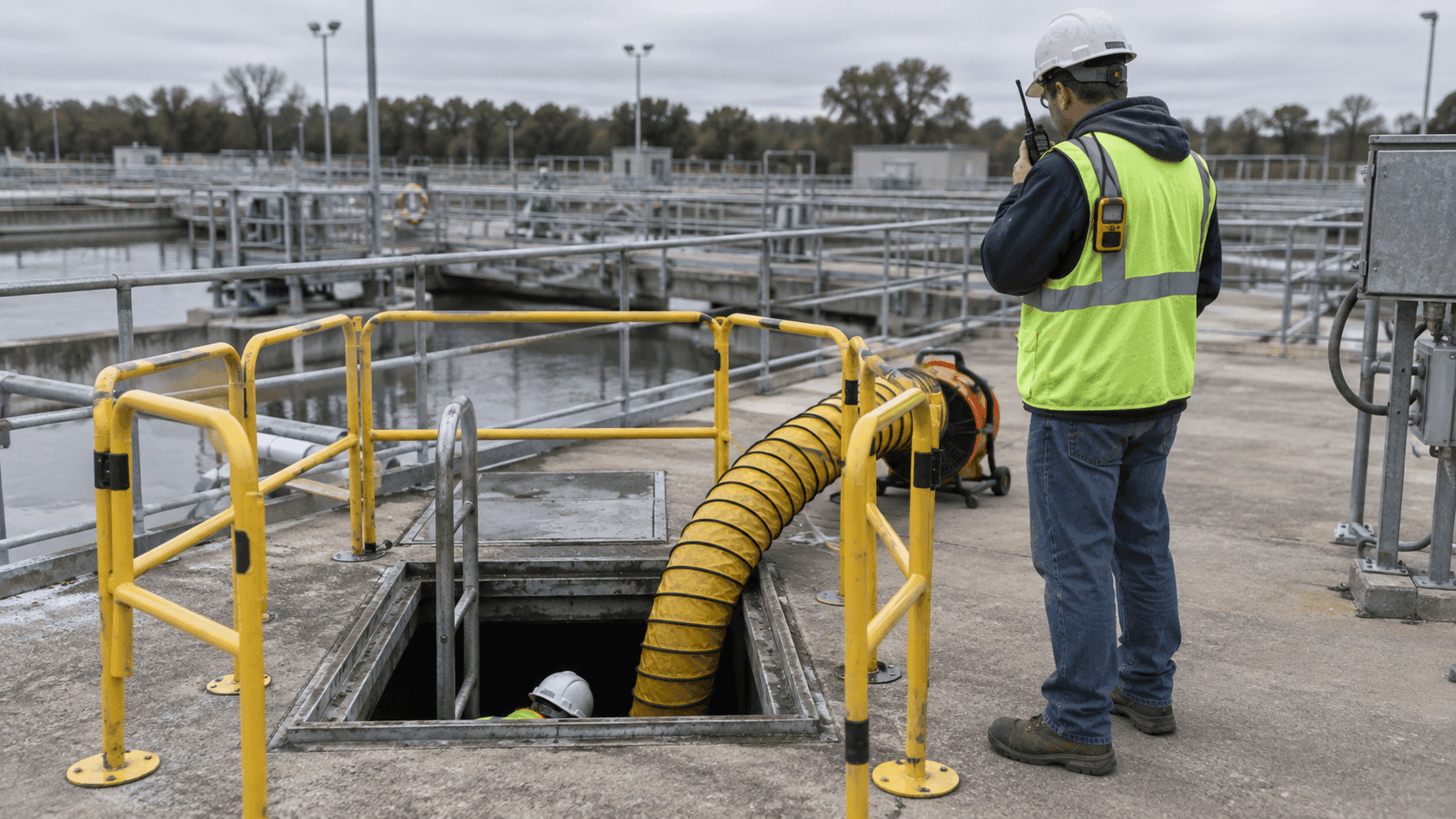
The manhole cover at a wastewater treatment plant comes off, and a confined space entry begins. Once two entrants climb down the ladder, the attendant left at the opening can see the first few rungs and the tops of their hard hats, and nothing more. From then on, what happens inside reaches the surface only as a voice over the radio. Next to the opening hangs a sheet of paper with the date and time of the work, the names of the entrants, and the oxygen and toxic gas readings.
Standing outside is the position the rule assigns to the attendant. OSHA's permit-required confined spaces standard, 29 CFR 1910.146, has the employer provide at least one attendant outside the permit space for the duration of entry operations, along with the communications equipment the attendant needs to monitor the status of the entrants.
The weight of that position shows in the numbers. A Bureau of Labor Statistics fact sheet published in July 2020, based on the Census of Fatal Occupational Injuries, counts 1,030 workers who died from occupational injuries involving a confined space from 2011 to 2018. Of those deaths, 126 were cases of inhaling a harmful substance in a single episode, and another 39 were cases of oxygen depletion.
Bring location tracking to this kind of site and the first question you meet is whether an anchor mounted outside can see inside. In a space enclosed by steel and soil the answer is usually no, so the design starts where the attendant stands, at the entrance.
I. What the confined space entry rules put at the entrance
The standard defines a confined space by three conditions: it is large enough and so configured that an employee can bodily enter and perform assigned work, it has limited or restricted means for entry or exit, and it is not designed for continuous employee occupancy. Its own examples of spaces that may have limited means of entry are tanks, vessels, silos, storage bins, hoppers, vaults, and pits. A permit-required confined space is one that also has at least one of four characteristics, the first being that it contains or has the potential to contain a hazardous atmosphere. Spaces like these turn up across water and wastewater, chemical, and manufacturing plants. The standard covers general industry, and construction work has its own counterpart in 29 CFR 1926 Subpart AA.
An employer whose employees will enter permit spaces must develop and implement a written permit space program. Under paragraph (d), that program covers the measures that prevent unauthorized entry, identifying and evaluating the hazards before anyone enters, the procedures and equipment for safe entry, and the designation and training of everyone with an active role, from entrants and attendants to entry supervisors and the people who test the atmosphere. Each entry then gets a permit, and the completed permit is made available to the entrants at the time of entry by posting it at the entry portal or by any other equally effective means.
Three more duties sit at the entrance. The attendant continuously maintains an accurate count of authorized entrants in the permit space and makes sure the means used to identify them accurately identifies who is inside. Exposed employees are informed of permit spaces through posted danger signs or any other equally effective means, and when unauthorized persons approach or enter during an entry, the attendant warns them away, tells them to exit if they have entered, and informs the entrants and the entry supervisor. The attendant also summons rescue and other emergency services as soon as the attendant determines that the entrants may need assistance to escape.
The entry permit goes one level further. It must identify the authorized entrants by name or by such other means, with rosters or tracking systems as the standard's own examples, as will enable the attendant to determine quickly and accurately, for the duration of the permit, which authorized entrants are inside. Entrants, for their part, exit as quickly as possible whenever an evacuation alarm is activated or the attendant or the entry supervisor orders them out.
Sort these provisions into work that needs human judgment and facts that end up as records, and "who went in, how many, when they entered and when they left" lands on the records side. That is as far as location data can help.
II. Meters read the air, people judge, records track entry
A location record knows nothing about the air. The standard has the permit space tested before entry is authorized and tested or monitored as necessary during entry, first for oxygen, then for combustible gases and vapors, and then for toxic gases and vapors. The permit records the results of the initial and periodic tests together with the names or initials of the testers and when each test was performed, and every canceled permit is retained for at least one year. By the standard's definition, a hazardous atmosphere includes oxygen below 19.5 percent or above 23.5 percent, flammable gas, vapor, or mist above 10 percent of its lower flammable limit, and airborne substances that could expose employees above their permissible exposure limits. Reading those numbers is the job of the instrument, and judging them is the job of the people the program designates.
Nor does any device take over the work of the attendant or the entry supervisor. Noticing that something is wrong, summoning rescue, and ordering the evacuation are done by people.
What a location record knows is narrow: which tag crossed the entrance, in which direction and at what minute, and how many tags are inside the zone right now. That narrowness is the point. The entry permit lists the authorized entrants, the people who may go in, while the entry log lists the people who actually crossed the entrance.
III. Signals blocked by steel and soil, an entrance line or interior anchors
UWB location tracking works by anchors receiving a tag's signal and calculating its position, and a confined space is closed to radio as well. The steel walls of a tank block the signal, and a manhole or pit surrounded by soil and concrete weakens it heavily. Some signal may leak out through the open entrance, but not steadily enough to calculate a position inside. An anchor mounted outside cannot see in any more than the attendant can.
So the design splits in two. The first approach stands where the attendant stands. Just outside the entrance, where the signal still reaches and people step into the controlled area, you draw a line, and In-out Tracking in ORBRO OS records who crossed it and in which direction. Zone Counting counts the people in the work area around the entrance. In this design it is normal for someone who goes inside to drop off the floor plan, and the fact that they are inside remains as the gap between an entry record and an exit record.
The second approach places anchors inside. When the space is large and the job is long, as in a utility tunnel or a large tank under maintenance for several days, anchors go inside and Zone Counting counts the people in the space directly. A TwinTracker UWB anchor covers 50 m under line-of-sight conditions, so in spaces with many bulkheads and corners the anchor spacing is set by measuring on site.
| Condition | Entrance line design | Interior anchor design |
|---|---|---|
| Suitable spaces | Manholes, pits, and small tanks with a single entrance | Utility tunnels, large tanks, ship hull block interiors |
| People still inside | Tags with an entry record and no exit record after it | Current headcount in Zone Counting |
| Position inside | Unknown | Confirmed at zone level |
| Over-capacity alert | A person judges from the records | Alert on an interior headcount condition |
| Prerequisite | A line can be drawn at every entrance | Anchors can stay inside for the duration of the work |
For short jobs with frequent comings and goings, the entrance line is enough, and for work where people stay long or spread out, interior anchors are added. Either way, keep the entrance line. Entry and exit are the two moments behind the attendant's accurate count, and the entrance is where a record catches both of them most clearly.
IV. Confined space entry logs and alerts in ORBRO OS
In-out Tracking stores each crossing of the line with its date, time, direction, object, and location, and the history can be downloaded as a file. In a space with interior anchors, Timeline shows each worker's zone dwell history by day and exports it to Excel.
Headcount alerts are set as conditions built on Zone data values. For a tank with three authorized entrants, a condition such as "tank interior headcount is 4 or more" raises an alert at one of five levels: Critical, Warning, Caution, Watch, or Normal. Link an SOP to that condition, and when the condition is met an SOP is created for the assigned group to work through, built from steps such as multiple choice checks, date and time input, SMS broadcast, and camera checks.
Approach by people who are not authorized is handled by Alert Zone, which raises an alert when a tag from a category not authorized for the entrance zone comes in. People without tags and today's entry permit are outside what this alert knows, so controlling entry and checking the roster stay with the entry supervisor and the attendant. If a camera covers the entrance, AI Event Manager detects a person falling and alerts the area around the entrance through a Horn Speaker or Signal Tower.
One objection comes up: with an attendant standing at the entrance, why keep a record at all? If there is one entrance and the job is done within an hour, a roster, a radio, and a handwritten confined space entry log may be enough. Records start to matter when several entrances are open at once, when the work runs across a shift change, or when people go back in after a break. The standard has the entry supervisor determine, whenever responsibility for the entry is transferred and at intervals dictated by the hazards and operations, that entry operations remain consistent with the permit, and the record is what lets anyone retrace the comings and goings between those checks. When an alarm sounds and everyone comes out, a second check joins the attendant's eyes and the roster: the tags with no exit record. It does not replace the attendant. It gives the attendant one more basis for confirming.
V. What to check before adding location records to confined space entry
- Your site's list of confined spaces. For each space, note the material, the number of entrances, how many people go in at once, and how long a job usually takes. This is where the two designs part ways.
- Where to draw the line. It has to sit before the signal drops out, at the point where people step into the controlled area, and every entrance gets one if there are several.
- Whether the space is a hazardous (classified) location. OSHA's electrical standard requires equipment in hazardous (classified) locations to be intrinsically safe, approved for the hazardous (classified) location, or safe for it (29 CFR 1910.307), so tags that go inside and any interior anchors are reviewed against this condition first.
- The order of handing out tags. Split entrants, attendants, and contractor personnel into categories, and have each person named on the permit wear their own tag and return it when the work is done, so that the record points to a person.
Closing thoughts
When the job is done, the two entrants climb back up the ladder, and the attendant checks the roster before putting the manhole cover back. If what is in hand at that moment is not just one sheet of paper but two entry records and two exit records, the confirmation that nobody is left inside is doubled. The last number checked before the cover goes back on is what location records add to a confined space entry.
ORBRO builds its own worker tags, TwinTracker anchors, the control software ORBRO OS, and AI Event Manager, its camera AI. That is why the entrance line, interior anchors, and the entrance camera can be designed together on one floor plan. Send us your list of confined spaces, the number of entrances for each, and how long a job usually takes, and we will work with you to separate the spaces where an entrance record is enough from the ones that need anchors inside.
Recommended Blogs

Safety Grants and Workers' Comp Premium Credits: How Contractors Fund Construction Safety Technology
2026-09-23

Visitor Flow Analytics, Camera or Smartphone When You Cannot Hand Out Tags
2026-09-22
Smartphone Indoor Positioning, What an App and Beacons Cover and When You Need a Badge Tag
2026-09-21

RTLS for Senior Living: Filling the Daily Care Log with Resident Location Data
2026-09-18