Time Difference of Arrival
High-Density RTLS Positioning Based on TDoA
ORBRO calculates stable coordinates even in high-density environments through receiver synchronization, signal quality evaluation, solution space constraints, and iterative optimization in UWB TDoA indoor positioning.
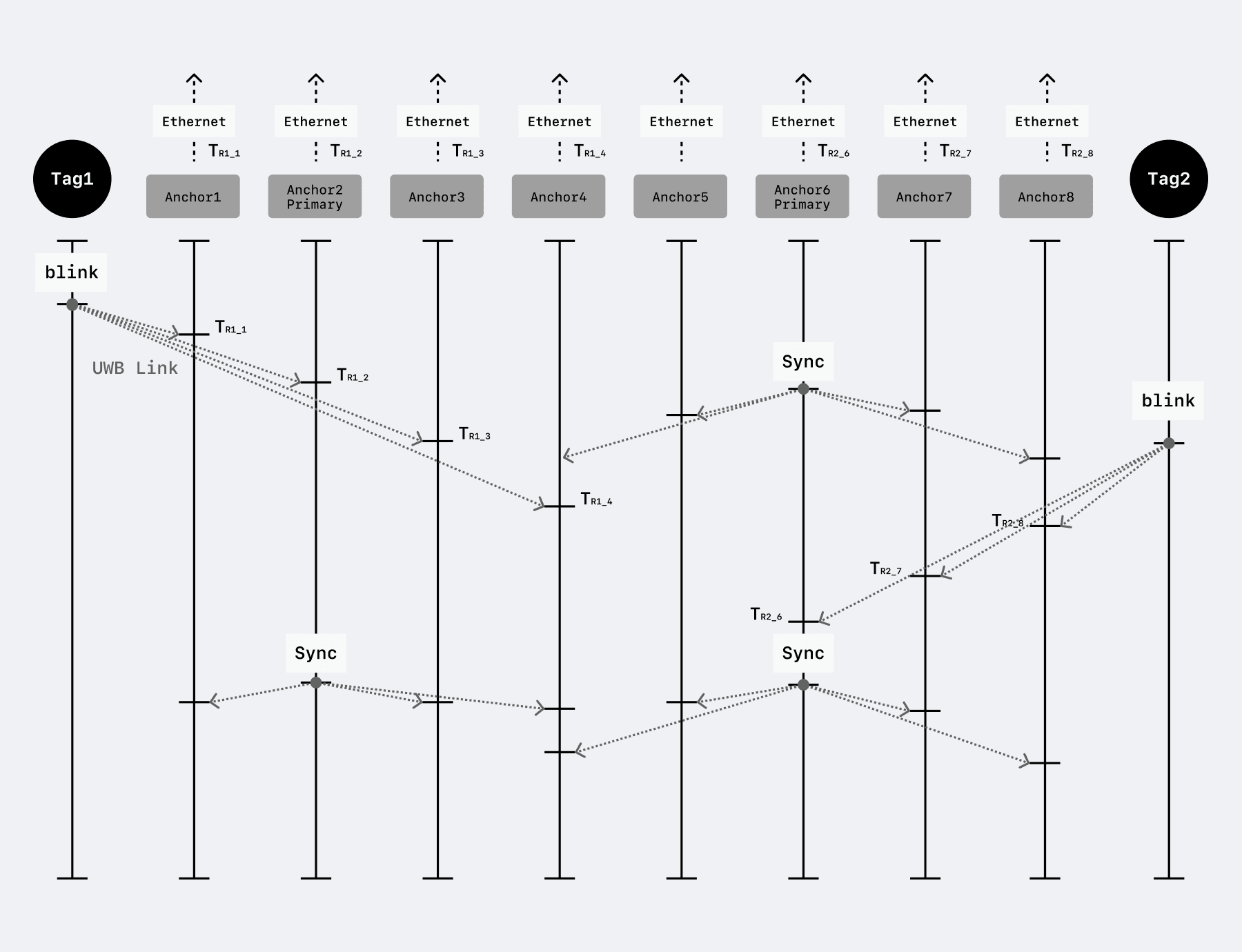
Limitations of TDoA Calculation and ORBRO's Structural Response
TDoA (Time Difference of Arrival) is a method of estimating the transmission location by analyzing the difference in time a single transmitted signal reaches multiple receivers. Because it does not require separate response processing from the terminal and calculations are performed only on the receiver side, it is simple in structure and capable of large-scale expansion, making it widely used as a high-precision location estimation technology in various industrial environments. However, this method guarantees consistent performance only under ideal conditions. Realistic variables such as reflections from indoor structures, clock discrepancies between receivers, and multipath reception distort the arrival time of signals and accumulate errors during the time difference calculation process. Additionally, TDoA is mathematically a non-linear optimization problem; if the initial estimation is inaccurate or there are no solution space constraints, the calculation may diverge or converge to a local minimum. These structural constraints can be summarized into three main issues: · Clock errors of just a few nanoseconds are amplified into location errors of several dozen centimeters. · Signal distortion occurring in reflection or NLOS (Non-Line-of-Sight) conditions is included in the time difference calculation, hindering accuracy. · If initial estimations or spatial constraints are inaccurate, the calculation may converge to physically invalid coordinates or fail to derive a solution. ORBRO solved these limitations not through simple filtering or post-processing, but through a redesign of the entire TDoA computational structure. We divided the entire flow from signal reception to coordinate output into a structure of collection, initialization, optimization, and quality verification, and inserted modules capable of quantitative control at each stage to ensure consistent convergence stability and result quality in real environments. This structural response is not just an algorithmic improvement, but the result of a system structure that has refined the entire TDoA calculation into a designable framework. The ORBRO TDoA calculation described hereafter consists of four core structural units, each performing an independent function to stably maintain real-time calculation quality.
6-Step Computational Flow for Precise Positioning: From Signal to Coordinates, How ORBRO TDoA Works
ORBRO's TDoA system goes beyond a simple RTT calculation structure and is designed as a multi-stage signal processing structure to secure the reliability of distance measurement and calculation quality. The technical response methods described in Chapter 2 are implemented within the actual system through the following six stages. Each stage is configured to quantitatively evaluate the quality of received signals and stably control the entire flow until a distance value is output.
Step 1. Receiver-to-Receiver Time Synchronization
The prerequisite for TDoA calculation is that the clocks of all receivers (anchors) must be synchronized to the same standard. ORBRO periodically exchanges reference signals through high-speed communication between receivers and compensates for each receiver's clock drift in real-time at the hardware level. This maintains high-precision time alignment in nanoseconds (ns) without post-filtering, securing reliable raw time data required for real-time calculation.
Step 2. Tag Signal Reception and Arrival Time Recording
The tag periodically transmits a signal, which reaches multiple receivers. Each receiver records the arrival time based on its clock, and this information forms the basis for subsequent calculations. ORBRO records not only the arrival time but also quality metadata such as signal strength and delay time to be used in later calculation quality judgment.
Step 3. Initial Value Setting through Time-Difference-Based Spatial Estimation
TDoA calculation is mathematically composed of a non-linear optimization structure, and the convergence quality of the calculation is greatly affected by the initial estimate. ORBRO sets the starting point of the calculation not as a simple center coordinate, but as a directionality-based coordinate considering the receiver array and time difference distribution. By reflecting the relative weights of each receiver's position and received time difference data, a single estimated point where the tag is most likely to be is designated as the initial value for the calculation. This method prevents the calculation from falling into local solutions and enables stable convergence even in peripheral locations.
Step 4. Convergence Stabilization through Solution Space Constraints
Because TDoA calculation is a non-linear optimization problem, there is a risk of converging to a local minimum or the calculation diverging if the initial value is inaccurate or the solution space is wide. ORBRO predefines the Z-axis (altitude) range of the calculable space and utilizes geometric information based on receiver arrangement conditions and tag-receiver distance to ensure calculations occur only within physically possible areas. This secures both convergence stability and result quality.
Step 5. Iterative Optimization Calculation
Once the initial estimate is set, ORBRO performs iterative optimization in a direction that minimizes time difference residuals. This process is based on a mathematical optimization model where calculations are repeated until the error falls below the convergence condition. Since a partial derivative-based convergence structure is combined with quality standards, the final position is output only if it passes the calculation quality check.
Step 6. Coordinate Verification and Final Position Output
When the calculation converges, ORBRO verifies whether the coordinates meet the final output conditions. Verification criteria include calculation quality, signal reliability, convergence patterns, and continuity with previous frames. Only coordinates that satisfy all criteria are output as the final position value; in case of calculation failure or quality deficiency, an automatic retry or exception flag is generated. The final position is transmitted in real-time to the UI or external systems for various operational flows.
Optimized Computational Structure Makes a Difference in Real-World Performance
Location calculation in a high-precision RTLS system is not just about outputting coordinates. Position values are comprehensively evaluated by various quality factors such as real-time performance, convergence speed, and consistency regarding environmental changes. In particular, since the TDoA (Time Difference of Arrival) method is calculated based on the time difference between receivers, a time difference error of just a few nanoseconds can be amplified into a coordinate deviation of several dozen centimeters, and performance differences become stark depending on the computational structure and initial condition settings. Indoor spaces make it difficult to maintain ideal signal quality due to reflections, multipath reception, and structural shielding. Therefore, the stability and reproducibility of calculations act as key factors determining the practical performance of an RTLS system rather than simple precision figures. ORBRO has maximized the reliability of calculations by inserting quality control at each stage and optimization algorithms based on a computational system that structurally reflects these conditions. In this chapter, we summarize how structural differentiation leads to quantitative results through the performance figures achieved by the ORBRO TDoA system in actual environments.
1. Accuracy
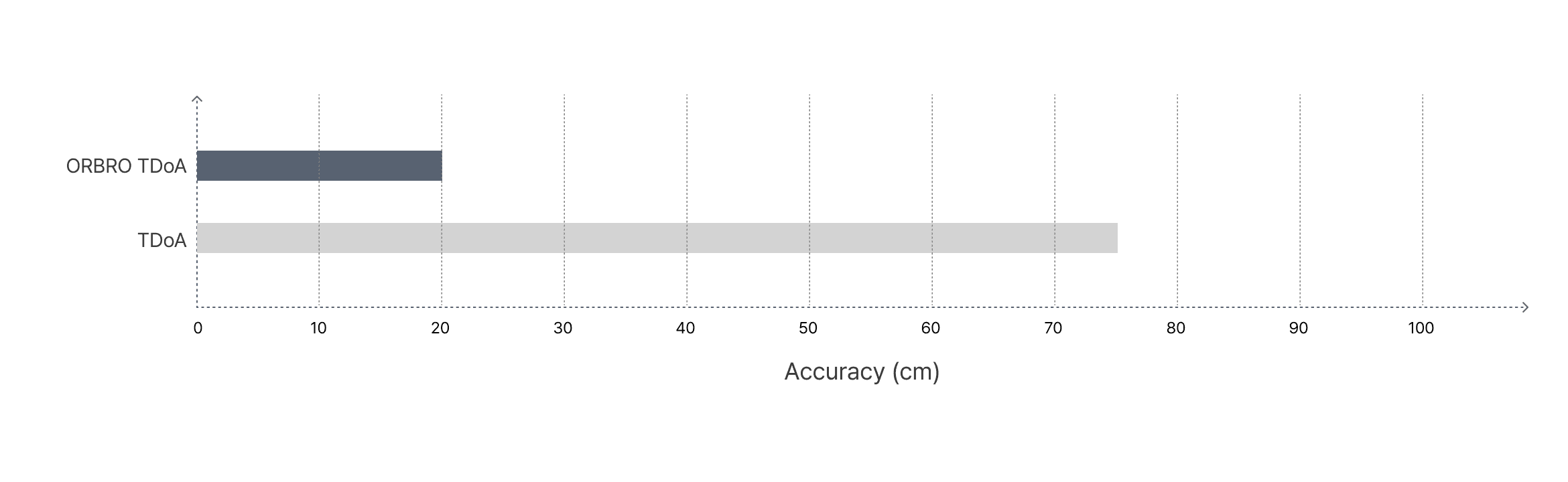
The prerequisite for TDoA calculation is that the clocks of all receivers (anchors) must be synchronized to the same standard. ORBRO periodically exchanges reference signals through high-speed communication between receivers and compensates for each receiver's clock drift in real-time at the hardware level. This maintains high-precision time alignment in nanoseconds (ns) without post-filtering, securing reliable raw time data required for real-time calculation.
2. Repeatability
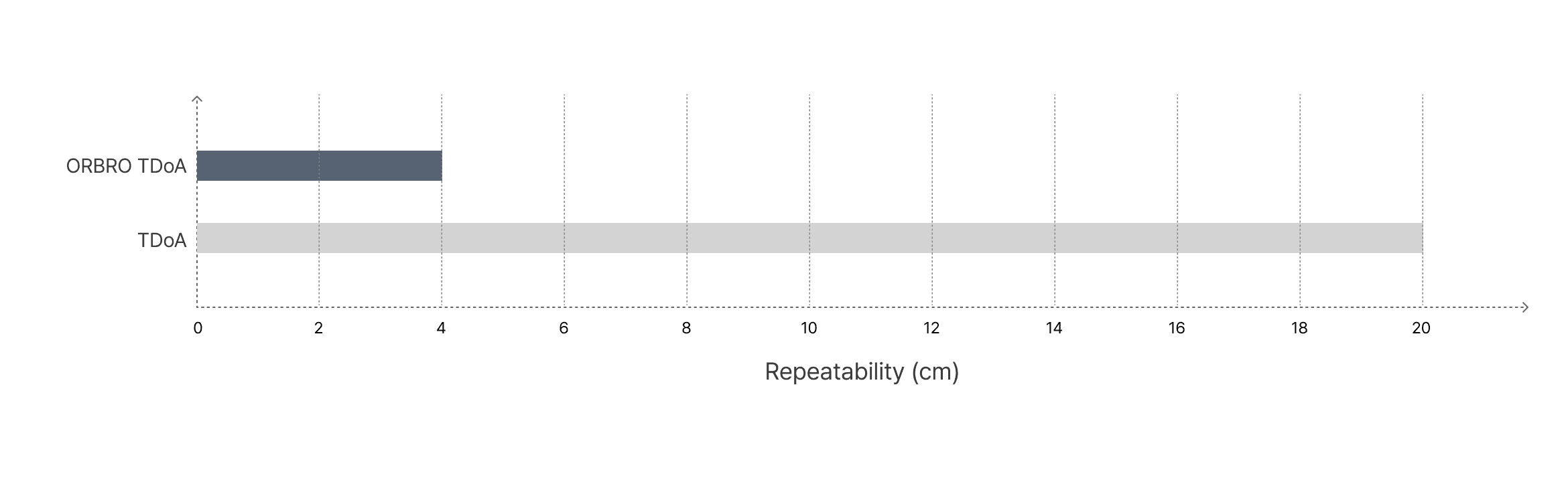
Repeatability is an indicator that evaluates how consistently coordinates are output when measured repeatedly under the same conditions. Even if the measurement environment is constant, coordinates will fluctuate if there are signal reflections, clock deviations, or computational variances. ORBRO has realized a low variance value of approximately 4cm on average through designs such as clock compensation, convergence quality-based correction, and Z-axis constraints. This performance is particularly important in environments where fixed-position tags must maintain their location for long periods or act as fixed reference points.
3. Coordinate Jitter Rate
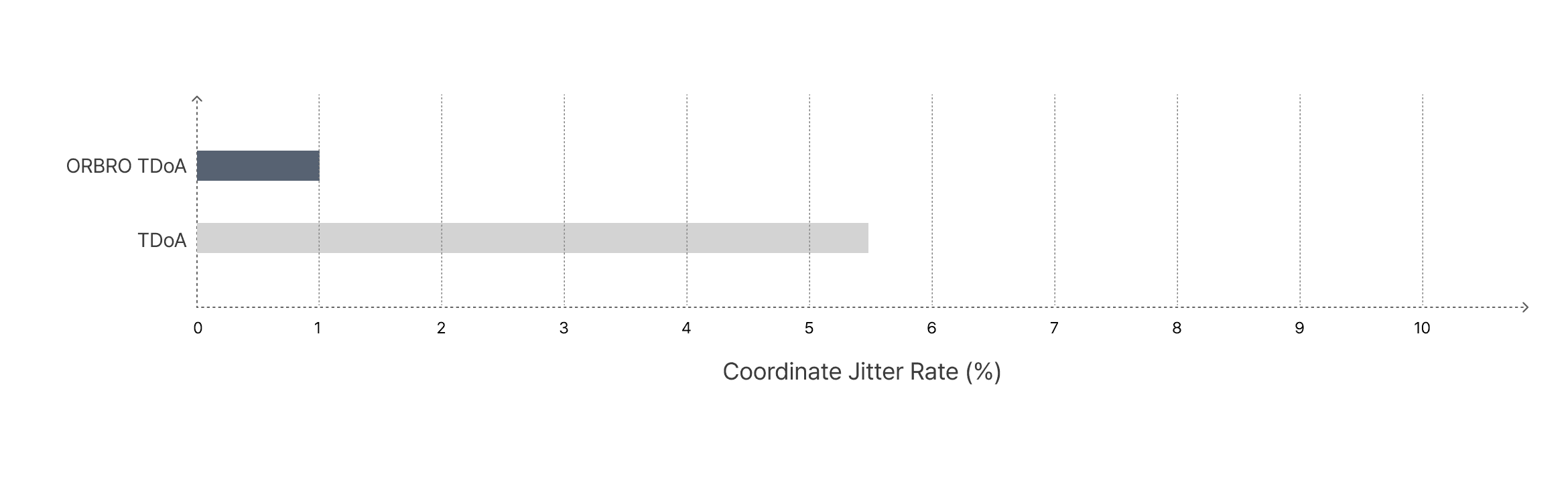
The coordinate jitter rate represents the frequency of abnormally large changes occurring between consecutively output position coordinates. This indicator reflects not only the consistency of signal quality in a real-time location system but also the stability of the calculation and exception-handling capabilities. ORBRO adopts a structural stabilization strategy that identifies and removes error signals in advance within the calculation structure rather than a simple filtering method, maintaining a jitter rate of less than 1% and increasing the reliability of the overall location flow.
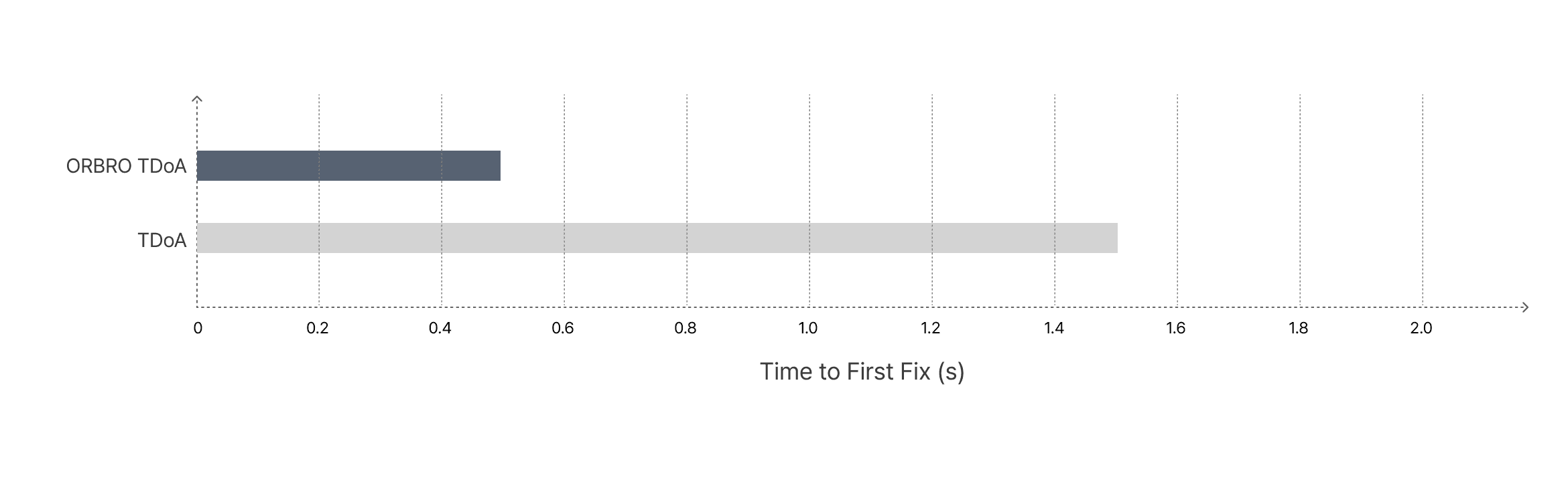
4. Time to First Fix
Convergence time refers to the time it takes for the system to output the first valid coordinate after a tag transmits a signal. This indicator, which determines the real-time nature of the location system, is greatly influenced by the initial value setting and calculation convergence speed. ORBRO secured a convergence speed of less than 0.5 seconds on average by combining WLS-based initial estimation and Taylor expansion correction algorithms. This allows the location to be tracked as soon as the tag starts moving, providing users with a fast and intuitive response.
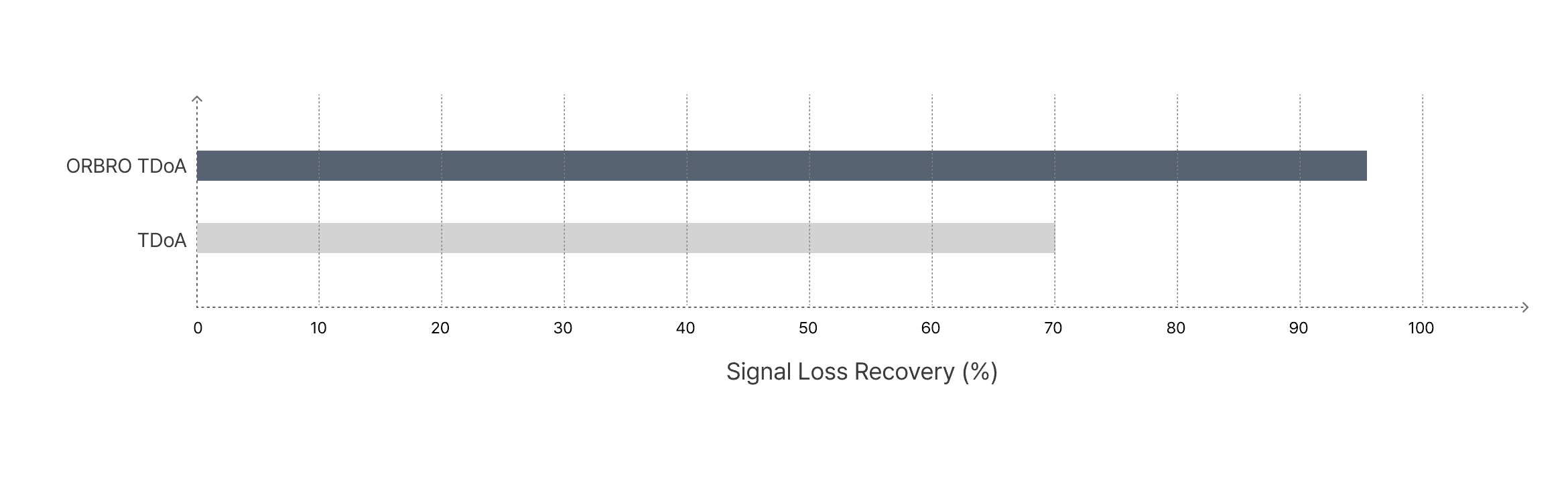
5. Signal Loss Recovery Rate
Recovery rate refers to how quickly the system can normalize location calculations when signals are temporarily not received from some receivers. This indicator reflects the overall reliability design, including calculation continuity, exception detection logic, and multi-convergence structures. ORBRO continues calculations based on remaining signals and previous convergence values even if some receivers do not respond, achieving rapid coordinate re-output of over 95% through recovery algorithms.
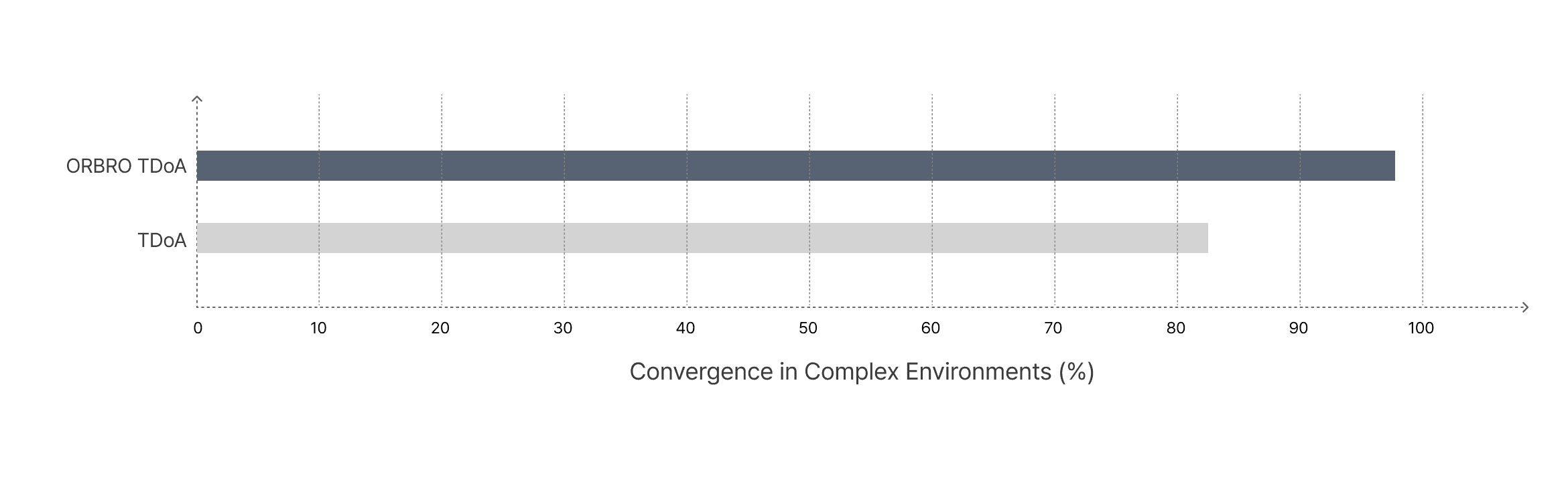
6. Location Stability in Complex Environments
Location systems must maintain stable coordinate calculations even amidst complex variables such as structural reflections, radio interference, and open space structures. ORBRO structurally controls the possibility of calculation failure through Z-axis constraints, receiver distance-based correction, and local solution avoidance algorithms, achieving a convergence rate of over 98% even in metal-dense areas or spaces where visibility is difficult to secure. This signifies responsiveness to environmental changes and the resilience of the computational structure beyond simple calculation success rates.
Precision Positioning is Completed by Structure – The Standard for TDoA Computation Redesigned by ORBRO
TDoA is not just a simple location estimation algorithm. Its computational structure must be composed of sophisticated layers—from receiver clock alignment and time difference interpretation to optimization convergence conditions and quality verification of final coordinates—to guarantee stable results. ORBRO follows the basic principles of TDoA but has redesigned its structure into a controllable system unit encompassing all key elements of location estimation, such as signal interpretation, calculation initialization, spatial constraints, and convergence evaluation. In this process, we have created a foundation to technically control the entire 'flow' of the calculation, rather than simply reducing errors. Even if signal quality varies or the environment becomes complex, ORBRO TDoA is configured to respond to exceptional situations and output accurate positions. TDoA is already a well-known technology, but precision, stability, and scalability differ completely depending on how the structure is designed. ORBRO's approach is the closest to the essence of this technology, representing a structural evolution that has elevated TDoA to a highly reliable, product-level real-time location system.
Average position error within 20cm
Achieves location accuracy of ±20cm even in industrial environments through high-precision time alignment and optimization structureInitial convergence speed within 0.5 seconds
Minimizes response time after system startup through fast initial estimation and iterative correction calculationsCoordinate jitter rate under 1%
Suppresses sudden coordinate jumps by maintaining calculation quality standards even in unstable signal or reflective environmentsOver 98% calculation success rate in complex environments
Secures stable convergence without calculation failure even in dense structures and multipath reception environmentsOver 95% signal loss recovery rate
Calculations do not stop and coordinates are output normally even if data from some receivers is missing
ORBRO Solutions Powered by TDoA
Connect asset and personnel location data with TDoA-based RTLS and explore representative solutions for each site.

Prevent accidents by tracking workers' locations in real-time
Automatically recognize a worker's current location with tracking technology and send immediate alerts when entering dangerous zones.
Learn More
Secure worker safety by detecting crane movements in real-time
Track the operating range of cranes with location sensing technology and automatically send warnings when workers approach.
Learn More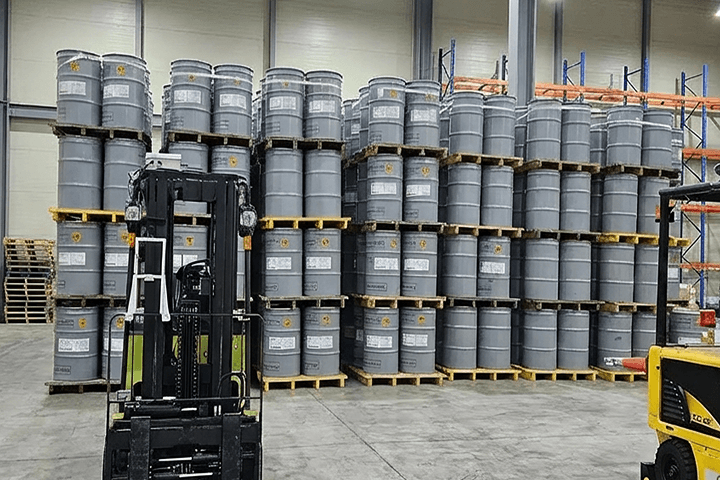
Forklift tracking system that never misses a signal, even in nuclear power plants
A location tracking system that operates stably even in structures where all sections are sealed with steel plates and have high ceilings.
Learn More
Safely control the flow from medical waste collection to sterilization with automation
Safely control the flow from medical waste collection to sterilization with automation.
Learn More
Streamline dock operations by automatically tracking container vehicle locations
Maintain a seamless operation flow at logistics hubs by identifying vehicle locations and dock status in real-time.
Learn More