UWB | Ultra-Wideband
What is UWB (Ultra-Wideband)?
UWB is a wireless communication technology that utilizes a very wide frequency bandwidth to transmit powerful signals for very short periods. It provides high precision and data transmission speeds suitable for location tracking and radar applications.
What is UWB (Ultra-Wideband)?
UWB (Ultra Wideband) is a short-range RF technology for wireless communication that can detect the location of people, devices, and assets with theoretically superior accuracy. Like other communication protocols such as Bluetooth and Wi-Fi, UWB transmits data between devices via radio waves. To achieve this, it communicates across an "ultra-wide" range of frequencies using short nanosecond pulses. UWB technology transmits billions of radio pulses in patterns every nanosecond across a wide frequency spectrum (at least 500 MHz or 20% of the center frequency). These signals are transmitted between transmitters and receivers. The receiving device analyzes the incoming patterns and converts them into data. This allows devices to not only transfer data quickly over short distances but also use these UWB signals to precisely detect a device's location. Devices equipped with UWB (such as smartphones, sensors, and anchors) can accurately locate transmitting devices like other smartphones or asset tracking tags, enabling location-aware communication and services in specific applications. While it may seem like a new advanced technology recently adopted in modern smartphones, UWB technology has been applied for decades. For many years, its use was limited or mostly seen in military radar and communication applications under the name "pulse radio." Since the FCC approved unlicensed use in 2002, UWB technology has continued to innovate and evolve, serving as the starting point for unlocking revolutionary location-based features.
The Increasing Adoption of UWB
Many large companies have realized the diverse potential of UWB and have begun developing or launching UWB-equipped solutions. One of the most notable, Apple, began implementing UWB technology with the launch of the iPhone 11, featuring the new U1 ultra-wideband chip. Other companies like Samsung have followed suit, implementing UWB in some of their latest smartphones and other devices. Google is also working on developing APIs to enable applications using UWB on Android devices. It is now a cost-effective option with hardware components small enough to be embedded in various types of devices. The NFL even uses ultra-wideband technology to track players' real-time positions and movements. UWB chips are mounted on players' shoulder pads, allowing the league to analyze how players move during a game. NXP and Volkswagen are exploring the possibility of using UWB in cars to provide a safer and more convenient vehicle experience. Alongside these developments, leaders in UWB technology include various UWB hardware vendors and consortiums such as the UWB Alliance and FiRA. They provide a range of UWB chips, anchors, and tags depending on specific use cases. Some experts predict that UWB technology will soon become as universal as Bluetooth and Wi-Fi, with some forecasting it will replace BLE as the primary standard for short-range communication and positioning.
Key Features and Advantages of UWB
The greatest strength of UWB is its accuracy. Thanks to its wide bandwidth of 500MHz or more and extremely short nanosecond pulses, UWB can measure signal arrival times with great precision, and ToF-based distance calculation built on this delivers positioning accuracy at the level of tens of centimeters. Unlike Bluetooth or Wi-Fi approaches that estimate position from signal strength (RSSI), UWB measures distance directly, so accuracy remains stable even in environments crowded with people and equipment. With fast position updates and low latency, UWB is particularly well suited for tracking moving workers, equipment, and assets in real time. UWB also stands out in reliability and security. Its low spectral power density means minimal interference with other wireless signals, and it can distinguish the original signal even in multipath environments where signals reflect off surfaces. Low power consumption allows battery-powered tags to operate for long periods without replacement, and because UWB verifies counterpart devices based on measured distance, it is highly resistant to relay attacks. Combined, these characteristics are driving rapid adoption of UWB in industrial environments that demand accurate, uninterrupted location data, such as manufacturing sites, logistics warehouses, and hospitals.
How UWB Positioning Works
UWB enables location determination through ToF (Time of Flight). This accurately measures the distance between a transmitter and receiver by calculating the time it takes for a signal to travel between devices. In some scenarios, it can also detect X, Y, and Z coordinates, adding an extara dimension to the positioning provided by UWB. The method of calculating ToF may vary depending on the use case or application. In UWB position measurement, two basic techniques can be used: Time Difference of Arrival (TDoA) and Two-Way Ranging (TWR).
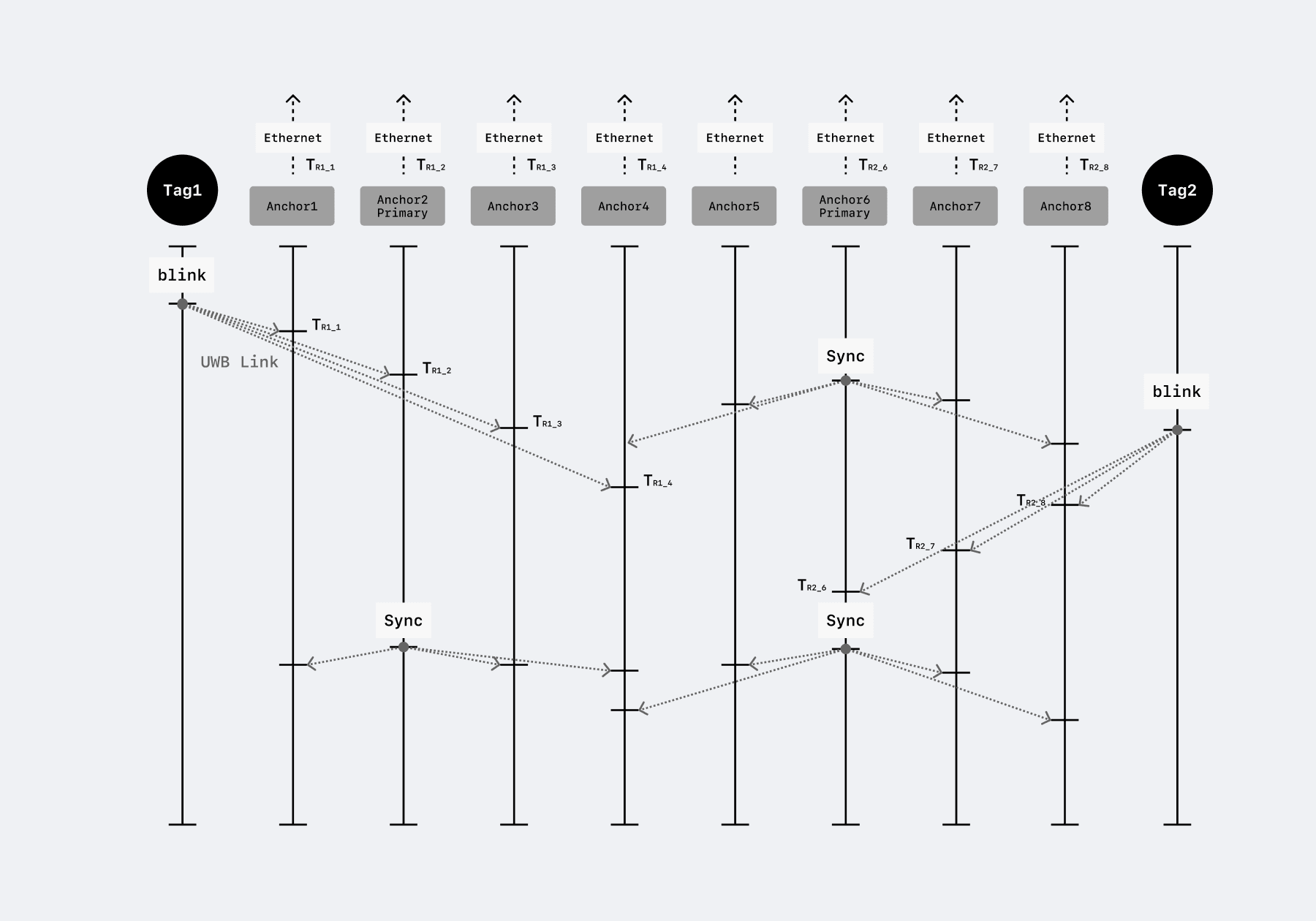
Time Difference of Arrival (TDoA)
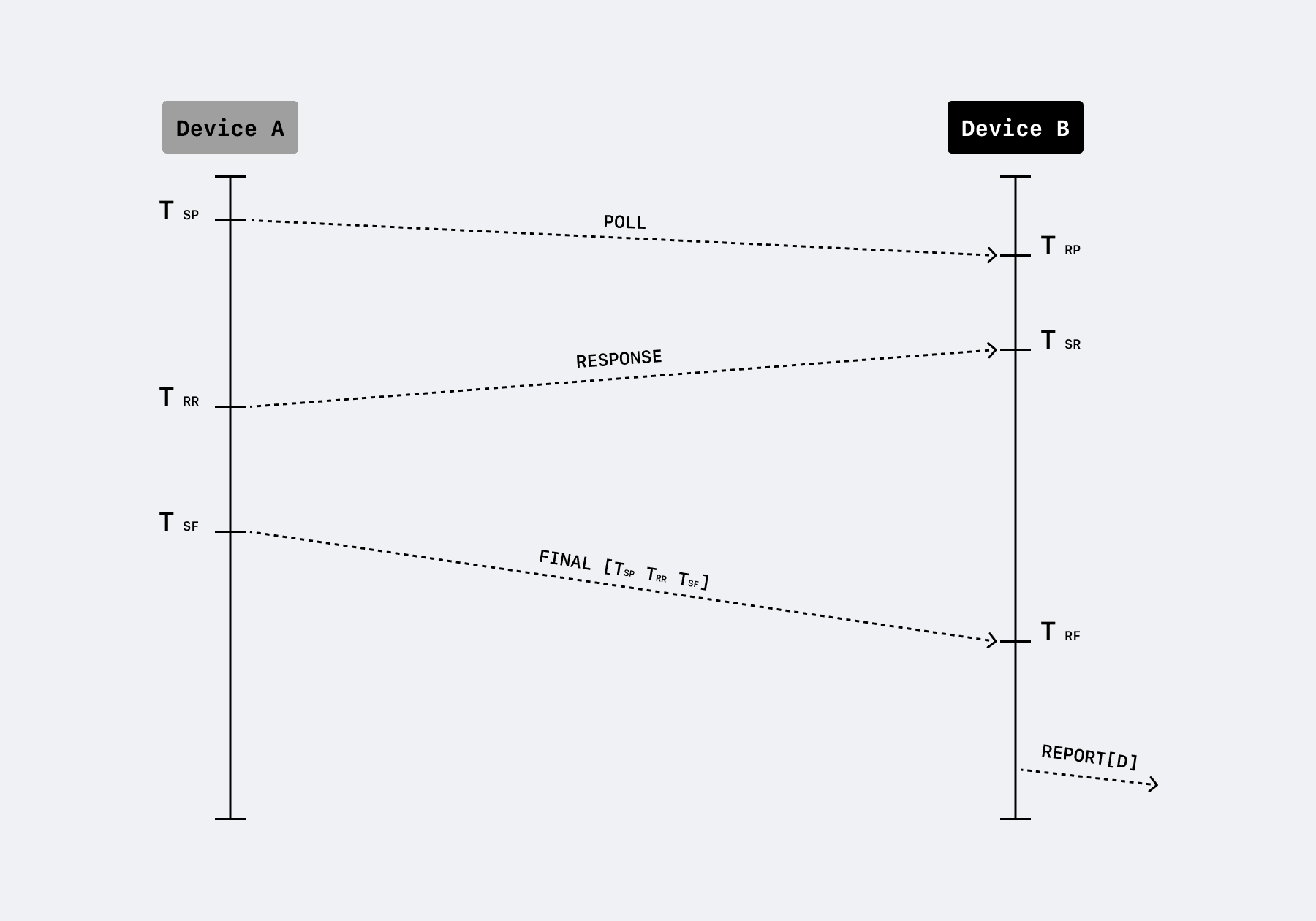
TWR is a technology that measures distance using two-way communication between two devices. For example, when devices like smartphones are near each other, they begin measuring the distance between them. The time it takes for a signal to travel between the two devices is multiplied by the speed of light to determine the relative position. This technology is often used to enable location-aware communication. While TWR uses two-way communication to detect the distance between one device and another, the determined position between these devices is utilized according to the specific field of application. TWR can also be used with fixed anchors and UWB devices, but the TWR process can only identify a device's location using one measurement partner at a time.
Two-Way Ranging (TWR)
TWR is a technology that measures distance using two-way communication between two devices. For example, when devices like smartphones are near each other, they begin measuring the distance between them. The time it takes for a signal to travel between the two devices is multiplied by the speed of light to determine the relative position. This technology is often used to enable location-aware communication. While TWR uses two-way communication to detect the distance between one device and another, the determined position between these devices is utilized according to the specific field of application. TWR can also be used with fixed anchors and UWB devices, but the TWR process can only identify a device's location using one measurement partner at a time.
How accurate is UWB positioning?
Thanks to fast nanosecond pulses detectable via ToF and limited interference with other RF transmissions, UWB enables accurate indoor location tracking with less than 50cm of accuracy under optimal conditions and placement. It can also quickly track the movement and behavior of devices with real-time results. Compared to other indoor positioning technologies, UWB offers superior accuracy. Other standards typically utilize Received Signal Strength Indicator (RSSI) to determine location and can only operate with accuracies such as BLE (< 5m) and Wi-Fi (< 10m). Some UWB technologies also allow for more precise positioning through direction finding, which requires multi-antenna devices capable of measuring the angle of the incoming signal.
What is the communication range of UWB?
UWB can detect the position of devices within a range of up to 200 meters. However, it typically works most effectively at short distances of 1-50 meters, and best results are obtained when there is a clear line-of-sight between devices or anchors. Over short distances, UWB provides extremely accurate, fast, and secure communication while maintaining minimal interference.
How does UWB differ from other positioning technologies?
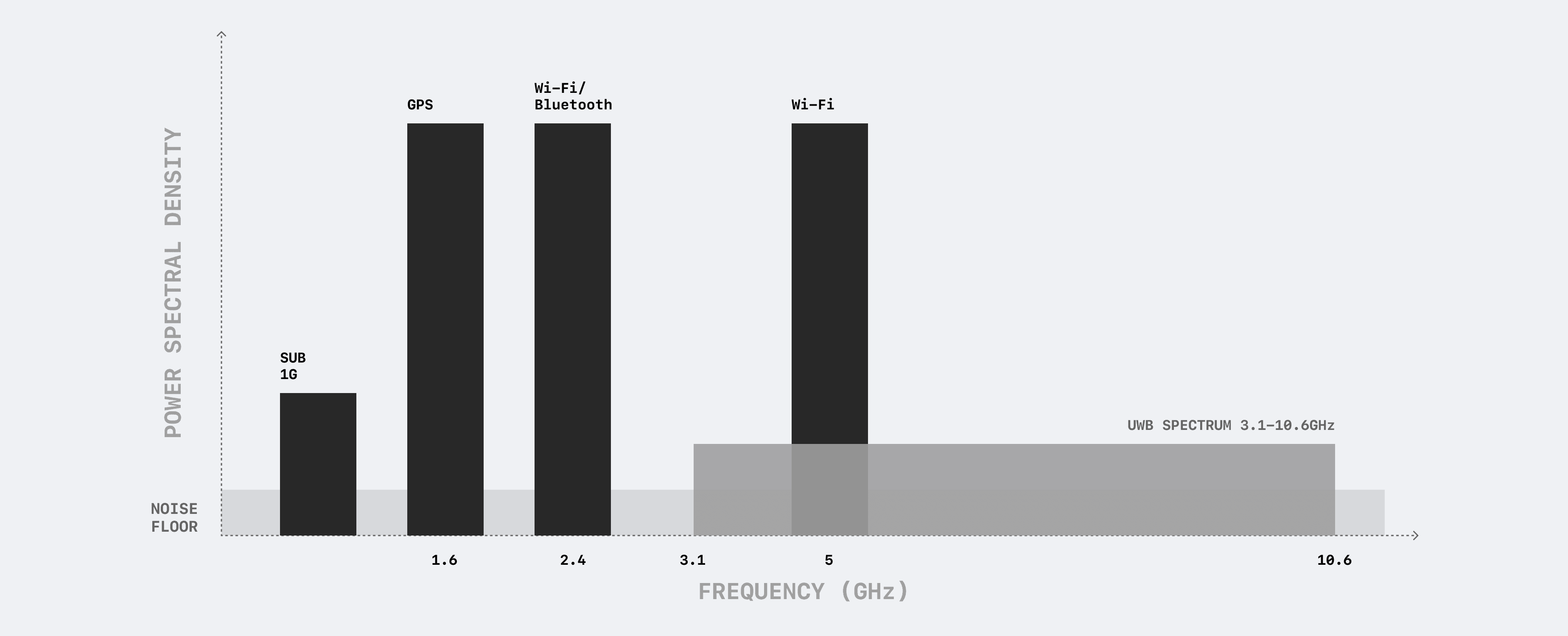
Each RF standard has its own unique characteristics and benefits, making them suitable options depending on individual requirements, budget, facilities, and specific location-based use cases. The most significant differences between UWB and other technologies are the wide frequency spectrum and the level of accuracy it can provide. UWB's accuracy makes it a particularly effective option for advanced indoor location-based use cases, such as asset tracking scenarios where absolute position and real-time movement are critical.
UWB vs Bluetooth
UWB and BLE share many commonalities – low power, low cost, and strengths in asset tracking technology. However, UWB can provide much higher accuracy than Bluetooth. This is due to UWB's precise distance-based positioning method via ToF. BLE positioning technology generally locates devices via RSSI, which offers a significantly lower level of accuracy depending on whether a device transmits a strong or weak signal to a beacon or sensor. BLE has a much shorter range and lower data rate than UWB and is more susceptible to signal interference. Bluetooth has a massive ecosystem and is one of the most popular positioning technologies. It is used in many wireless devices, and flexible hardware options like BLE beacons can be easily implemented.
UWB vs Wi-Fi
Wi-Fi has become a core RF technology in indoor positioning due to its widespread use in our devices and indoor spaces. In advanced location-based scenarios, Wi-Fi's accuracy and flexibility can be limited. For these high-end applications, high accuracy is required, and UWB technology excels in this regard. Because Wi-Fi measures signal strength rather than distance, it is less accurate than UWB and more prone to interference. Conversely, UWB has strong immunity, resulting in fewer interference issues. Additionally, UWB requires less power, allowing for the creation of useful and affordable tools like asset tracking tags powered by coin cell batteries. However, because Wi-Fi offers the advantage of leveraging existing infrastructure like access points and various Wi-Fi-enabled devices, it remains an important indoor positioning technology when high accuracy is not required.
ORBRO Solutions Powered by UWB
Check out representative solutions that apply the precise positioning performance of Ultra-Wideband (UWB) to field operations.

Prevent accidents by tracking worker locations in real-time
Automatically recognize worker locations with tracking technology and send immediate alerts when entering dangerous zones.
Learn More
Ensure worker safety by detecting crane movements in real-time
Track crane operation ranges with location detection technology and automatically send warnings when workers approach.
Learn More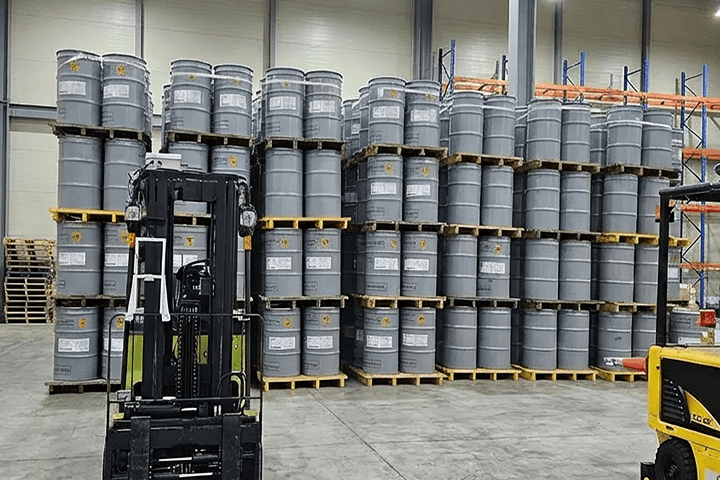
A forklift tracking system that never loses signals, even in nuclear power plants
A location tracking system that operates reliably even in structures sealed with steel plates and high ceilings.
Learn More
Streamline dock operations by automatically tracking container vehicle locations
Maintain seamless operational flow at logistics hubs by identifying vehicle locations and dock status in real-time.
Learn More