BLE | Bluetooth Low-Energy
BLE Location Tracking and Positioning Technology
BLE is a wireless communication technology with low power consumption and lower data transfer speeds. It is mainly used in small devices or low-power sensors and functions as a small transmitter like a beacon. It is also utilized in smart homes, smart cities, smart factories, and IoT technologies.
What is BLE?
Bluetooth Low Energy (BLE) is a Radio Frequency (RF) technology for wireless communication that can be utilized for various indoor location tracking purposes. Using BLE technology, the location of people, devices, and assets can be detected and tracked for use cases such as asset tracking, indoor navigation, and proximity services. Like other communication protocols such as Wi-Fi and UWB, BLE can be used to send and receive data wirelessly. BLE 4.0 was released in 2010 and designed to consume significantly less power than the previous version, Bluetooth Classic. This energy-efficient design led to the emergence of various new Bluetooth technologies, including integration with smartphones and various wireless devices, development of wearables and IoT devices, and battery-operated BLE beacons.
The Evolution of BLE Technology
The growth of BLE technology has brought fundamental changes to the global Bluetooth ecosystem. Many Bluetooth devices have entered indoor spaces, and there are now over 8 billion Bluetooth devices worldwide. New Bluetooth-compatible infrastructure and tools provide innovative location-aware capabilities. Since the release of Apple's iBeacon in 2013, many BLE technologies have emerged. iBeacon was designed to allow physical beacons to communicate with nearby wireless devices, working alongside iOS and Android applications. In 2015, Google released Eddystone, a beacon protocol focused on openness and interoperability. Along with these two leading beacon protocols, various physical beacon products and other BLE technologies—such as location tracking sensors and tags—have enabled a wide range of indoor tracking and location service applications, changing how people and devices interact with indoor spaces. These technologies and overall Bluetooth communication protocols continue to evolve. In 2016, Bluetooth 5.0 was introduced. Based on BLE 4.0, this new version offers higher data transfer speeds and communication over longer distances. Bluetooth 5.1, unveiled in 2019, enables more precise location detection through direction finding (DF), which is expected to provide centimeter-level accuracy. BLE is one of the most popular RF technologies for indoor location tracking because it is widely used in wireless devices, features low power and low cost, offers many easy-to-implement hardware options, and provides flexibility across various location-based applications.
What is a BLE Beacon?
BLE beacons are small, versatile, low-power Bluetooth transmitters that can be detected by wireless devices like BLE-enabled smartphones. Beacons can be attached to walls or structures or placed on mobile assets to provide a location reference for indoor positioning applications. This supports the BYOD (Bring Your Own Device) concept, allowing anyone to interact with BLE-enabled applications using their smartphone or other built-in devices. BLE beacons locate a device to provide relevant content such as documents, videos, and apps, or guide and engage users by providing information based on their time or location. Beacons transmit signals at regular intervals, which can be detected by other BLE-enabled devices. Location data collected from the beacons is gathered by BLE devices and sent to an IPS (Indoor Positioning System) to determine the device's location. This supports various location-aware applications and can trigger specific actions. Beacons come in various shapes and sizes. Many operate for several years using built-in batteries or can be powered via connections like USB. Since BLE technology generally costs less to produce than other RF technologies, it offers hardware options that are small, inexpensive, and low-maintenance, with potential for customization to meet unique deployment requirements. Some beacons go beyond BLE to integrate additional technologies like accelerometers or temperature sensors for enhanced results. Virtual beacons allow BLE beacon technology to be added without significant additional hardware. With virtual Bluetooth beacons, antennas can be added to compatible Wi-Fi access points and used with additional software tools for various indoor positioning applications. Many standard enterprise Wi-Fi access points now come with built-in BLE technology. This allows organizations to use access points as beacons and sensors to detect and locate BLE devices in transit without setting up auxiliary infrastructure.
How does BLE positioning work?
BLE indoor positioning solutions use BLE-enabled sensors or beacons to detect and locate Bluetooth devices, such as smartphones or tracking tags, in indoor spaces. Location data collected by sensors or data transmitted by beacons to mobile devices is gathered and analyzed by various positioning applications to implement diverse location-aware use cases.
BLE Positioning using Beacons
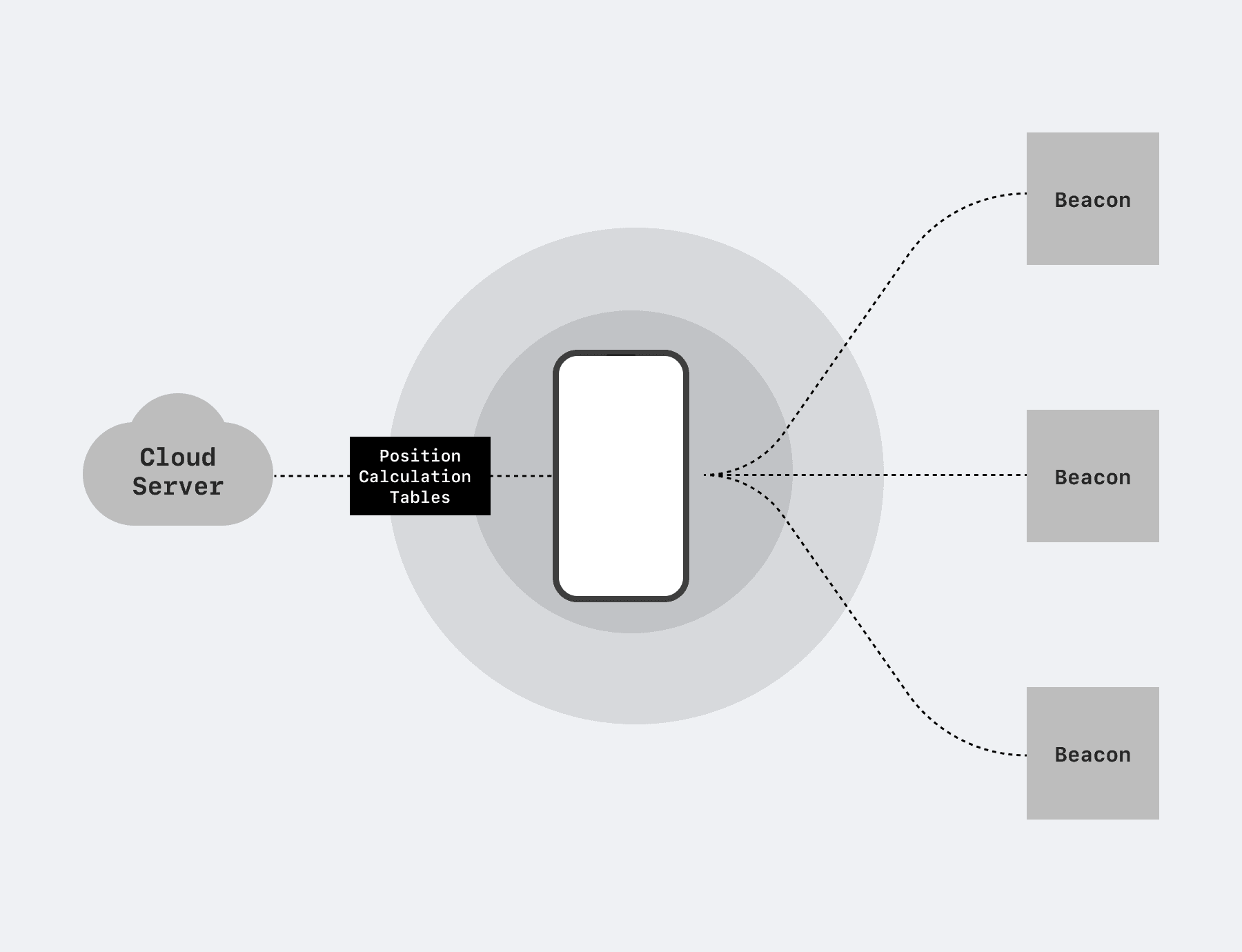
BLE beacons continuously transmit BLE signals. These signals can be detected by nearby devices, including smartphones and BLE-enabled sensors. When beacons are placed in fixed locations throughout an indoor space, the continuously transmitted signals include a unique identifier for each beacon. This identification code is sent periodically along with other data according to the beacon communication protocol. Smartphones or other wireless devices supporting dedicated apps or pre-configured services can receive and analyze signals from beacons when within range (user-centric) or transmit this information to a server (server-centric). Detection between a single beacon and a device can enable proximity-based location services to determine if they are within range. Through communication between multiple beacons strategically placed throughout the indoor space, a vector map using the relationship between beacons and wireless devices can be extracted to determine the device's location. Depending on the application, the determined location can trigger specific tasks or be utilized for various services. BLE beacons can also be placed on mobile devices, which is useful in asset tracking scenarios. BLE beacons installed on these mobile devices can be detected and located by fixed BLE-enabled sensors.
BLE Positioning using Sensors
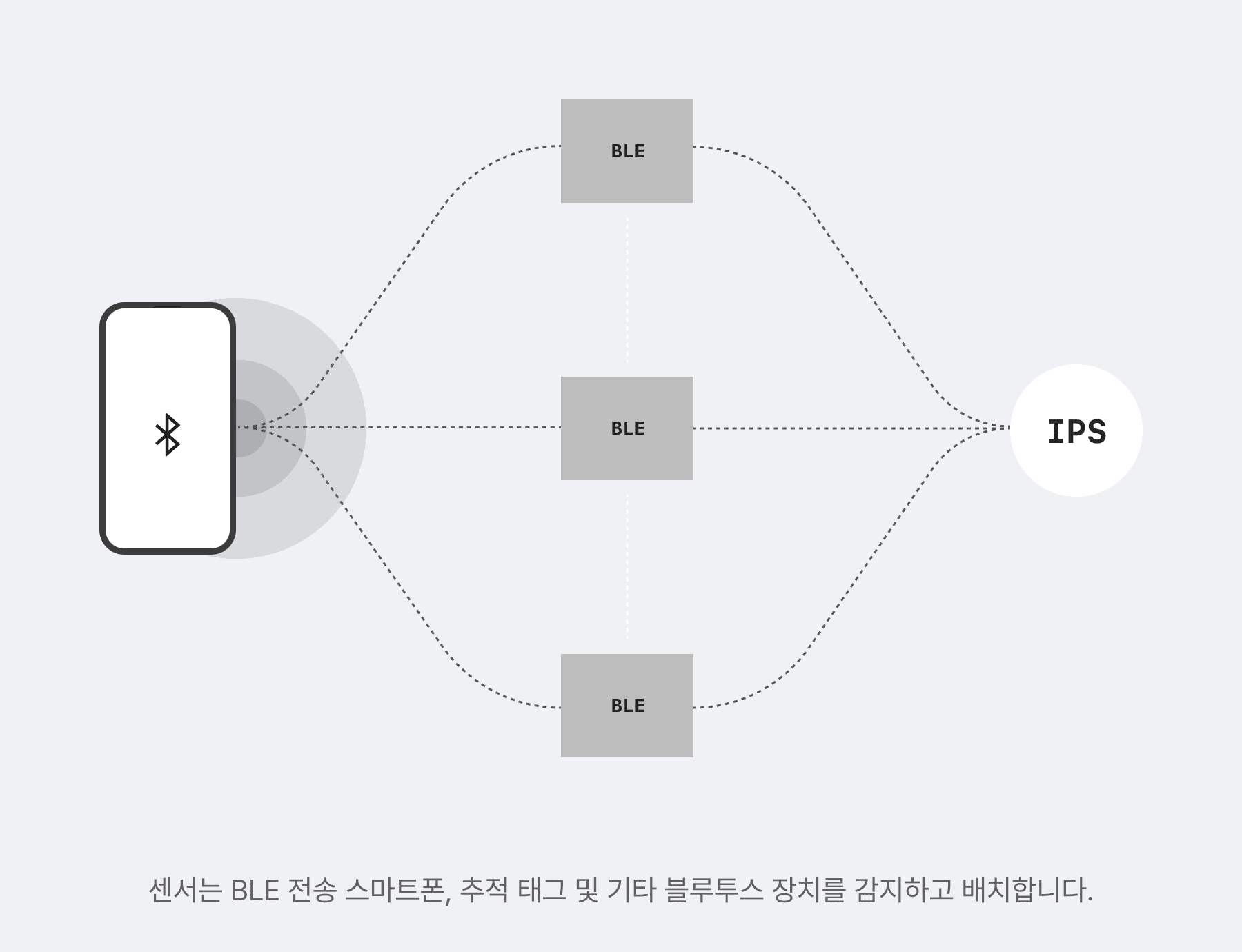
Positioning using BLE sensors utilizes BLE-enabled sensors placed at fixed locations in indoor spaces. These sensors passively detect and locate Bluetooth devices—such as BLE smartphones, asset tracking tags, beacons, personnel badges, and wearables—based on their signal strength. This location data is transmitted to a central Indoor Positioning System (IPS) or Real-Time Location System (RTLS). The location engine analyzes this data to extract a vector map and determine the transmitting device's location. These coordinates can be used to visualize the device or asset's location on an indoor map or for other purposes depending on the specific location-aware application.
How accurate is Bluetooth positioning?
BLE indoor tracking and RTLS can provide varying levels of accuracy depending on the system architecture, hardware selection, and the density of deployed sensors or beacons. Both indoor tracking methods using BLE sensors or beacons can generally provide a location accuracy of less than 5 meters under optimal conditions and placement.
How does BLE differ from other RF technologies?
UWB can detect the location of a device within a range of up to 200 meters. However, it usually works most effectively at short distances of 1-50 meters and yields the best results when there is a clear line of sight between devices or anchors. At short ranges, UWB provides highly accurate, fast, and secure communication with minimal interference.
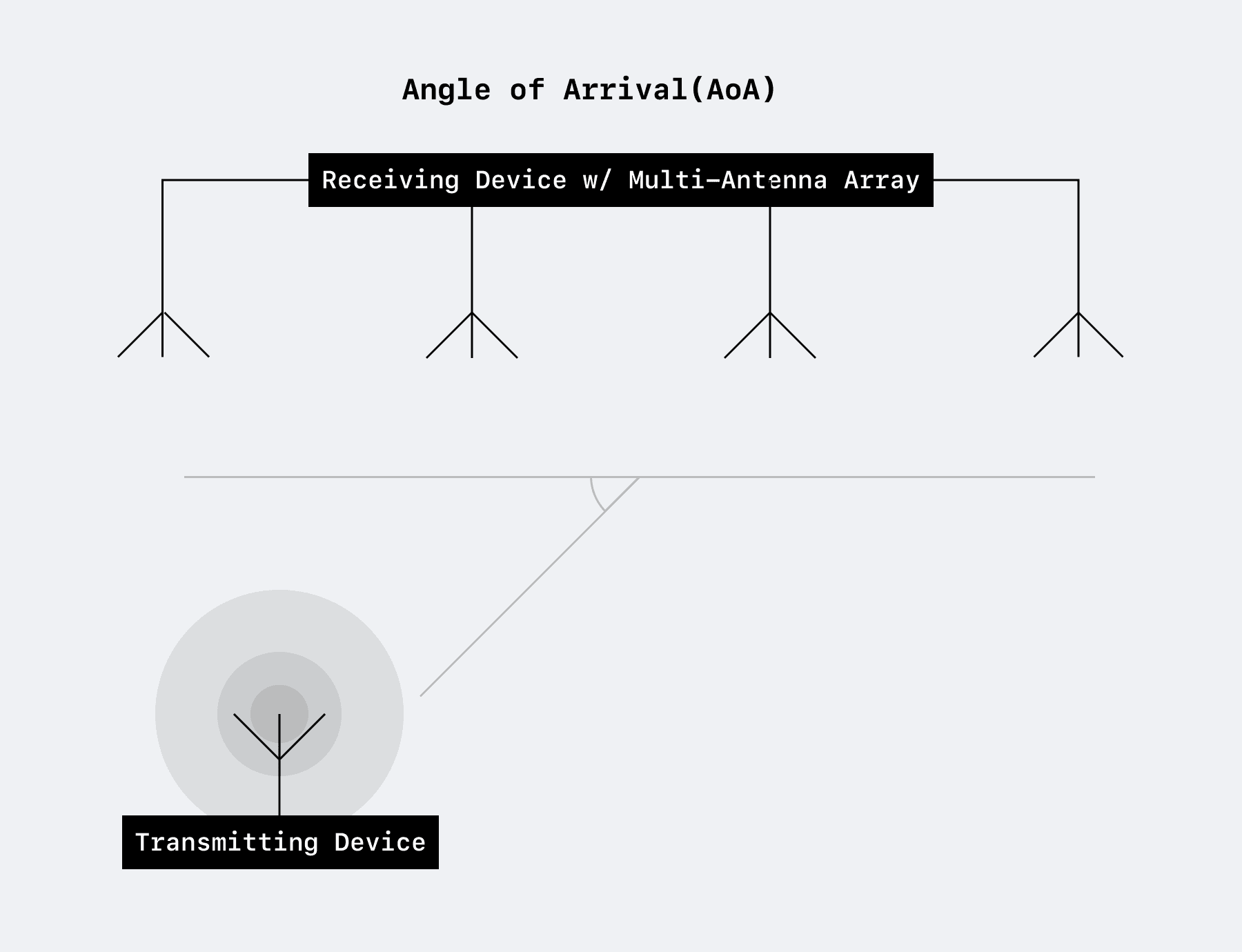
Similar to Wi-Fi technology, Bluetooth generally estimates location using the device's signal strength (RSSI). This method typically provides meter-level accuracy and is significantly less precise compared to technologies like UWB. UWB uses Time of Flight (ToF), a distance-based measurement technology, to provide highly accurate centimeter-level precision. While BLE is not currently the most accurate RF technology for indoor tracking, it is still highly effective and one of the most widely used. Since many indoor tracking scenarios do not require high precision, BLE remains a suitable choice offering unique advantages such as flexibility, low power, low cost, and ease of implementation. With the release of Bluetooth 5.1 and new direction-finding capabilities, BLE will be able to determine locations with sub-meter accuracy. This is achieved through the new ability to calculate the direction of Bluetooth signals via Angle of Arrival (AoA). This technology, used alongside signal strength (RSSI), tracks the position of devices and assets with enhanced accuracy. To find the direction, a mobile asset (tag or beacon) with a single antenna transmits to a fixed BLE sensor with a multi-antenna array. After receiving the signal, the phase shift across the multiple antennas is measured to determine the arrival angle of the transmitting mobile device. Combining RSSI and AoA generates device coordinates with centimeter-level accuracy.
What is the communication range of BLE?
The range of BLE tracking technology can vary depending on whether BLE beacons or BLE-enabled sensors are used and the characteristics of the indoor space. BLE generally operates within a shorter range than other RF technologies like UWB or Wi-Fi, working best within 0-25 meters and potentially reaching up to 100 meters under optimal conditions and placement.
How does BLE differ from other RF technologies?
Bluetooth, like other wireless standard technologies, offers unique characteristics and advantages that may make it a suitable option depending on individual requirements, budgets, facilities, and specific location-based use cases. The most significant differences between BLE and other technologies are its low power consumption and flexibility across many location-aware applications. BLE is built into devices throughout indoor spaces, utilized in many tracking systems, and can be scaled for indoor location tracking across various industries and use cases.
BLE vs Wi-Fi
BLE and Wi-Fi are two of the most common RF technologies across our daily lives and indoor spaces. Both operate in the 2.4GHz frequency range and share many similar features, including large ecosystems and established use in indoor tracking. Both BLE and Wi-Fi use RSSI to detect the location of people, devices, and assets. However, BLE is known to achieve higher accuracy. BLE requires significantly less power, enabling more flexible hardware options and applications. However, since many organizations already possess Wi-Fi infrastructure, the introduction of BLE requires the integration of new beacons and sensors. Wi-Fi can support longer ranges and higher data rates, whereas BLE is more restricted in those areas.
BLE vs UWB
BLE and UWB share common characteristics such as low power, low cost, and asset tracking capabilities. However, UWB can provide significantly superior accuracy compared to Bluetooth. This is due to UWB's precise distance-based positioning method via ToF. BLE generally identifies a device's location through RSSI, which provides considerably lower accuracy depending on whether the device transmits a strong or weak signal relative to the beacon or sensor. BLE also has a much shorter range and lower data rate compared to UWB. Nevertheless, Bluetooth is a widely used RF technology that can be deployed in many indoor spaces through flexible hardware options like BLE beacons, asset tags, and sensors.
ORBRO Solutions Powered by BLE
Check out representative solutions that connect asset and personnel data using BLE's low-power, short-range connectivity.

Precisely track asset locations in warehouses to automatically manage inventory flow
Precisely track asset locations in warehouses to automatically manage inventory flow.
Learn More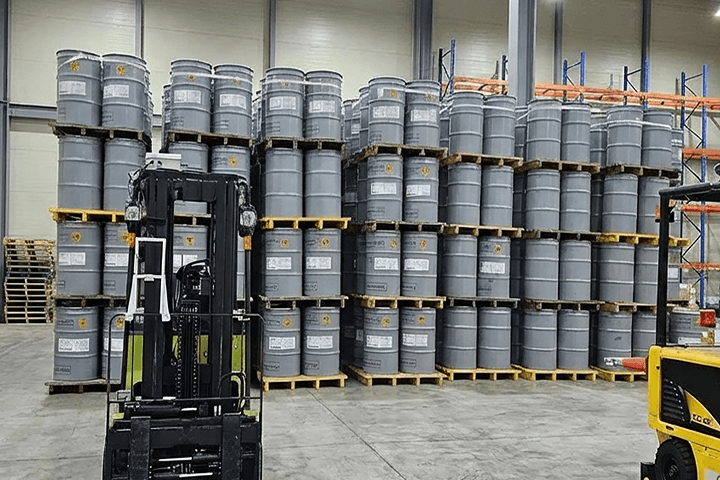
Forklift Tracking System that never loses signal, even in nuclear power plants
A location tracking system that operates stably even in structures with high ceilings and areas fully enclosed by steel plates.
Learn More
Track office assets in real-time to prevent unauthorized removal and loss
Track the current location of office assets with asset tags and send automatic alerts when they are moved outside.
Learn More