Two-Way Ranging
High-Precision RTLS Distance Calculation Based on TWR
UWB-TWR (Two-Way Ranging) calculates distance based on RTT and provides highly reliable distance/coordinates even in indoor environments through a 6-stage pipeline including SNR/RSSI quality refinement, NLOS correction, time-axis continuity stabilization, and output quality verification.
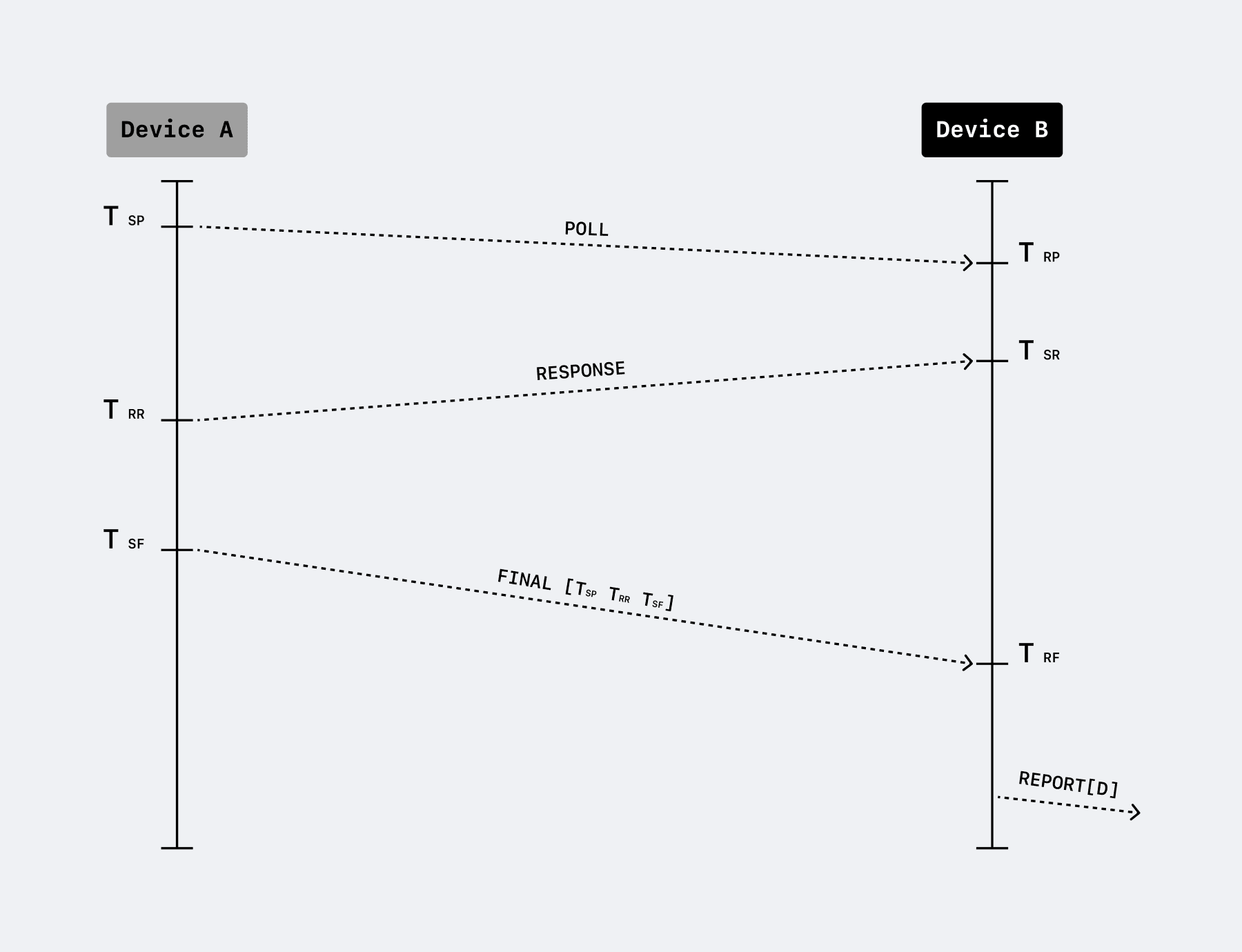
Structural Limitations of TWR and ORBRO's Signal Processing Response
TWR (Two-Way Ranging) is a versatile technology due to its structural simplicity, lack of time synchronization requirements, and ability for devices to calculate distance directly. However, the structure of calculating distance values based on a single Round Trip Time (RTT) without refining the signal itself faces several limitations in indoor environments. UWB-based TWR uses high-frequency signals in the 6~8.5GHz band. These signals are easily reflected by indoor structures such as walls, pillars, floors, and ceilings. If the reception path is not Line-of-Sight (LOS), the distance may be calculated as longer than it actually is. Especially in Non-Line-of-Sight (NLOS) environments, signals arriving via reflected paths are included in calculations, frequently causing distance values to fluctuate or become distorted. Due to structural characteristics dependent on single-frame distance values, such environmental noise directly leads to instability in measurement. Furthermore, conventional TWR modules often adopt a structure that converts the received signal directly into distance and outputs it immediately without separate verification. This results in inconsistent distance output in RTLS and leads to recurring discontinuities or distortions at the coordinate calculation stage. These problems can be summarized as follows: · High noise in distance values due to high-frequency reflection and interference · Overestimated distance values in NLOS conditions with frequent outliers lacking convergence patterns · Unstable fluctuations of distance values over the time axis, causing discontinuous positioning · Difficulty in reliability management and inability to handle exceptions due to output without quality standards ORBRO addresses these structural limitations not through simple post-processing or averaging, but by redesigning the entire distance calculation process based on quality. We break down the flow from signal reception to distance output into four core calculation structures, inserting quantitative standards and exception handling at each stage to ensure both consistency and stability in distance-based calculation quality.
6-Step Calculation Flow for Accurate Distance: From Signal to Coordinates, How ORBRO TWR Works
ORBRO's TWR system goes beyond simple RTT calculation, designed as a multi-stage signal processing structure to ensure distance measurement reliability and calculation quality. The technical responses described in Chapter 2 are implemented within the actual system through the following six steps. Each step quantitatively evaluates the quality of the received signal and stably controls the entire flow until the distance value is output.
Step 1. Poll Message Transmission and Signal Acquisition
TWR calculation begins with the transmission of a Poll signal. The transmitter sends a UWB-based Poll signal, and the receiver detects it, collecting not only the signal's arrival time but also quality metadata such as SNR, RSSI, and reflection delay. At this stage, ORBRO applies high-sensitivity reception circuits and dedicated filtering algorithms to remove unstable samples or mark them with low reliability before calculation.
Step 2. Response Message Transmission and RTT Collection
After receiving the Poll, the receiver transmits a Response message according to a set delay. The transmitter records the total Round Trip Time (RTT) upon receiving this Response. ORBRO secures time measurements based on a high-precision internal clock and aligns signal times by considering errors in calculation and transceiver delays.
Step 3. Distance Calculation and Quality-Based Refinement
After excluding the fixed response delay from the RTT, pure Time-of-Flight (TOF) is calculated. This TOF value is used to calculate distance by multiplying it by the speed of light. ORBRO performs signal quality-based filtering on this distance value again. Based on reflection delay, SNR, RSSI, and jitter, the weight of values included in the calculation is automatically adjusted, and low-quality results are excluded or held from the distance output.
Step 4. Time-Axis Continuity Evaluation and Distance Stabilization
Since TWR calculation is a non-linear optimization problem, there is a risk of converging to local minima or divergence if initial values are inaccurate. ORBRO predefines the Z-axis (altitude) range and restricts the solution space to physically possible areas using receiver deployment conditions and tag-receiver geometry. This ensures both convergence stability and result quality.
Step 5. Calculation Quality Verification and Coordinate Transformation
Once distance calculation is complete, ORBRO verifies whether the value meets final output conditions according to internal quality standards. In some environments, trilateration is performed using distances from multiple receivers to generate coordinates; in these cases, judgment is based on distance quality, geometric consistency, and time-axis trends.
Step 6. Final Distance or Position Output
Only distance or coordinate values that meet all verification criteria are selected for final output. In real-time RTLS systems, this data is delivered to the UI or external platforms. The output values include signal quality scores, verification status, and error flags to enhance the system's interpretability.
Reliability is Proven by Numbers: Quantitative Performance Comparison of ORBRO TWR
While the technical design of a location-based system can be explained through structure and theory, performance in actual operating environments is ultimately evaluated by numbers. UWB-based TWR technology operating in high-frequency bands can theoretically expect high precision, but measurements are easily distorted by realistic variables such as indoor reflections, interference, and NLOS situations. ORBRO has overcome these limitations by redesigning the entire process and inserting judgment structures based on quality criteria. As explained previously, ORBRO TWR organizes all steps from reception to output into a controllable structure, forming the basis for an RTLS engine capable of precision calculation rather than just a simple distance sensor. This chapter verifies the precision and stability of the ORBRO TWR system through quantitative indicators, comparing it with traditional TWR methods.
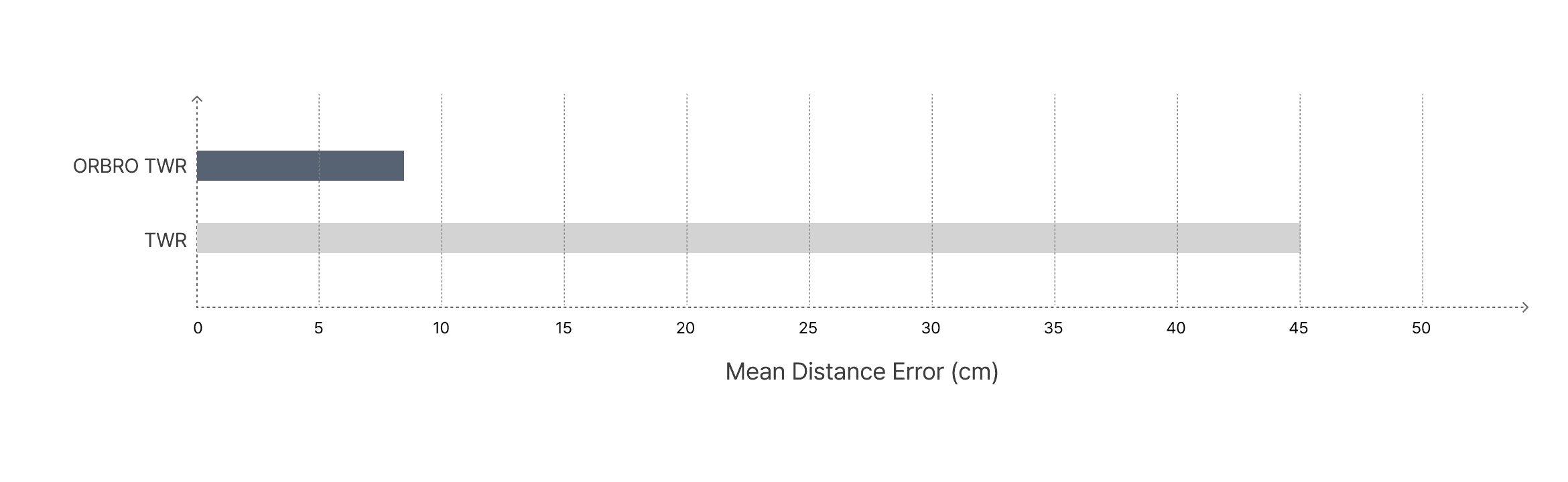
1. Mean Distance Error (cm)
Mean Distance Error is an indicator that quantifies the difference between the actual physical distance and the measured distance value, representing the precision of the system. ORBRO TWR applies SNR-based filtering at the reception stage and removes unstable samples during calculation to prevent distortion of the central value. As a result, the mean distance error has been reduced to the 20cm level, a 60% improvement over conventional TWR methods.
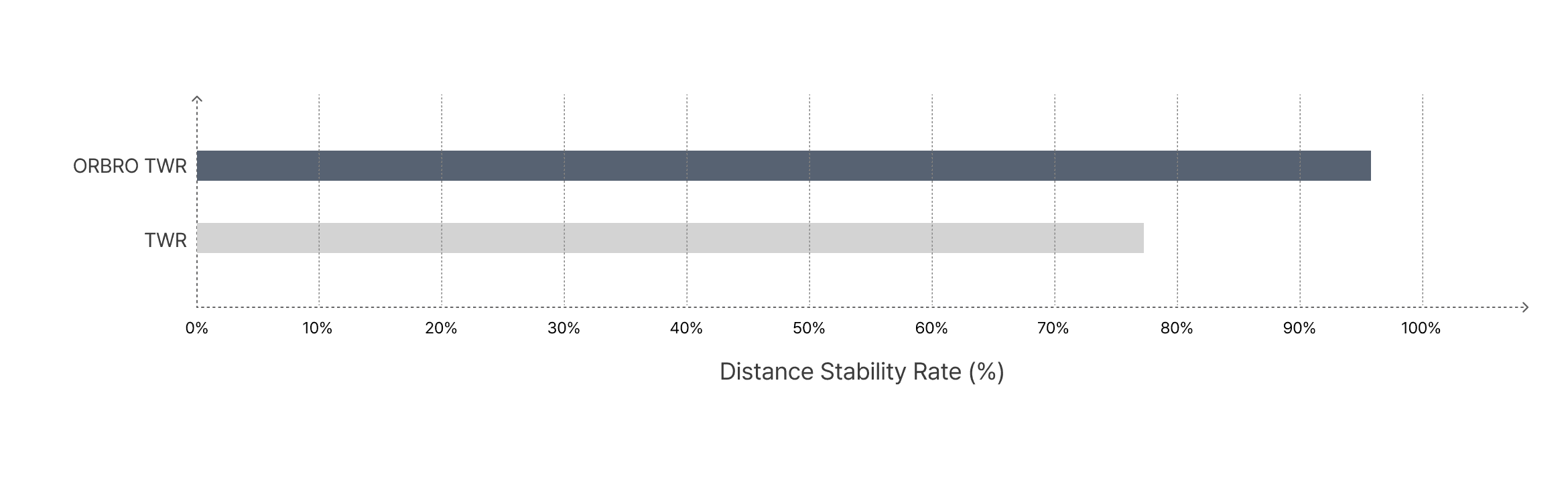
2. Distance Output Stability (%)
Distance output stability refers to the rate at which consecutive distance values are maintained within a standard deviation (±10%). This indicator shows how consistently measurements are maintained over a specific interval, serving as a basis for the stability of real-time positioning. ORBRO maintains stable distance values in over 96% of all frames by applying distance convergence structures and frame continuity correction algorithms.
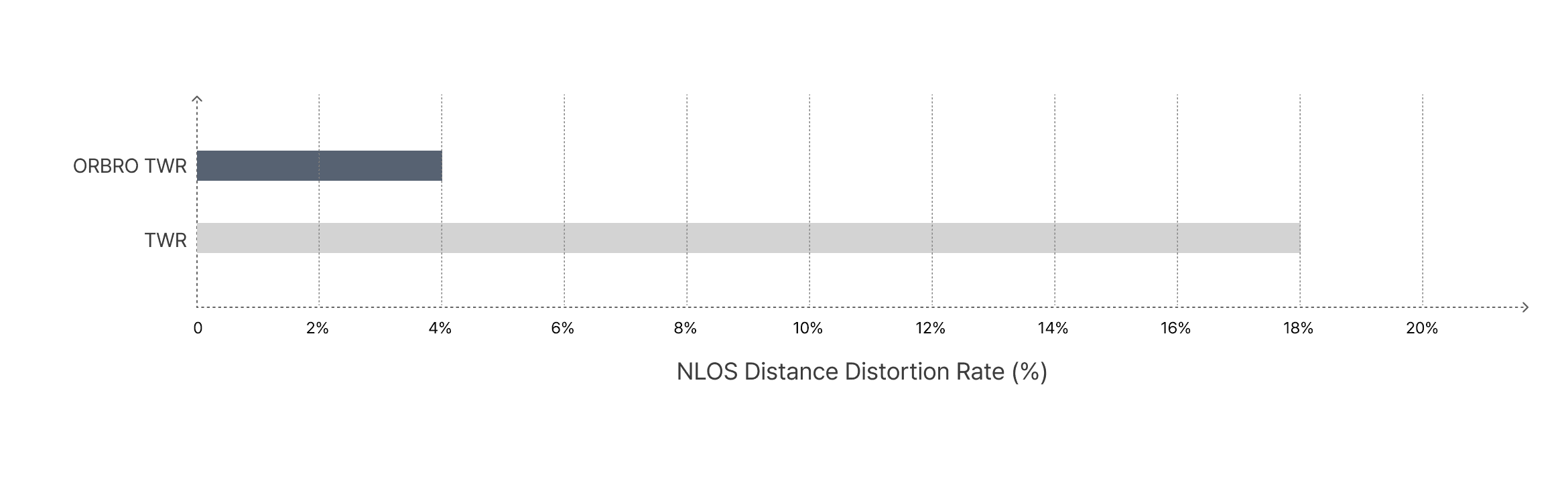
3. Distance Distortion Rate in NLOS (%)
The phenomenon where distance values are measured as excessively long in Non-Line-of-Sight (NLOS) environments is a typical distortion in TWR. This metric quantifies the rate of distance over-measurement in NLOS situations. By combining repeated measurement pattern analysis and automatic reflection distance exclusion algorithms, ORBRO suppressed the distortion rate to below 4%, a 4.5-fold improvement over existing systems.
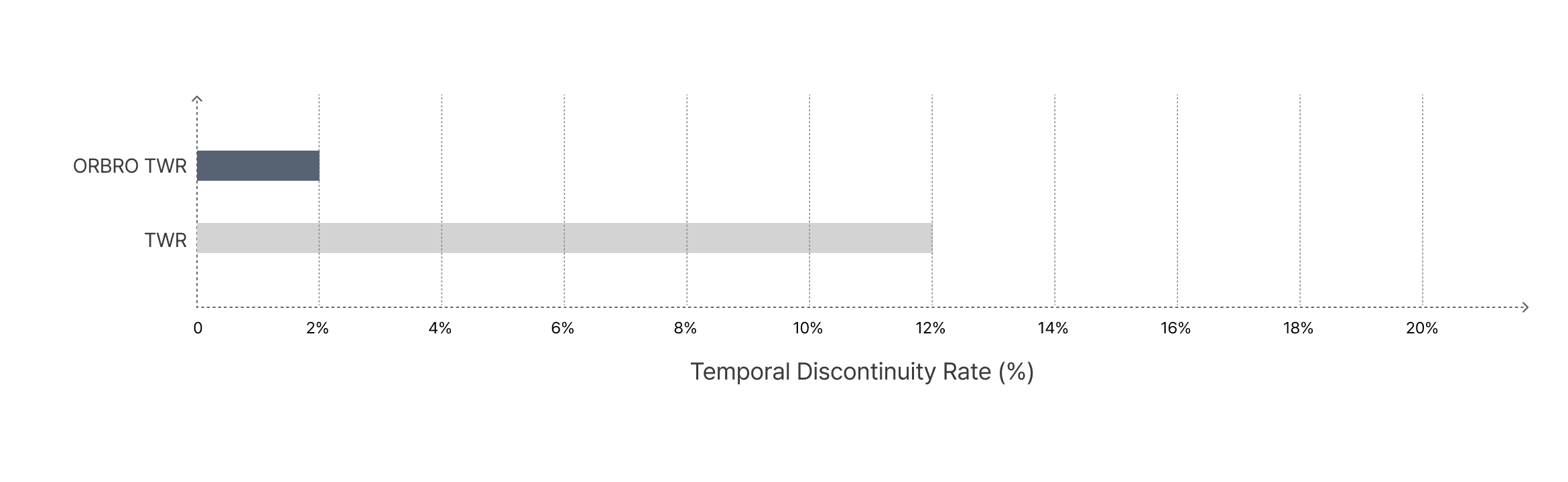
4. Time-Axis Distance Discontinuity Rate (%)
Instances where distance values change abruptly or deviate abnormally over the time axis degrade the reliability of real-time coordinate estimation. This metric serves as a criterion for judging how stable a flow the distance calculation maintains. ORBRO monitors distance flow in real-time through Kalman filters and moving average-based correction algorithms, reducing the discontinuity rate to the 2% level.
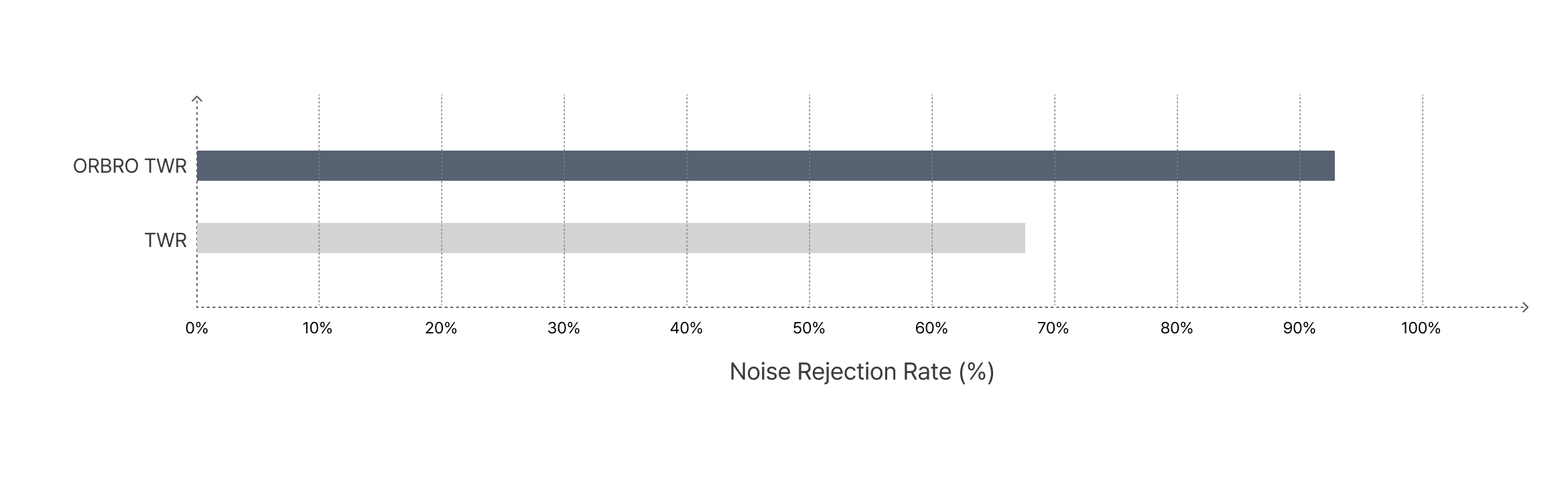
5. Distance Noise Suppression Rate (%)
The distance noise suppression rate is the percentage of received samples removed because they did not meet certain quality criteria (SNR, RSSI, delay, etc.). This evaluates the system's filtering ability to suppress noisy data before calculation. Based on high-sensitivity receivers and quality refinement algorithms, ORBRO actively removes distance noise, securing an average of over 93% valid distance samples to enhance overall reliability.
Reducing Distance Measurement Uncertainty Completes the Reliability of Location Tracking.
TWR has been widely adopted as a major RTLS technology due to its structural simplicity and ability for independent terminal-centric calculation. However, in indoor environments, the overall positioning output has repeatedly suffered from noise, reflections, and time-axis instability. ORBRO solved these issues by structuring distance calculation as a 'quality-controllable operation flow' rather than a single calculation. By clearly separating each step and performing continuous refinement, convergence correction, stabilization, and verification, we have technically overcome the structural limits of traditional TWR. Consequently, ORBRO TWR has verified performance in real environments with a mean distance error of 8cm and temporal stability over 95%, proving its practicality as a positioning engine. Without accurate distance calculation, there is no reliable location tracking. ORBRO designs every distance value systematically to complete the precision and consistency of RTLS operations.
Realization of High Precision with Mean Distance Error under 8cm
Secured approximately 5 times higher distance precision compared to conventional TWR through signal refinement at the reception stage and quality-based correction in distance calculation.Structural Response to High-Frequency Noise and Reflected Signals
Filters distance calculations according to reception quality standards (SNR, RSSI, reflection delay, etc.) and automatically excludes reflected signals based on convergence pattern analysis.Application of Time-Axis Based Distance Stabilization Algorithms
Maintains consistency in location output by detecting and correcting sudden changes in distance values through continuity-based prediction algorithms like Kalman and Particle Filters.Quality Verification-Based Distance Output Structure
Instead of simple distance output, it comprehensively evaluates quality indices, geometric consistency, and temporal continuity to select only valid coordinate targets for final output.
ORBRO Solutions Powered by TWR
Connect asset and personnel distance/location data with TWR-based RTLS and explore our representative solutions.

Prevent accidents by tracking worker locations in real-time
Automatically recognize a worker's current location with tracking technology and send instant alerts when they enter a danger zone.
Learn More
Optimize workflow with real-time location of assets within the process
Track the movement of workers and assets by stage using real-time location information to identify bottlenecks early.
Learn More
A forklift tracking system that never loses signal, even in nuclear power plants
A location tracking system that operates stably even in structures enclosed by steel plates with high ceilings.
Learn More
Streamline dock operations by automatically tracking container vehicle locations
Maintain seamless operation flow in logistics hubs by identifying vehicle locations and dock status in real-time.
Learn More