Why Keep Field Data Off the Cloud — The Rise of Edge & On-Premise Monitoring
2026-07-15
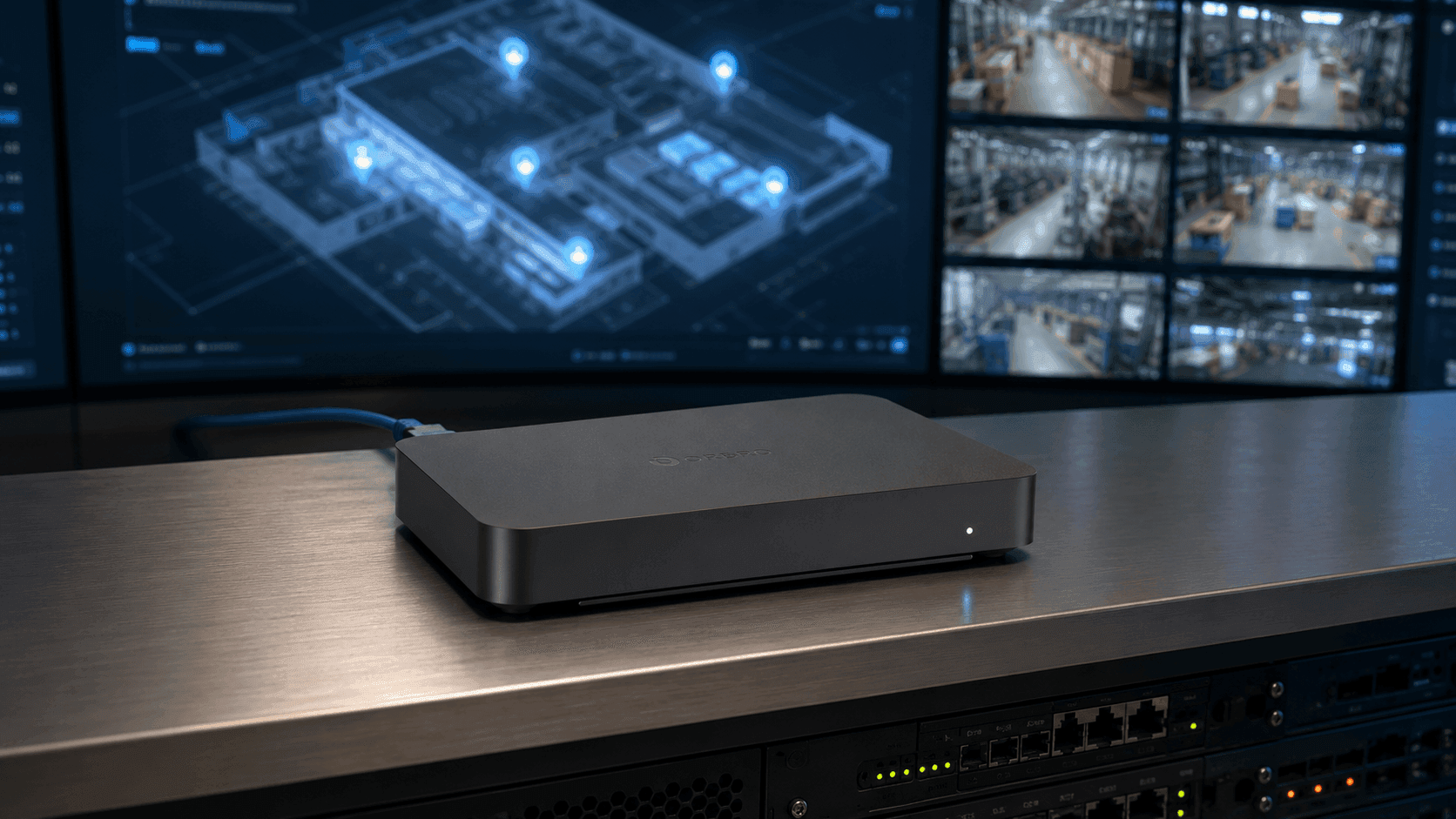
Digital twin monitoring, smart factories, real-time location systems (RTLS) — the technologies that turn a physical site into data are multiplying fast. Yet the very first question on the floor is surprisingly simple: "Where do we keep all of this data?"
For the past decade, "just send it to the cloud" felt like the default answer. But on a site where location tags spit out coordinates dozens of times per second and dozens of cameras stream video events in real time, that answer begins to wobble. Bandwidth, latency, and above all security. In places like government facilities and manufacturing plants — where the internal network is deliberately separated from the public internet — "send it to the cloud" is often not even an option.
That is why attention is returning to processing and storing data right where it is generated: at the edge, and on-premise. This article looks at why these two ideas matter again for real-time monitoring, and how scattered field signals can be pulled into a single screen.
I. Why "Process It On-Site" Again
The cloud is an excellent default. You do not have to buy servers, you can connect from anywhere, and you can scale capacity on demand. But in the specific case of real-time monitoring, a few of the cloud's assumptions start to work against you.
The first is latency. When an alarm has to sound in the instant before a forklift and a worker collide, the round trip of sending data hundreds of kilometers to a data center, waiting for a decision, and getting it back is anything but short. The second is bandwidth. Location streams and video are generated constantly and in volume; pushing all of it off-site makes line costs snowball. The third is continuity. If the internet drops for a moment, a cloud-dependent system stops with it — but safety and disaster monitoring must not stop at exactly that moment. The fourth is data sovereignty. Who was where, and what a camera captured, is sensitive information, and many organizations forbid that data from leaving the premises at all as a matter of policy.
II. Edge Computing — Processing Data Where It Is Born
Edge computing places a small compute device close to where data is generated and does the first round of processing there, instead of on one giant central cloud.
It is closer to a site manager deciding and acting on the spot than to sending every approval up to headquarters and waiting for a reply. Work that is "needed immediately" — calculating location coordinates, judging a dangerous situation in a video feed, raising an alarm when a condition is met — is handled by the on-site device, and only summarized results or data that needs long-term storage are selectively passed upstream.
This approach tackles the problems above head-on. Because decisions happen on-site, latency is almost nil; because raw data is not all uploaded, bandwidth is saved; and even if the external line goes down, on-site monitoring keeps running. ORBRO uses exactly this structure: a compact on-site edge server (ORBRO Edge Pro) with the integrated monitoring platform ORBRO OS installed directly on top of it. The key is that location tracking and monitoring are completed inside the site itself, without ever connecting to the cloud.
III. On-Premise — Data That Never Leaves the Site
If edge computing is about "where you process," on-premise is about "where you keep it and who operates it." On-premise means installing and running software and servers directly at the customer's site or inside their own facility, rather than on an external cloud. Its opposite is exactly the cloud and SaaS.
The biggest value is that data never crosses the organization's fence. Public-sector disaster and safety control, a manufacturer's production floor, and security-critical facilities are often run with the internal network physically separated from the public internet (an air gap). In such environments you could not use a cloud service even if you wanted to; the system has to be designed for on-premise from the start for adoption to be possible at all.
There is, of course, a price. The organization has to shoulder installation, updates, and fault response itself. So what actually matters in on-premise goes beyond "does it install cleanly on-site" to "does it stay stable after installation, and do the features it needs keep getting added?" This is why people say stabilization is harder than the initial build.
IV. Cloud Monitoring vs. Edge & On-Premise Monitoring
| Aspect | Cloud-centric | Edge & On-Premise |
|---|---|---|
| Processing location | External data center | On-site edge device / in-house server |
| Real-time response | Round-trip latency | Immediate on-site processing |
| Bandwidth cost | High, full raw transfer | Only summaries sent, reduced |
| Network outage | Risk of monitoring halt | On-site monitoring continues |
| Data security | Leaves the premises | Kept on-site / air-gapped |
| Best-fit sites | Distributed, small-scale | Manufacturing, public, secure |
The two are less a question of superiority than a choice driven by the nature of the site. But the more a site has real-time response and security riding on it at once, the more the scale tips toward edge and on-premise.
V. The Hard Part Is "Integration" — Scattered Signals Into One Screen
Up to here it has been about where you process and where you keep data. But the site's real headache comes next. When location-tracking gear, CCTV, access control, and assorted sensors each run in their own separate systems, the operator has to flip between several screens and merge the situation in their own head.
The value of edge and on-premise is completed when it meets this integration. Real-time location (RTLS), events extracted from video, access records, and condition-based alarms are combined into a single platform inside the site and placed on one screen. ORBRO OS provides more than twenty functions — location tracking, data analytics, AI events, access management, and more — in a single OS-style shell, with video event detection handled by AI Event Manager so it overlays on the same screen as the location data.
This is where ORBRO's approach differs a little. It designs everything from the hardware — location tags and the like — to the on-site edge server and the monitoring software on top, in one hand. Because it is not locked into a particular conglomerate's ecosystem or an external cloud, it can absorb the site's demand of "do not send data outside" as a structural principle from the start. Rather than competing on the superiority of any single technology, the real competitiveness of integrated monitoring lies in the ability to merge many signals into one picture inside the site.
VI. What to Consider Before Adopting
If you are evaluating edge and on-premise monitoring, it is worth weighing the following together.
- On-site hardware spec and scalability — does the edge device have headroom as the number of tags and cameras grows?
- Maintenance structure — who takes responsibility, and how, for updates, monitoring, and fault response after installation? On-premise lives or dies on this part.
- Hybrid design — is a compromise possible where sensitive raw data stays on-site while only summary data, such as management KPIs, is sent upstream?
- Scope of integration — of location, video, access, and sensors, how much will you bind into a single platform?
VII. Closing
Cloud or not is no longer a binary. What matters is a design that puts each kind of data where its nature belongs. Field data with real-time response and security at stake is more sensibly processed and kept on-site, and monitoring is truly completed when that data is merged into a single screen rather than left scattered.
ORBRO proposes a way to connect everything from location tracking to AI video events inside the site — by placing the integrated monitoring platform (ORBRO OS) on an on-site edge server (ORBRO Edge Pro), on-premise. If you need monitoring that takes in your whole site at a glance without sending data outside, a consultation can help sketch the configuration that fits your site.
Recommended Blogs
School Mapping Data and the Annual July 1 Verification in Georgia
2026-09-07

Patient Elopement Detection, Start With the Exit Routes, Not the Whole Ward
2026-09-11

Semiconductor Fab Personnel Tracking: Why Location Is Stored Only by Floor and Zone
2026-09-14