OSHA Heat Rule 2026: What Is Proposed, What Is Already
2026-08-31
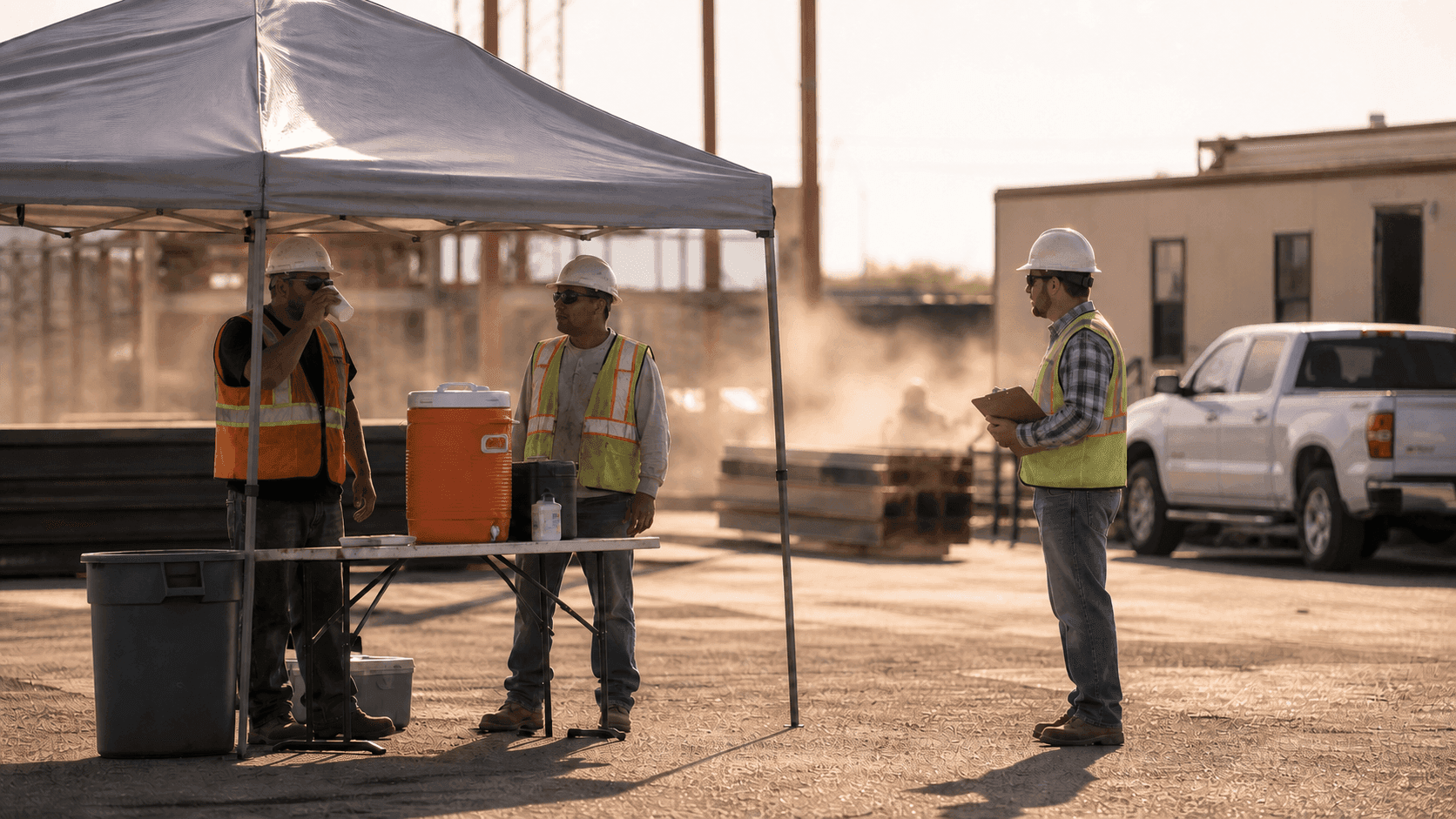
Ask three safety managers about the OSHA heat rule and you will get three answers. One says the federal heat standard is coming, and the site heat illness prevention plan is already written against it. One says the rule is dead. A third says none of it matters, because California and Oregon already bind them today.
All three are partly right. The federal heat rule is proposed, not final. Seven states have their own occupational heat standards enforceable now. And federal OSHA reissued its heat National Emphasis Program in April 2026 for up to five more years, so heat inspections continue whether or not a federal standard ever lands.
The work differs in each case. Against a proposal you plan. Against a state standard you comply, against specific numbers and specific documents. Against an enforcement program with no standard behind it, OSHA cites under the General Duty Clause, and those cases turn on what you can show afterward.
One duty runs through nearly all of them: someone has to watch workers, and someone has to record what was measured. Thresholds change, so read the standard itself and check with your counsel or the enforcing state agency before acting on any summary, this one included.
I. Proposed, enforced, or neither
OSHA published its proposed rule, "Heat Injury and Illness Prevention in Outdoor and Indoor Work Settings" (docket OSHA-2021-0009, proposed 29 CFR 1910.148), in the Federal Register on August 30, 2024 at 89 FR 70698. The comment period closed January 14, 2025, an informal public hearing ran June 16 through July 2, 2025, and the post-hearing comment period closed October 30, 2025.
As of late August 2026 there is no final rule, and the rulemaking has not been withdrawn. It sits at the Proposed Rule Stage, and the current Unified Agenda entry for RIN 1218-AD39 points toward another round of proposal rather than a finish line: a Supplemental NPRM targeted for December 2026, Final Action targeted for October 2027. Those are planning dates, not commitments, and a supplemental proposal means the text below can still change before it binds anyone.
So the proposal is worth reading, but it is not a duty. It works off two triggers, each of which can alternatively be met by a wet bulb globe temperature at the matching NIOSH limit.
1. What the initial heat trigger would require, at a heat index of 80°F
Cool drinking water at one quart per employee per hour. Shaded outdoor break areas, and indoor break areas with air conditioning or increased air movement. Acclimatization over the first week for new and returning employees. Paid rest breaks as needed, and regular two-way communication.
2. What the high heat trigger would require, at a heat index of 90°F
All of the above, plus a hazard alert and a paid rest break of at least 15 minutes every two hours. Then comes the provision safety technology vendors have circled for two years. Proposed 1910.148(f)(3) would require observing employees for signs and symptoms by at least one of three methods: a mandatory buddy system; observation by a supervisor or heat safety coordinator, capped at 20 employees per observer; or, for employees alone at a work site, two-way communication with contact at least every two hours.
3. Enforcement never paused, and it runs on its own track
A revised heat NEP, CPL 03-00-024, took effect April 10, 2026, canceling the April 2022 program and operative for no more than five years. Most of its machinery carries over rather than arriving new. A heat priority day is one when the heat index is expected to reach 80°F or more, and on those days compliance officers should ask about heat hazard prevention during inspections opened for other reasons. Programmed heat inspections are separate: those occur on days the National Weather Service has announced a heat warning or advisory for the area. What changed is the target list. OSHA retargeted on its own citation data and BLS injury data, dropping 46 industries and adding 22 for a total of 55 that reach past the obvious ones into plastics product manufacturing, general freight trucking, and electric power generation.
With no standard to cite, the vehicle is the General Duty Clause, OSH Act Section 5(a)(1). An April 2026 analysis by Ogletree Deakins counts roughly 7,000 heat-related inspections between April 2022 and December 2024, against roughly 200 a year from 2015 through 2020, producing sixty General Duty Clause citations. That ratio is the point. These cases are fact-intensive, and your records of what you measured and what you did are the material they get argued over.
II. The state standards that are already enforceable
The appendix to OSHA's April 2026 heat NEP lists seven State Plans with heat standards: California, Colorado, Maryland, Minnesota, Nevada, Oregon, and Washington. They are not variations on one template. Scope, triggers, and even the existence of a temperature threshold differ, and so does who is covered at all. Washington's heat rules are outdoor only, Minnesota's apply indoors only, and Colorado's reach agricultural labor alone.
| Standard | Trigger | Core duties beyond water |
|---|---|---|
| California T8 3395, outdoor | Shade when the temperature exceeds 80°F; high heat procedures at 95°F | 14-day close observation of employees newly assigned to a high-heat area; at 95°F, in the covered high-heat industries, effective communication, one of four observation methods, designated emergency callers, pre-shift meetings |
| California T8 3396, indoor, from July 23, 2024 | 82°F; the subsection (e) duties at 87°F, or at 82°F with heat-restrictive clothing or high radiant heat | Written Heat Illness Prevention Plan; cool-down areas kept below 82°F unless infeasible; at the higher trigger, measure temperature and heat index, record whichever is greater with date, time and location, then engineering, administrative and PPE controls in that order |
| Oregon OAR 437-002-0156, indoor and outdoor, from June 15, 2022 | Heat index 80°F; high heat practices at 90°F | Written rest break schedule at 90°F under one of three options, one being Oregon OSHA's simplified schedule running from 10 minutes per two hours at 90°F to 40 minutes per hour at 105°F; written acclimatization and emergency medical plans |
| Washington WAC 296-62-095, outdoor, year-round, from July 17, 2023 | Action level 80°F, or 52°F in non-breathable clothing | Cool-down rest of at least 10 minutes every two hours at 90°F, 15 minutes hourly at 100°F; observation at 90°F by regular communication with employees working alone, a buddy system, or other effective means |
| Maryland COMAR 09.12.32, indoor and outdoor, from September 30, 2024 | Heat index 80°F; high heat procedures at 90°F | Written plan available to employees and MOSH; 10 minutes rest per two hours above 90°F, 15 minutes hourly above 100°F, or a NIOSH schedule; acclimatization up to 14 days for newly exposed and returning employees |
| Nevada NAC ch. 618 (R131-24), employers required by NRS 618.383 to keep a written safety program | No temperature threshold; climate-controlled spaces exempt while the climate control works | One-time written job hazard analysis covering job classifications where most employees are exposed more than 30 minutes of any 60; where hazards are found, the written program must cover water, rest, means of cooling, monitoring, training, and emergency procedures |
| Colorado 7 CCR 1103-15, agricultural labor only | Days at or forecast to reach 80°F | At least 10 minutes of rest per two hours of work under increased risk conditions, which include a 95°F high, air quality advisories, shifts over 12 hours, and an employee's first four workdays |
| Minnesota Minn. R. 5205.0110, indoor only | WBGT limits by workload | Two-hour time-weighted-average WBGT ceilings of 86°F light work, 80°F moderate, 77°F heavy, plus training |
Read that table twice if you operate in more than one state. A network with buildings in Sacramento, Baltimore, and Reno sits under three regimes at once, one keyed to indoor temperature, one to heat index, and one to a job hazard analysis with no thermometer in it.
III. What the rules have in common
Strip away the thresholds and two duties show up almost everywhere, along with one branch for the worker nobody can see.
1. Someone has to be watching, and the ratio is written down
California 3395 puts four permitted methods on the page for high-heat work at 95°F and above, in the industries those provisions cover: supervisor or designee observation of 20 or fewer employees, a mandatory buddy system, regular communication with a sole employee such as by radio or cell phone, or other effective means of observation. Washington's high heat section offers three, and the federal proposal offers three with the same 20-per-observer cap. Cal/OSHA's indoor rule adds a duty at the front end: an employee newly assigned to a work area that reaches 87°F, or 82°F where clothing restricts heat removal or radiant heat is high, must be closely observed by a supervisor or designee for the first 14 days.
2. Lone workers get a contact interval
Every one of these rules branches here. California allows regular communication with a sole employee, Washington names it first among its three methods, and the federal proposal would set the cadence outright at contact every two hours.
3. Measurements have to become records
The quieter obligation, and the one most programs handle worst. Where California 3396(e) applies, the employer measures both the temperature and the heat index and records whichever is greater, with the date, time, and specific location of every measurement, kept 12 months or until the next measurement, whichever is later. Nobody credits you for the reading you took. They ask for the file.
IV. Why observation breaks down on a real site
A 20-to-1 ratio sounds administrable until you draw it on a site plan. It assumes the 20 are visible. On a 40-acre yard, in a warehouse with mezzanines and racking, or along a linear job like a pipeline, one supervisor's line of sight covers a fraction of the crew, and the fraction changes hourly.
Exposure moves with the person, too. The heat index at the break tent is not the heat index on the mezzanine above the ovens, or inside a trailer at two in the afternoon. A worker crosses three exposure regimes in a shift while the site's official reading stays in one spot, which is why California asks for the specific location of each measurement.
The roster is the third problem. Lone work removes the observer entirely, the least acclimatized person on site is often a contractor who started this week, and at shift end a supervisor who spent the day running work reconstructs the record from memory.
V. Where location data, sensors, and video AI fit
No product carries an employer's heat obligations. What a heat standard asks for is a written plan, trained people, water, shade, breaks, and a supervisor who acts. What technology does is narrower: it supports the procedures you have already written, and it leaves evidence that you carried them out.
1. Knowing where people are, and whether they are still moving
A UWB tag on a badge or hard hat reports position continuously, and indoors, in a deployment tuned for it, closely enough to tell one aisle from the next. The system therefore knows who is inside a zone you designated as high heat, how many, and for how long, which is the input an observation ratio, an acclimatization window, or a break cadence actually needs. The same tag carries two features aimed at the lone-worker branch: no-motion detection that flags a tag stopped longer than a threshold you set, and an SOS button. Neither diagnoses heat illness. Both shorten the gap between something going wrong and somebody finding out. That is the core of ORBRO's UWB RTLS.
2. A second observer where cameras already exist
Most sites already have cameras on the yard, the dock, and the main aisles. AI Event Manager watches those feeds for a person collapsing or lying down and raises an event with the clip attached, so whoever reviews it sees what happened rather than an alarm code. Where nobody is looking, a camera that notices stands in for the supervisor who cannot be in two places.
3. Zones, thresholds, and the file you will need later
Temperature and heat index sensors placed by zone feed the same map as the location data, so a reading carries a place and a time without anyone transcribing it. When a threshold is crossed, ORBRO OS runs the response you configured: notify the supervisor for that zone, list who is inside it, log what was done and when. Whether a given record does what a specific state rule asks is a question for that standard's text and your counsel, not for a vendor. But the shape of the record is the shape these rules describe. See ORBRO OS.
VI. What to evaluate
1. The rule you are actually under
An indoor plastics plant in California and an outdoor crew in Washington need different things. Start from your standard's trigger and its observation clause, then ask what the system produces against those words.
2. Accuracy where the heat is
Zone-level accuracy is enough for occupancy counts and break tracking, but aisle-level accuracy matters when the hot zone is one bay. Ask for figures measured somewhere like your site, with racking and metal in the way.
3. What the record looks like in twelve months
Export the log during the pilot. Check that it carries date, time, location, and the action taken, and that someone who was not there can read it.
4. Where the alert goes at 2 a.m.
A no-motion event with no owner is worse than no event. Map every alert to a named role, a device, and an escalation step, then rehearse it the way you rehearse an evacuation.
5. Worker acceptance and data scope
Location data on people is sensitive. Put in writing what you collect, who sees it, how long you keep it, and what it is never used for, and take that to a toolbox talk before it appears on a badge.
VII. Closing thoughts
The direction is legible even with the federal rule unfinished. Every heat standard now in force, and the federal proposal too, asks the same two questions: who is watching this worker, and where is the record. Answering that for a small crew in one building is a scheduling problem. Answering it across a site with contractors, mezzanines, a yard, and a night shift is an information problem, and adding supervisors does not solve it.
Which is why the useful shape is one view of the whole site rather than three disconnected tools: location from UWB RTLS, video AI that notices what nobody was watching, and a digital twin where zones, thresholds, readings, and responses live in one place, so the plan you wrote and the record you keep are the same object. ORBRO builds that as a single platform, with ORBRO OS as the operations layer over it.
If you are rewriting a heat illness prevention plan this year, or working out how a written observation procedure would run on your site, we are glad to walk through it with your EHS team, including the parts where technology is not the answer. Get in touch and we will start from your site plan and your standard rather than a product list.