What Is AI Automation? A Comprehensive Guide to Reshaping the Future of Enterprise Operations
2025-10-20

As operating costs continue to rise and global supply chains remain volatile, businesses in Vietnam are facing a critical question: How can they achieve more with fewer resources? The answer does not lie in overextending human labor, but in a concept redefining Industry 4.0—AI automation.
So, what is AI automation exactly? Why are leading manufacturing and logistics corporations investing millions of dollars in this technology? Let’s break it down and explore how to leverage it to gain a decisive competitive advantage.
1. Understanding the Concept: What Is AI Automation?
Traditionally, automation has been associated with RPA (Robotic Process Automation). RPA excels at mimicking repetitive human actions on computers—such as copying and pasting data or sending bulk emails—based on rigid, pre-programmed rules. However, when faced with unexpected scenarios outside predefined workflows, RPA simply stops functioning.
This is where AI automation sets a new benchmark. AI automation combines mechanical or software-based automation with the “brain” of artificial intelligence, including Machine Learning, Natural Language Processing (NLP), and Computer Vision.
Unlike traditional automation, AI automation does not execute tasks blindly. It can observe, learn, reason, and make decisions in complex environments involving unstructured data and constantly changing conditions. In simple terms: if traditional automation is the “arm,” AI automation equips that arm with a powerful “brain.”
2. The Evolutionary Stages of AI Automation in B2B Enterprises
To fully understand AI automation, we must examine its three maturity levels in enterprise applications:
Level 1: Cognitive Automation
Instead of employees manually reviewing thousands of invoices, AI can automatically scan documents using OCR, interpret content with NLP, extract key information such as payment amounts and partner names, and input the data directly into ERP systems.
Level 2: Predictive Automation
AI analyzes historical data to trigger proactive actions before events occur. For example, the system automatically places raw material orders when AI algorithms forecast a surge in next month’s market demand, combined with declining current inventory levels.
Level 3: Autonomous Automation
This represents the pinnacle of AI automation. Machines, production lines, and software systems communicate with each other, self-diagnose errors, and automatically adjust operational parameters—without human intervention.
3. Operational Breakthroughs: AI Automation Combined with Digital Twin and RTLS
The true value of AI automation in heavy industry, manufacturing, and logistics multiplies when integrated as the “core engine” of technologies such as Digital Twin and RTLS (Real-Time Location Systems).
Autonomous Maintenance with Digital Twin
A smart factory may operate a full Digital Twin of its production line. AI automation continuously analyzes vast IoT sensor data streams feeding into the virtual replica. If abnormal motor vibrations are detected, the system does more than send an alert. It automatically generates a work order in the management system, checks spare-part inventory availability, and dispatches an engineer to the location before the motor fails and causes costly downtime.
Touchless Logistics Coordination with RTLS
In warehouses spanning tens of thousands of square meters, RTLS tracks the real-time positions of forklifts and personnel. When an urgent order arises, AI automation instantly calculates the shortest route, assigns the task to the nearest available forklift, and reroutes other vehicles to avoid congestion or collisions. All of this occurs within seconds—without manual radio coordination by warehouse managers.

4. A Four-Step Roadmap for Risk-Free AI Automation Deployment
Understanding what AI automation is represents only the first step. Successful implementation requires a strategic approach to avoid budget waste:
Process Audit
Avoid automating disorganized workflows. Review the entire operational chain and identify bottlenecks that consume time and generate frequent errors.
Data Digitization and Preparation
AI automation runs on data. Ensure operational, asset, and workforce data are digitized and centrally stored.
Pilot Project (PoC)
Start with a focused initiative. For example, apply AI automation to analyze RTLS location data within a single warehouse zone for two months to measure reductions in unnecessary travel time.
Choose the Right Technology Partner
Select B2B technology providers capable of delivering an integrated platform where AI, location tracking systems, and Digital Twin solutions communicate seamlessly.
Conclusion
To answer the question “What is AI automation?”—it is no longer a distant futuristic concept, but a survival tool in the digital era. It removes the boundary between software and the physical world, transforming static factories and warehouses into intelligent, self-optimizing ecosystems.
Rather than remaining on the sidelines of this transformation, business leaders must reassess their operational models today. Delayed adoption of intelligent automation not only forfeits cost-optimization opportunities but also poses the greatest risk of falling behind in the global competitive landscape.
Recommended Blogs

Is That Location Still Current? Checking RTLS Data Freshness
2026-10-14

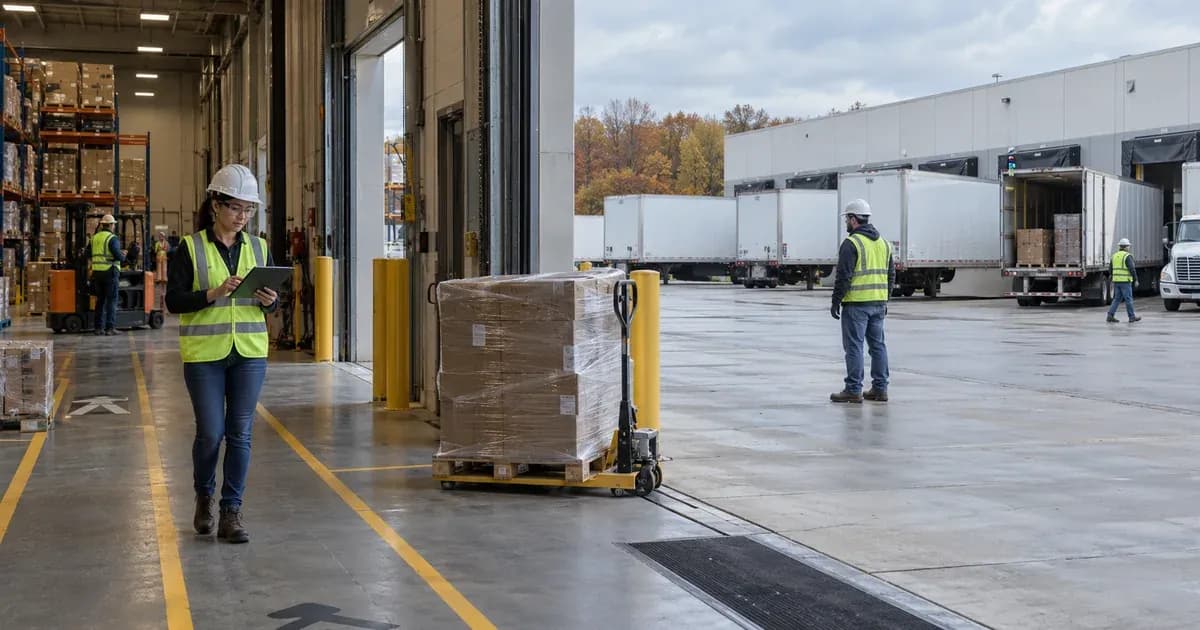
AI-generated illustration of the selected local environment; not a photograph of a customer site.
2026-10-13
Asset Tracking Across the Warehouse Door: Joining Indoor and Yard Records
2026-10-12
Forklifts Queue at Dispatch. Look at Dwell Time.
2026-10-08