Seeing Danger Before It Is Visible — AI That Protects Pedestrians at Intersections
2026-07-16
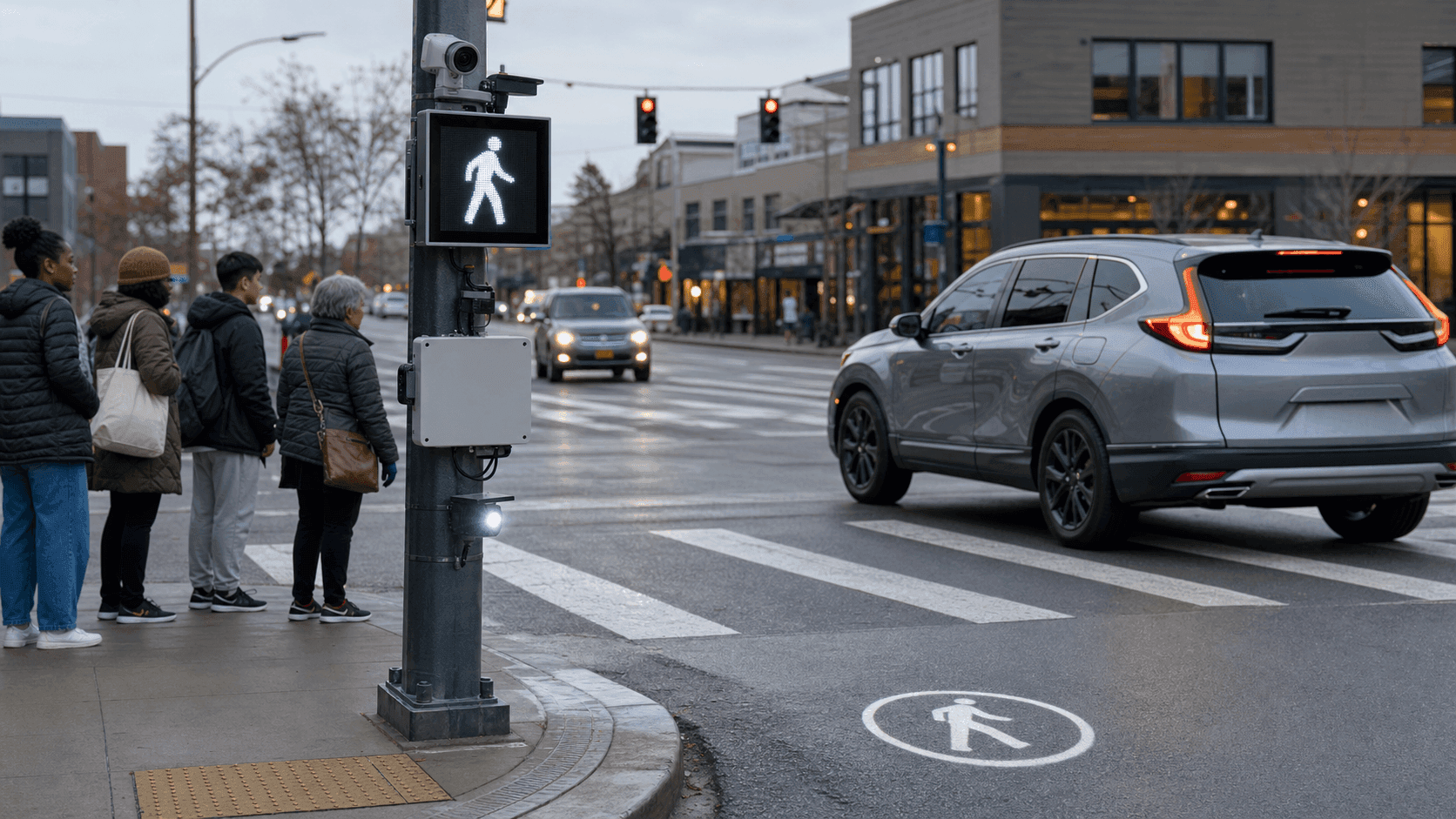
Around the world, total road deaths have fallen for decades — but pedestrian deaths have not kept pace. The World Health Organization estimates about 1.19 million road-traffic deaths every year, and vulnerable road users — pedestrians, cyclists, and motorcyclists — make up more than half of them. In the United States, pedestrian fatalities have risen to their highest levels in decades even as cars grow safer (GHSA). The pattern is consistent: wherever people and vehicles mix at close range, rules alone struggle to protect them.
South Korea, where this system was built and proven, is a telling example. It passed some of the strictest pedestrian laws anywhere — the "Min-sik Act," which imposes heavy penalties for school-zone crashes, and a nationwide requirement to stop before turning right. Yet in 2025, right-turn pedestrian deaths hit a record high (Korean National Police Agency). The reason is simple: a rule can tell a driver to stop, but it cannot make the pedestrian around the corner visible. This article looks at how AI reads an intersection's blind spots first and warns drivers and pedestrians at the same time.
I. The Blind Spot Is the Real Problem
A right-turn corner, a narrow side street, a school zone — what they share is that buildings, walls, and parked cars hide people and vehicles from each other until the very last moment. Conventional signals and signs act only on what is already visible. The most dangerous instant — when neither side can see the other yet — carries no information at all. To close that gap, you need something that looks around the corner for both parties and warns them before they meet.
II. AI Sees First — Four Steps in Under a Second
An AI crosswalk-safety system runs from detection to warning in under a second, with no human in the loop.
- Object recognition — the AI camera detects and tracks four classes: people, vehicles, bicycles, and kick scooters.
- Collision-risk prediction — from each object's direction and speed it computes the time left to a collision, flagging danger only when a threshold is crossed, which suppresses false alarms.
- Two-way simultaneous warning — the driver is warned on an LED display, while the pedestrian is warned by a floor logo-projector and a voice speaker — both sides, within a second.
- Data logging and transfer — every event is stored as data and shared in real time with local government, police, and fire services.
The heart of it is step three. Where most systems alert only the driver or only the pedestrian, this one tells both at once so each becomes aware of the other.
III. One Unit Watches Eight Risks at Once
A single camera detects eight road risks simultaneously: right-turn blind spots, vehicles emerging from side streets, sudden dashes in school zones, fast approaches, night and bad weather, jaywalking, bicycles and e-scooters, and crowd density. Children are trained as a distinct class so the AI can catch a sudden school-zone crossing early, and personal mobility devices like bikes and scooters are separated into their own class for uninterrupted tracking. Trained on low-light data, it recognizes reliably from video alone even at night, in rain, or against backlight — the same vigilance at any hour, in any weather.
IV. The Decision Is Completed On-Site
This system analyzes video on-site rather than sending it to the cloud. The on-site AI computer, ORBRO Edge Pro (a 50-TOPS NPU), processes up to four cameras at once and runs standalone, without a separate server or cloud. So even if the network drops, the on-site unit keeps deciding and warning. Personally identifiable video is processed only on-site; only statistics and event data leave the device, which is favorable for privacy. Existing CCTV integrates as-is regardless of manufacturer, and because the unit mounts on existing structures with no road excavation, one intersection typically takes about two hours to install. An IP66 all-weather enclosure keeps it running through cold, heat, and dust. Designing everything — from hardware to the on-site edge computer to the monitoring software — in one hand lets ORBRO absorb the "keep the data on-site" demand as a structural principle.
V. Is It Proven?
For a new safety technology, the question that matters most is whether it actually works. Since 2018, this system has been built and operated at roughly 180 sites together with about 30 public agencies across Korea, and by ORBRO's operating data, no pedestrian traffic accidents have been reported at operating sites. The technology reached TRL 9 — the highest, field-proven maturity level — and is recognized by Korea's road-infrastructure authorities. The evidence rests on three legs: years of field operation, certified technical maturity, and adoption across public agencies.
VI. Closing
Rules set the standard, but to keep them people must first be able to see the danger. An AI intersection-safety system reads the risk in a blind spot before people meet and warns drivers and pedestrians at once. It is one of the most practical ways for a city to move toward the UN's goal of halving road deaths by 2030. ORBRO covers everything from equipment to monitoring as one integrated system, and you can start with a site diagnosis where accidents cluster. If you'd like, we can sketch a configuration that fits your city and streets.
Recommended Blogs
Right Coordinates, Wrong Floor? Validating Multi-Floor RTLS
2026-10-19
Returned but Not Ready: Tracking Returnable Container Recovery
2026-10-16
Replacing an RTLS Tag Without Losing the Asset's History
2026-10-15
Is That Location Still Current? Checking RTLS Data Freshness
2026-10-14