Hospital Asset Tracking: When Finding a Surgical Device Takes 30 Minutes
2026-08-06
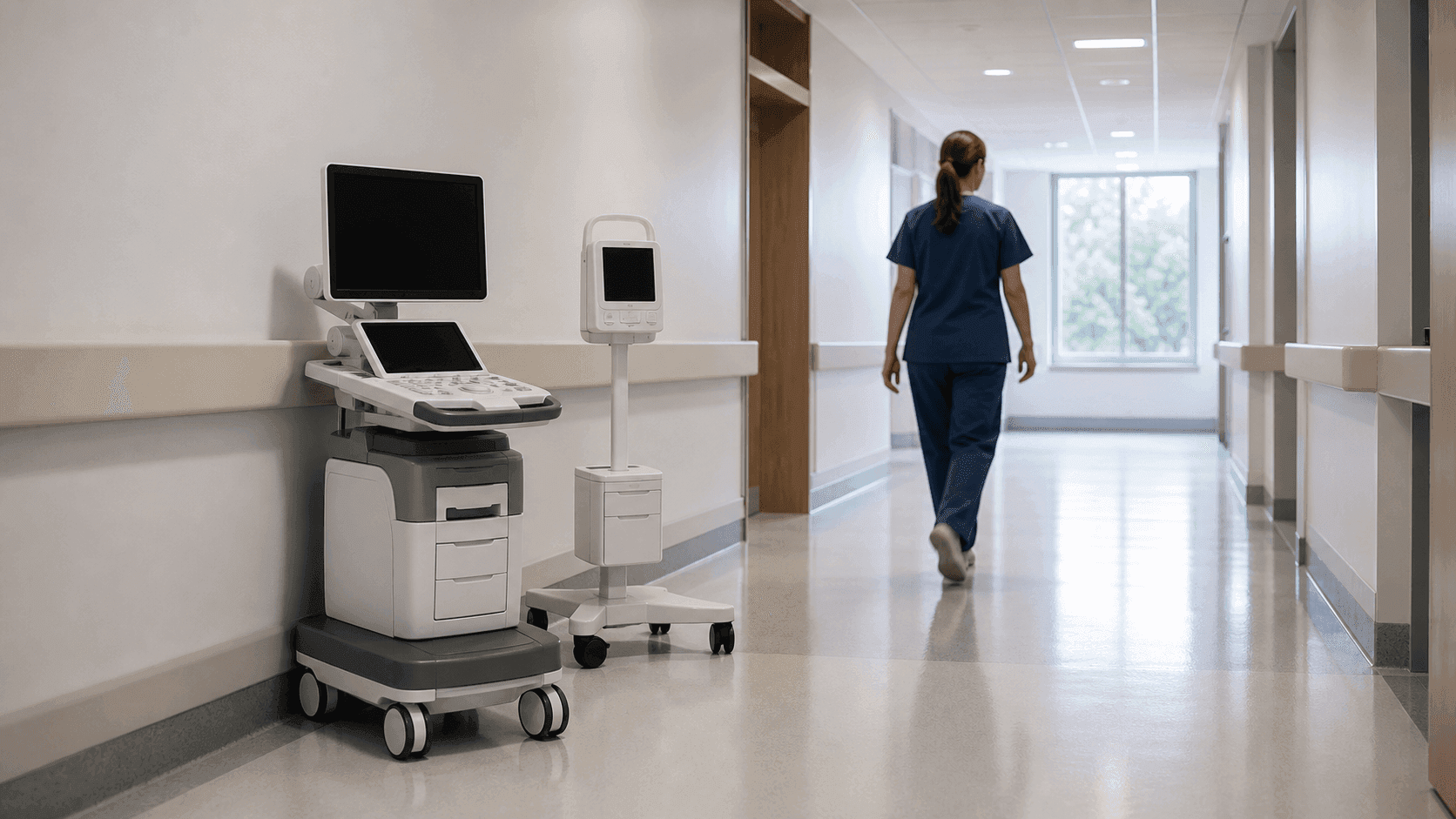
A hospital is one of the buildings with the most wheeled objects in it. Portable ultrasound units, infusion pumps, patient monitors, wheelchairs, surgical instrument sets. Most of them do not stay in one place, and many cross several floors in a single day.
A hospital knows its bed count precisely. It is a licensed number and a managed number. But where the portable ultrasound is right now — which floor, which ward — is usually established by making phone calls.
And there is something the hospital knows even less well. Whether that device is being used at all.
Fail to answer the first question and the floor loses time. Fail to answer the second and the hospital loses money. Both answers come out of the same data.
I. Three Things That Happen When You Don't Know Where Equipment Is
1. Search time eats clinical time
Time spent hunting for equipment is a story you hear in every hospital. The problem is that this time is never counted as waste anywhere. Staff are moving while they search, so it lands in no metric.
In a factory, if you cannot find material the line stops — and a stopped line leaves a number behind. In a hospital, if you cannot find a device a schedule slips, and the slipped schedule pushes the next one, but nothing anywhere is recorded as "spent looking for a device."
2. The conclusion "we don't have enough" is reached incorrectly
This is the more expensive problem. When a device is not available at the moment it is needed, the conclusion converges on one thing: buy more.
But very few hospitals actually know whether they are short. Judging a shortage requires knowing the peak concurrent usage, not the quantity owned, and that data does not exist. What accumulates instead is the experience of "it wasn't there when I needed it," and that becomes a purchase request.
In reality it is common for a spare unit to sit in another ward's corridor for days. The asset is not short; the location and usage state of the asset is unknown — and the price of that ignorance is one more device.
3. Inventory and audit records get rebuilt by hand
Asset audits, maintenance interval management, recovering loaned equipment. All of it is the work of reconstructing, after the fact, something that already happened. Because it is reconstruction it takes time, and because it is reconstruction it can be wrong.
II. Why Positioning Is Unusually Difficult in a Hospital
From the standpoint of indoor positioning, a hospital presents a different kind of difficulty than a factory. It does not reduce to a single accuracy number.
There are many compartments. Factories are often one wide space with equipment placed in it; hospitals are finely divided by walls. Patient rooms, treatment rooms, exam rooms, operating rooms. The resolution required is not "somewhere on the third floor" but "room 7, ward A, third floor." A few metres of error points at the room next door. And if you intend to infer usage from zones, this resolution becomes a precondition.
Floors are the problem. Hospital equipment moves between floors by elevator. Misjudge the floor and what you have is not location information but a misunderstanding. Floor discrimination has to be verified separately from planar accuracy.
You cannot stop. A hospital runs 24 hours. The window for opening ceilings and pulling cable is short, and the work has to proceed zone by zone in stages. In a hospital, the installation method narrows the very feasibility of the project.
Radio needs care. Introducing new wireless equipment into a space dense with medical devices is itself a review item. UWB spreads its signal across a wide band at very low power, so it produces little interference concentrated on any single frequency. That does not mean the review can be skipped. Confirming this against the specific device mix of the hospital before deployment is a separate necessity.
Because of these conditions, anchors in a hospital are designed per compartment rather than as "a few covering a wide area." PoE, which carries power and data on one cable, reduces ceiling labour — and where the construction window is narrow that difference matters more than it sounds. ORBRO's ceiling anchor TwinTracker supports PoE 802.3af, finishing the installation with a single Ethernet run.
UWB accuracy is usually quoted at roughly ±10–30 cm by specification, but the real figure depends on compartment structure and anchor layout. The question a hospital should ask is not how many centimetres the average error is, but whether it resolves to the room, and whether it ever confuses the floor.
III. From "Where Is It" to "Is It In Use"
Putting a position on a screen is half the job. The other half is reading what that position means. Usage is determined by overlaying three signals.
First, did it move? Location tags contain an accelerometer. Originally it is there to save battery — stretch the update interval while stationary, transmit often only while moving. But that signal doubles as the primary clue to usage. A portable device that has not moved once in three days is a device nobody has used in three days.
Second, where is it? The same stationary state means different things in different places. Parked in the equipment store is not the same state as sitting inside a treatment room. Define zones on the floor plan and position becomes context.
Third, how long was it there? Once zone entry and exit are recorded as events, dwell time accumulates automatically. Twenty minutes in a treatment room and six hours in a treatment room are different stories.
Overlay the three and you can sort a device into in use, standby, idle, or abandoned. And this is not a snapshot at one instant but a distribution accumulated over time. How many hours a day it was used, how weekdays differ from weekends, which ward turns it over fastest.
There is a limit here that has to be stated honestly. What location and movement tell you is the likelihood that something was used, not that it was used. A device entering a treatment room and a device actually being used on a patient are different facts. So this data should be used in two ways. One is idle detection — finding devices that have not moved at all carries almost no error. The other is relative comparison — comparing the usage distribution across twenty units of the same device type cancels out the inaccuracy of the absolute value. If you need to establish usage as fact, a further step of joining this to the device's own power or operating log is required.
IV. Four Decisions Utilization Data Changes
Once usage data accumulates, judgements previously made on experience acquire evidence.
You gain grounds for not buying more. If peak concurrent usage sits below the quantity owned, what is short is not equipment but distribution. Conversely, if the peak genuinely reaches the owned quantity often, that is the strongest possible attachment to a purchase request. Either way the decision moves from instinct to data.
Redistribution between wards becomes possible. Utilization splitting unevenly across wards is common. Once an aggregate shows which ward is holding the slack, you move units. Moving is overwhelmingly cheaper than buying.
Abandoned equipment surfaces. A device that has not moved in a long time is either an idle asset or a device that is not where it should be. Set an alert and a loss stops being a discrepancy discovered at audit and becomes an incident handled that week.
Maintenance and calibration can run on actual usage. Today it is mostly calendar-based: a heavily used device and a barely used one get inspected on the same interval. Once usage hours accumulate, you can reorder that so the heavily used ones are seen first.
The premise underneath all of it is that the number on the screen is the number from the existing asset ledger. A system that displays tag numbers does not get used on the floor. Binding the asset ledger to tags one-to-one is the first step, and if it is skipped every aggregate downstream comes out in a different language.
In ORBRO OS, Zone Manager defines zones while In-out Tracking and Timeline handle entry, exit, and dwell history. Finding "the nearest available device" is a different function from tracking a specific device — and since the floor asks the former far more often, it is handled separately as Nearby Search.
V. What a Hospital Should Decide Before Deploying
There are conditions to settle before the technical specification.
Decide first what you will not tag. Not patients. What this article covers is equipment. Whether to handle staff location is an entirely separate question, requiring purpose, consent, and retention to be designed again from scratch. Quietly folding it into an asset management project is the worst possible way to proceed. The same principle applies to utilization data: what is measured is the utilization of equipment, not the workload of people. It is worth fixing that distinction in writing early in the project.
Verify floor and room discrimination in a pilot zone first. Hang anchors in one ward, measure room-level discrimination and floor determination, and the design the whole facility needs falls out as arithmetic. Since usage is inferred from zones, no zone discrimination means no utilization figures either. The benchmark is the number from that ward, not the number in the catalogue.
Decide which equipment goes first. Projects that tag every asset at once usually run late. The order is: what goes missing often and gets searched for often, and what is expensive. The value of utilization data also shows up here first.
Build the no-downtime installation plan into the design. Installation is a scheduling problem, not a technical one. Proceeding zone by zone, and choosing a power and data method that minimises cabling, is what sets the construction duration.
Bind it to the systems you already run. If an asset ledger is already in operation, location and usage history have to go into it. Adding one more screen is less effective than adding one location column to the screen people already open.
Closing
What is hard about hospital asset management is not the technology of measuring position. It is translating position into the language of the hospital. Not a coordinate but "ward A, third floor." Not a tag number but an asset number. And not a single dot but "this device was used for N hours last month."
That last sentence is the point of this article. Use location tracking only as a tool for finding equipment and it ends at saving time. Read the same data as utilization and it changes the next budget. And the second is a far more persuasive language for hospital leadership.
For that, positioning and interface cannot stand apart. Without room-level discrimination, however well built the screen, the utilization figure will state a falsehood; and however accurate the coordinate, if it never emerges as an audit record the floor goes back to paper. ORBRO builds tags and anchors, edge positioning computation, and the ORBRO OS control layer, which is why there is no reason to treat the two separately.
One ward is enough to start. Take a handful of devices and a handful of anchors, confirm the conditions above, and the full design falls out as arithmetic. For ORBRO real-time location tracking, site condition review and pilot zone design are things we work through with you — get in touch.