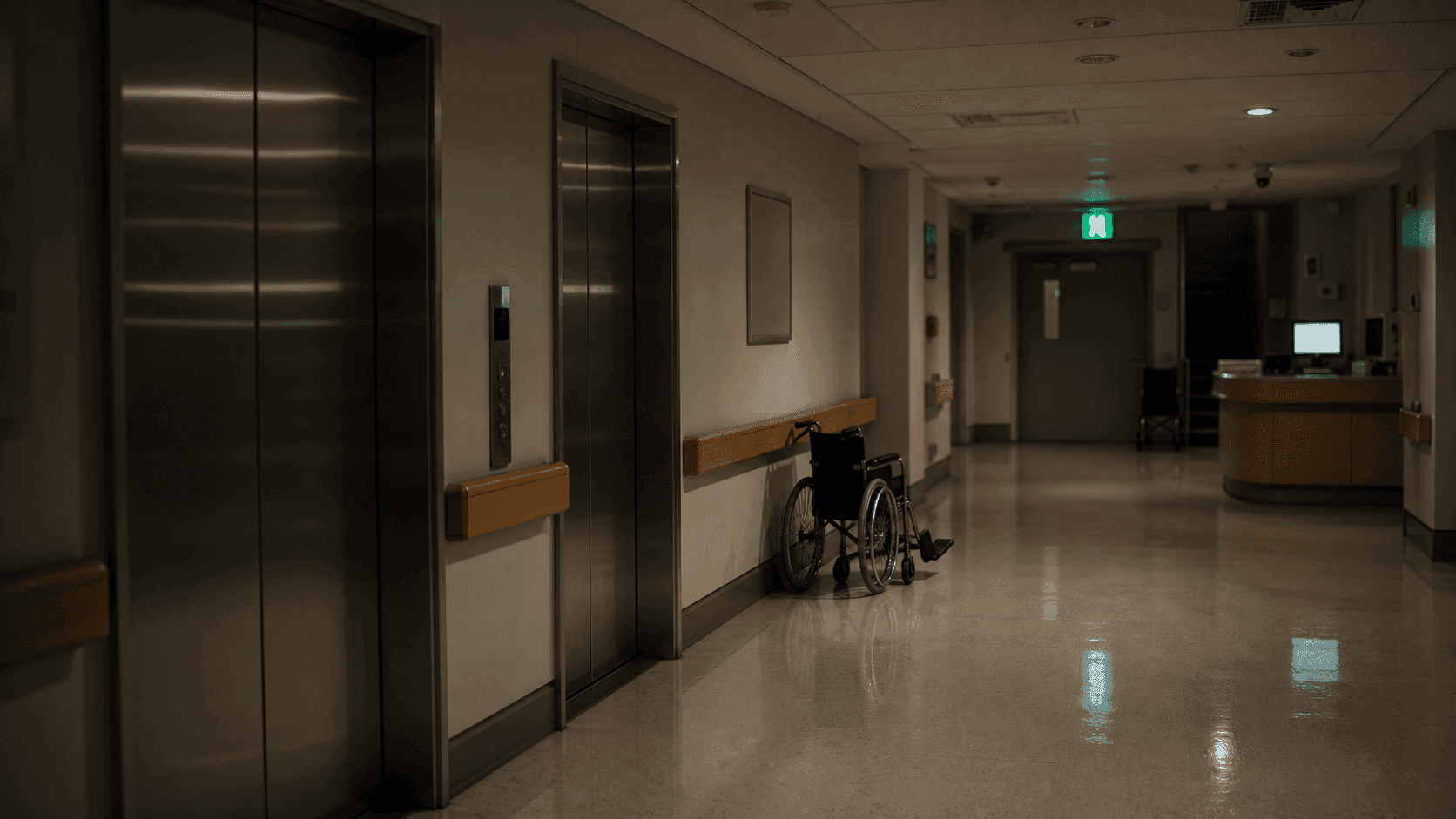
When the night shift finds one room empty, the next few minutes run much the same way on every ward. Check the bathroom, sweep the corridor, look in the lounge, and if the patient is still not there, head out toward the elevator lobby and the stairwell. By then the patient may already be on another floor or out of the building.
When someone suggests putting location tracking on the ward to reduce that, the conversation usually runs one way. How many units does it take to cover one ward. Somebody divides the floor area, multiplies by the number of floors, and the discussion stops at the number on the page.
But elopement does not happen evenly across a ward. It follows routes. Leaving a ward means passing an elevator lobby or a stairwell and going through the ward entrance. Whichever room a patient starts from, the last few dozen meters converge on the same places.
So the first design question is not which areas to cover. It is where a patient has no choice but to pass. Ask that one first and the equipment count falls, and more to the point the alert arrives earlier.
I. What happens when you cover a ward evenly
Blanket coverage design is intuitive. Put a grid on the plan and fill it with no blanks. Coordinates come out of any room, so the screen looks smooth.
There are two problems.
First, the quote swallows the discussion. When the number covers not one ward floor but a whole hospital at the same density, that number has a hard time getting through a budget meeting. Even when it does, the start date slips.
The second one is bigger. Even coverage can still mean a late alert. However finely the coordinates in rooms and corridors are drawn, if the finding that a patient has left the ward arrives after the boundary was crossed, the response has already turned from a check into a search. What nursing staff need is not a screen showing where a patient is right now. It is the few minutes in which they can still reach the patient.
Put the two together and the order sorts itself out. Budget and time go to the exit routes first.
II. Fit the exit routes first
The indoor reader ORBRO uses on wards is TwinTracker BLE. It receives the signal from the tag a patient wears and determines position. Where that reader goes decides the result.
1. Elevator lobby, stairwell entrance, ward entrance
These three points come first. A path out of the ward passes one of them without exception. With a reader here, the alert goes out while the patient is standing in front of the elevator button. A configuration that gets these three points right arrives sooner than one that covers the whole ward evenly.
2. Restricted areas inside the ward
The medication room and the treatment room are a different kind of place. A patient has no reason to be in them, and the moment of entry is itself the thing to check. With a reader in these areas, entry shows on the nurse station screen as it happens. Placing readers on restricted areas and exit routes first catches the points that actually matter while reducing the scale needed to cover a whole ward. Applying different rules per area is covered in detail in RTLS zone settings and how they are used.
3. What the patient wears on the wrist
Medical Wristband is close in form to the patient identification band a hospital already uses. It feels less like one more device being fitted, so refusal to wear it goes down. The material is specified to hold up through in-house disinfection procedures. A band coming loose at the wrist happens often with patients who have difficulty with memory or judgment, so removal detection is applied after checking the specification.
| Decision | Even coverage across the ward | Exit routes first |
|---|---|---|
| First placement | By grid on the plan | Elevator lobby, stairwell, ward entrance |
| Alert timing | After the boundary is crossed | While standing before the boundary |
| Initial unit count | Proportional to floor area | Proportional to the number of route points |
| Expansion | Whole ward from the start | Replicated after one ward is proven |
III. What it means to alert before the patient leaves
Knowing where someone is and knowing before they leave are different. The second one takes more than coordinates. It needs to hold, for each patient, how far the permitted range extends.
The on-premise server handles that comparison. It keeps comparing each patient's permitted area against the current position and sends a warning before the range is left. The permitted range changes with the stage of recovery for the same patient, so this value is held as something that changes during operation rather than a setting decided once at the start.
An alert being generated and an alert arriving are also different. Put it on the nurse station screen alone and nobody sees it during the hours the station is empty. ORBRO OS sends the same alert to the station screen and to the assigned staff member's handheld, and recipients are configured by shift and by assigned ward. Who acknowledged it and when stays in the history, so at handover that history is the record itself.
The scope of what gets recorded is also settled at the start. Procedure rooms and treatment rooms hold presence only, and areas where a detailed path is kept are separated from areas where it is not.
IV. Elopement is not the only incident
Elopement is not the only situation on a ward where a late response becomes a problem.
Band removal is one. From the moment the band comes off the wrist, that patient is no longer on the screen. Attempt and outcome become the same thing, so the moment of removal is treated with the same weight as elopement.
Falls and long periods without movement are another. Someone who has gone down in a bathroom or a corner of a room and has not moved for a while is not visible from outside the room. The movement at the moment of the fall and the state of staying still afterward are checked together and passed on as an alert. What matters here is that the place and the time come with the alert. Nursing staff can judge where to go straight away only when the alert says which place and what time.
Room calls sit inside the same system. Pressing a Safety Bell installed in a room or a treatment room shows the location it was pressed from on the station screen along with the alert. On a ward that already has call equipment in use, the first thing to look at is running the two side by side rather than removing what is there.
Medical equipment locations run on the same infrastructure. Fit a dedicated tag to a mobile imaging unit or a surgical microscope and the last recognized area and time come out under equipment name and asset number, with running hours and idle periods accumulating alongside. The equipment side is covered separately in hospital asset management and medical equipment tracking.
V. What to consider for a hospital rollout
There are two gates in a hospital that other sites do not have. Put those two first and attach the remaining practical items after them.
1. Radio effect on medical devices
A ward already carries a lot of wireless equipment, and patient monitoring and treatment devices sit next to it. How many readers go where is decided with that condition in view. Review installation positions and output before installation, and put a step in the schedule to go over the layout drawing together with the clinical engineering department. Leaving this review until after work starts is how a layout ends up changing wholesale.
2. Where the patient information stays
Ward location data sits next to patient information. The ORBRO configuration handles position determination and permitted-area comparison on an on-premise server, which keeps patient information inside the hospital. For a hospital that starts its review from the premise that data does not leave the building, this point is where the early discussion begins. The on-premise processing structure itself is covered as a structure in edge and on-premise monitoring.
The practical items that follow.
- Prove it on one ward first. Place readers on the exit routes and confirm through actual shift operation that alerts reach the station and the handhelds in time. Take the adjusted values from there into the next ward.
- Start with the items that get approved first. Bundle position, alert delivery and chart integration into one and the whole thing moves at the pace of the slowest item. Split them and the approved items start.
- Check the vendor's open scope before scheduling chart integration. Set the schedule after the integrable scope is confirmed.
- Set the rules for collecting and reusing bands. How collection at discharge, disinfection and reassignment attach to ward workflow is what gets the first month through.
Closing thoughts
Patient elopement detection is not a system for watching a ward. It is a layer that makes the few minutes in which nursing staff can reach a patient before they leave, and that keeps the moment a band comes off and the state of lying still after a fall from being missed on the same screen. What makes those minutes is not the number of units. It is where the receivers sit.
ORBRO builds everything from Medical Wristband and TwinTracker BLE to the ORBRO OS monitoring screen in one place. Placing readers on the exit routes, comparing against each patient's permitted area on an on-premise server, splitting alerts by shift and keeping an acknowledgement history all run through one system. Safety Bell calls and medical equipment tags sit on the same screen.
Reader placement and alert rules change with ward layout and shift structure. See the configuration and connected products on the patient elopement detection solution page, and send us a ward floor plan and a shift roster and we will work through placement points and rollout order with you.