OSHA Warehouse NEP Renewed for Five Years, What Inspectors Check
2026-09-01
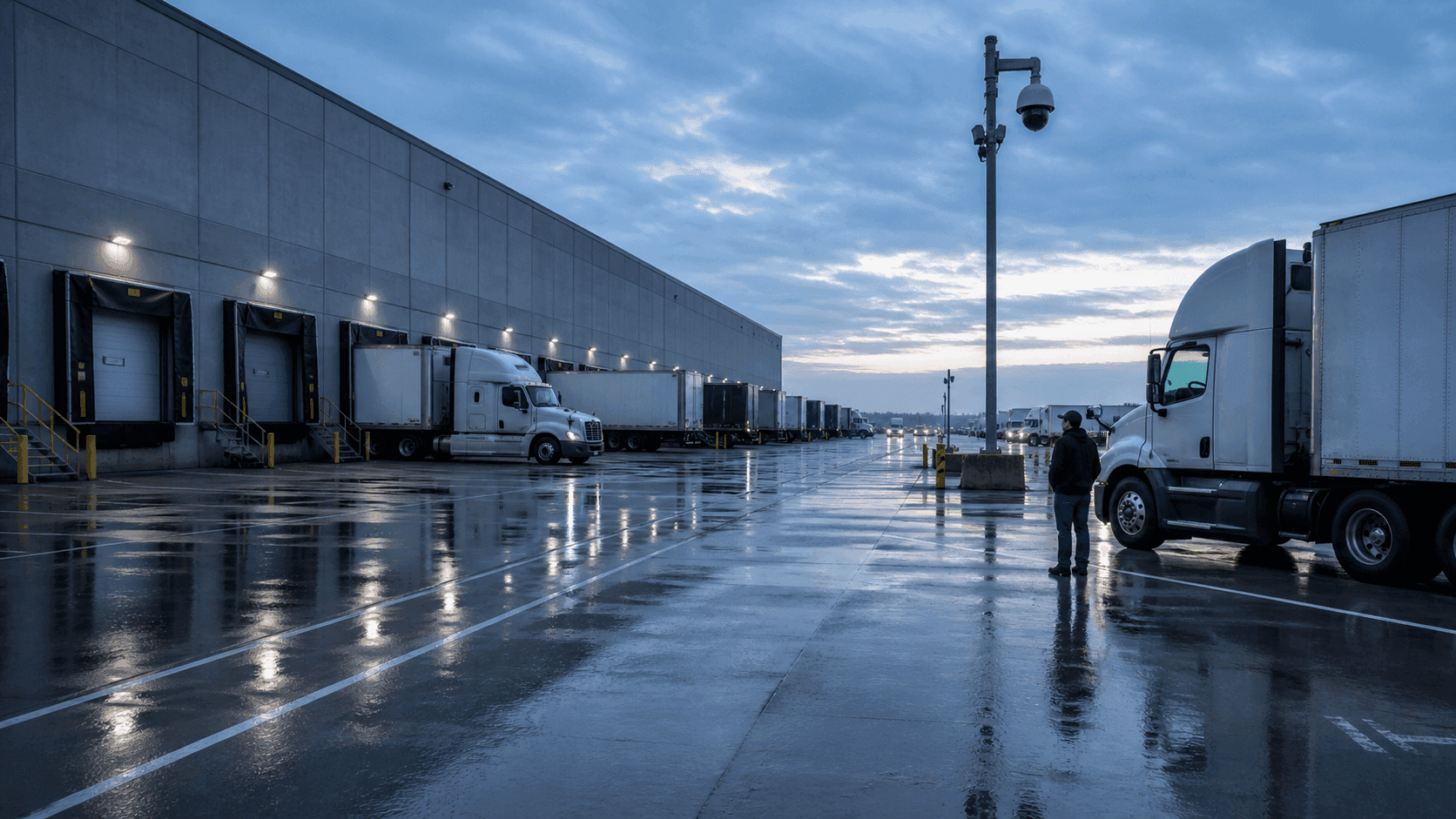
On July 31, 2026, OSHA's warehouse National Emphasis Program came back into force. The renewed directive, CPL-03-00-026, was signed on July 6 by Assistant Secretary David L. Keeling and supersedes the warehousing and distribution center NEP that took effect on July 13, 2023. One detail matters most: the new instruction expires five years from its effective date instead of three, putting programmed warehouse inspections on the calendar through roughly July 31, 2031. OSHA says inspections under it began the day it took effect.
Be precise about what that is. An emphasis program is an enforcement directive, not a standard; it creates no duty of its own, only a direction for where OSHA sends compliance officers and what they examine once inside. The duties come from the standards, from state law, and from the General Duty Clause.
The directive explains why OSHA keeps returning to this industry. Its background section reports that the first 18 months of the 2023 program produced more than 1,700 violations and removed approximately 37,410 workers from hazards, and that employment in warehousing and storage more than doubled in ten years, from 882,100 in December 2015 to 1,836,200 in December 2025. Injury rates in the covered codes sit above the national baseline: for 2020 through 2024 the directive puts general warehousing and storage at 5.2 total recordable and 4.4 DART, against 2.6 and 1.6 across private industry.
Read the directive and the statutes themselves for the scope of any obligation, and run their application to your sites past your own counsel. This is orientation, not legal advice.
I. What the renewal changed, and what it did not
OSHA's own list of significant changes is short. It dropped coverage of high-injury-rate retail establishments, Table 3 in the 2023 program, so home centers, hardware stores, supermarkets, and warehouse clubs now sit outside it. It removed the mandatory screening requirements for ergonomic and heat hazards, clarified Area Office discretion to expand an inspection based on fatalities, catastrophes, complaints, or referrals in covered codes, moved the term from three years to five, and changed the OIS code to WAREHOUSE.
The screening item is the one most likely to be misread. Dropping a screening instruction is not the same as dropping a hazard, and heat and ergonomics both remain in the directive's inspection focus. What changed is the instruction to the compliance officer, not the exposure on your floor.
The program covers seven NAICS codes: Postal Service processing and distribution centers (491110), couriers and express delivery (492110), local messengers and local delivery (492210), and general (493110), refrigerated (493120), farm product (493130), and other (493190) warehousing and storage. Every inspection under it is a comprehensive safety inspection.
State Plans run on their own clock. Within 60 days of the effective date, each must file a notice of intent saying whether it will adopt, or already has, a warehouse emphasis program at least as effective as the federal one. Adoption itself is strongly encouraged rather than required, and where a state adopts, it should happen within six months. Twenty-two State Plans cover private-sector workplaces, California, Washington, and Oregon among them, so the question reaches non-federal sites into 2027.
II. What an inspector actually looks at
The directive lists the focus hazards for a comprehensive warehouse inspection, prefaced with "including, but not limited to." Its background section names the patterns behind them: struck-by, caught-in-between, slips, trips, and falls, plus blocked aisles.
1. Powered industrial vehicle operations
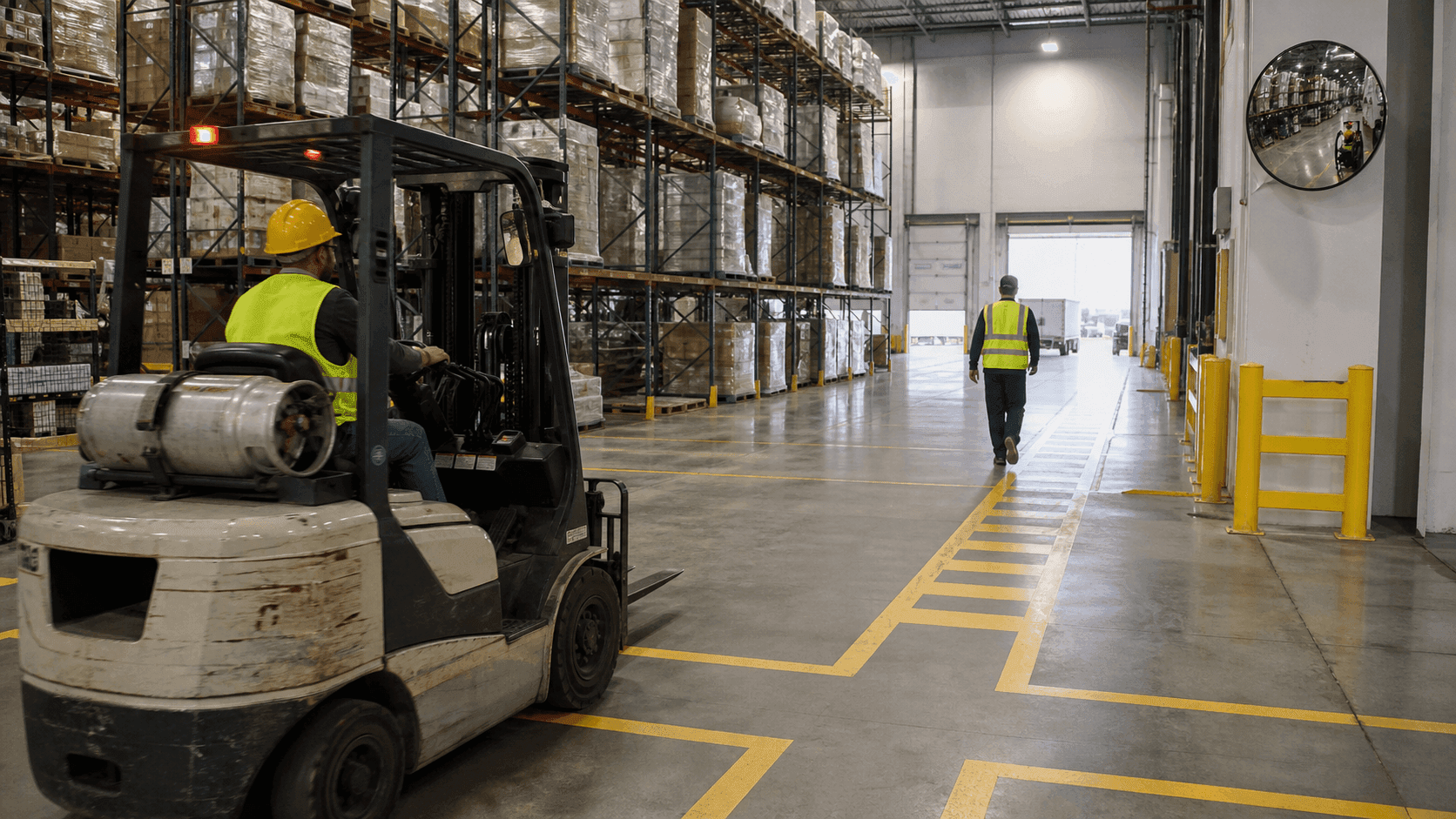
Forklifts, order pickers, and the rest of the fleet, plus the operator training and written certification 29 CFR 1910.178(l) requires.
2. Material handling and storage
Rack loading and damage, stacking stability, and how loads move between dock and pick face.
3. Walking-working surfaces
Floor condition, housekeeping, mezzanine edges, and the slip and trip exposures of every shift.
4. Means of egress
Exit routes unlocked, marked, lit, and unobstructed. Blocked aisles appear by name in the directive's hazard list, and in a building that flexes with volume, an aisle blocked at 9 p.m. is a different fact from one clear at audit time.
5. Fire protection
Sprinkler clearance, extinguisher access, and the storage practices underneath.
6. Heat
Heat stayed in the focus list after the mandatory screening instruction came out of it, and OSHA's separate heat NEP was revised effective April 10, 2026 with a term of up to five years. The federal heat standard itself is still only a proposal: the August 30, 2024 NPRM has not been finalized, and the Unified Agenda now projects a supplemental proposal in December 2026 and final action in October 2027. If it is finalized it will carry its own duties. Until then OSHA cites heat under the General Duty Clause, and where a state has written its own rule, that rule binds.
7. Ergonomics
Still in the focus list, and in New York it now carries a separate state duty, below.
One budgeting note: OSHA's maximum penalties did not rise this year. A May 21, 2026 OSHA memorandum explains why: BLS never produced October 2025 CPI-U data during the government shutdown, so the annual adjustment could not be made and the 2025 amounts stand at $16,550 for a serious violation and $165,514 for a willful or repeated one.
III. The state layer in California and New York
California's AB 701 (Labor Code sections 2100 through 2112), in force since January 1, 2022, covers warehouse distribution center employers with 100 or more employees at a single center or 1,000 or more statewide. Each employee gets a written description of any quota upon hire, and a quota may not prevent a meal or rest break, bathroom access, or compliance with health and safety laws; time spent complying counts as productive time. Current and former employees may request their most recent 90 days of work-speed data, answerable within 21 calendar days, and the Labor Commissioner may target worksites whose annual injury rate runs at least 1.5 times the warehousing industry average.
New York's Warehouse Worker Protection Act, effective February 19, 2023, mirrors that structure at the same thresholds. The newer piece matters more for EHS: Labor Law section 789, effective June 1, 2025 per NYSDOL, requires covered employers to run a program that identifies and minimizes the risk of work-related musculoskeletal injuries, with written worksite evaluations by a competent person updated annually, annual paid training, and anti-retaliation protection.
California warehouses carry an indoor heat duty on top of that, and unlike the federal proposal this one is in force today. Cal/OSHA's Title 8 section 3396, effective July 23, 2024, applies to indoor work areas at 82°F or above when employees are present. At 87°F, or 82°F with heat-restrictive clothing or high radiant heat, the employer must measure temperature and heat index, record whichever is greater, and log the date, time, and location of every measurement.
IV. Where forklifts and people meet
In OSHA's preliminary FY2025 top ten most-cited standards, powered industrial trucks ranked eighth with 1,826 citations, down from sixth place and 2,248 in FY2024. The casualty numbers are harder to date than you would think: BLS's fatal-injury series by source of injury ends at 2022, when 73 workers died in incidents whose primary source was a forklift, order picker, or powered platform truck, and the 2024 census, released February 19, 2026, carries no source-of-injury table at all. For nonfatal cases, the National Safety Council's compilation of BLS data counts 25,110 forklift-source cases involving days away, restricted duty, or transfer across 2023 and 2024.
Every approach to keeping people and trucks apart makes a trade.
| Approach | How it senses | Strengths | Limits |
|---|---|---|---|
| Camera with AI vision | Classifies people and vehicles in the frame | Nothing to wear, so visitors and temps are covered; leaves a clip | Needs sightlines and light; range is inferred, not measured |
| RFID or magnetic field | A truck-mounted reader wakes a worn tag inside a fixed radius | Simple to fit, tolerant of dust and racking, alerts at once | A fixed bubble, hard to shape around a corner; near, but not where |
| UWB ranging | Two-way time of flight between tag and anchors, or between two tags | Distance resolved to tens of centimeters, holds up among steel racking | Everyone who must be seen carries a tag; anchors need power and mounting |
Which one fits depends on who walks your floor. A site with a stable badged workforce can tag everyone. A site with daily contractors and drivers cannot, and that is where cameras stop being second best and become the only thing that sees the untagged person.
V. What location data does on a warehouse floor
Three jobs. The first is zone entry: draw a polygon around a charging area, a wrapper, or an aisle under active putaway, and the system raises an event when a badge enters at a time it should not. The second is proximity, where a UWB tag on a pedestrian and one on a truck measure closing distance directly and warn both before the corner. The same data on a heat map shows which intersections produce near misses week after week, which makes a better toolbox talk than a reminder to watch for traffic.
The third job belongs to the cameras. Blocked egress is a visual condition, not a position: a pallet in front of an exit route has no badge and never will. That is a detection job for AI Event Manager, which classifies the obstruction in the frame and raises it into the same queue.
None of this makes a facility compliant with anything, and no vendor should tell you otherwise. What it does is help you carry out the plan you already wrote and leave a record that you did. If your emergency action plan covers accounting for all employees after evacuation, which is what 29 CFR 1910.38(c)(4) requires it to address, a live view of who has not reached the assembly area supports the head count procedure your plan describes. OSHA prescribes no method there; roll call and area sweeps appear in its own guidance. If your heat plan calls for measurements by location, zone-level data gives that record something to point at.
The reason to put these on one screen is that inspectors do not audit by subsystem. ORBRO OS carries the floor plan, the zones, the live positions from ORBRO's UWB RTLS, and the camera events in one view, so "what was happening in aisle 12 at 2:40 p.m." has one answer instead of three.
VI. What to evaluate before you commit
1. Precision against the decision
Room-level accuracy is enough for mustering. Warning a pedestrian before a blind corner is not. Decide the decision first, then the technology.
2. The alert path
An event that lands only in a dashboard nobody watches is not a control. Ask where the alert goes, who acknowledges it, and what the record looks like.
3. What happens to the data
Worker location data is sensitive, and in California and New York it sits beside statutes on work-speed data and retaliation. Set retention, access, and purpose before the pilot, in writing.
4. A pilot with a number attached
One aisle, one shift, one measurable output such as near-miss counts at one intersection. If nothing moves in eight weeks, that is useful too.
VII. Closing thoughts
The direction is consistent: the warehouse NEP runs five years instead of three, California and New York have written injury rates and work-speed data into statute, and the federal heat proposal, still unfinished, was drafted around observing people rather than posting a sign. All three rest on knowing what happens on the floor, and being able to show it afterward.
That is the argument for treating location, vision, and the floor plan as one system rather than three purchases, and ORBRO builds it that way: UWB RTLS for whoever carries a tag, AI Event Manager for what only a camera can see, ORBRO OS as the view that ties both to the building. If you are scoping a warehouse, we are glad to work through where anchors and cameras would go.