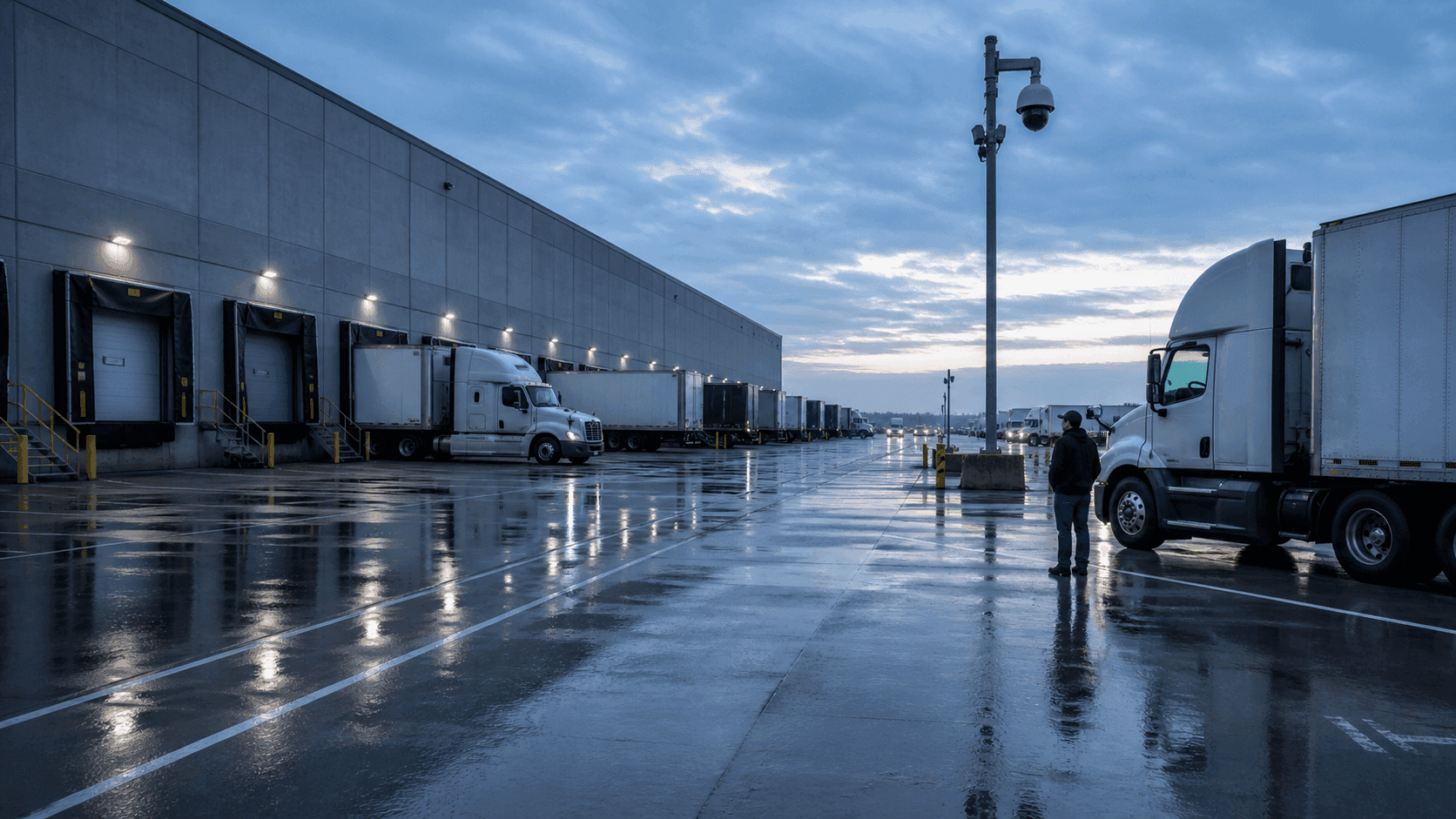
A truck clears the gate at 5:52 in the morning for an eight o'clock appointment. It sits in the third staging lane. At 9:40 it backs into door 27. At 12:05 the door is released. At 12:20 it is off the property.
Six weeks later there is a detention invoice and a phone call. The carrier says the truck was held for six and a half hours. The warehouse says the truck was at a door for two hours and twenty five minutes, which is inside the window, and that arriving two hours early was the carrier's choice. Both of them are reading their own records. Neither record is a lie.
The argument does not resolve because the disagreement is not about the facts. It is about which moment counts as zero, and nothing in the country says which one it is. The federal government has said as much in print.
That is an odd place for an industry to be, and it is where a yard operator has to work anyway. The practical response is not to wait for a definition. It is to make sure your yard produces the same five timestamps every day, so that whatever definition ends up in a contract can be computed from them.
I. Three layers, and only one of them is a rule
Detention gets discussed as though something is about to change. It helps to separate what exists into three layers, because two of them are activity and only one of them is in force.
There is no federal obligation today. No federal rule caps how long a truck may be held at a warehouse dock, and none requires a facility to pay for that time. Whatever a carrier collects, it collects because a contract says so. That is the starting point, and it is worth stating plainly before the rest of this section, because the rest of this section is easy to mistake for regulation.
There is federal research under way. In 2023 the Federal Motor Carrier Safety Administration published a notice for a study called "Impact of Driver Detention Time on Safety and Operations," Docket No. FMCSA-2023-0172, at 88 Federal Register 58060 on August 24, 2023. The background section defines the term the way the industry uses it. Detention time, the notice says, refers to the extra time commercial motor vehicle operators wait at shipping and receiving facilities due to delays associated with the loading and unloading of cargo, and drivers are often not paid for that extra time.
Then comes the sentence that explains why the phone call six weeks later never ends cleanly. "Although there is currently no standard definition of detention time," the notice says, the industry, the U.S. Government and academic research have typically used dwell time, meaning the total amount of time spent at a facility, exceeding two hours, to define when detention occurs.
The study also sets out to "assess the utility of existing intelligent transportation systems (ITS) solutions to measure detention time," and states that "Approximately 80 carriers and 2,500 CMV drivers will provide data in the study." A collection notice is not a finding, and we are pointing at the notice rather than at any conclusion drawn from it.
There is a legislative conversation. The Congressional Research Service report R48759, "Surface Transportation Reauthorization: Commercial Trucking Issues," dated December 10, 2025, lists detention among the matters Congress may take up. It opens by noting that "With surface transportation funding authorizations set to expire on September 30, 2026, Congress" may debate surface transportation bills covering FMCSA matters.
The report describes the same convention in the same terms. "An unofficial industry standard is that detention time refers to any amount of time beyond two hours that a truck dwells at a warehouse facility." It also notes something operationally sharp that rarely makes it into a rate discussion: "detention time counts toward truck drivers' maximum 14 hours per day of duty time but does not count toward their 11 hours per day of maximum driving time." And it puts the incentive problem in one line. "Warehouse operators may treat truck driver time as a free good," expecting the truck to be available shortly after they are ready to load or unload.
The report also records that in September 2025 FMCSA proposed a three year pilot program under which a small number of drivers could extend the fourteen hour duty window by up to three hours, as a way of studying the effects of detention. A proposal is a proposal. Nothing in this layer is an obligation, and a reauthorization debate is a debate.
What survives all three layers is the two hour number. It is a convention rather than a rule, but it is the number that ends up in contracts, and a convention is only usable if both sides agree where zero is.
II. Zero is the whole argument
Ask five people in a yard when the detention clock starts and you will get four answers.
The appointment time is one candidate. Arrival at the back of the gate line is another. Check in at the guard shack is a third, and it differs from arrival by however long the line was. The moment the trailer is spotted at a door is a fourth, and it is the one warehouses tend to prefer. The moment the driver reports ready to be worked is a fifth. Some contracts pick one. Some pick one for inbound and another for outbound. Plenty of them do not say at all, which means the number gets settled by whoever has the more confident spreadsheet.
The choice is not cosmetic, because of what the CRS report points out about the hours of service math. Waiting consumes the fourteen hour duty window and returns nothing against the eleven hour driving limit. So the same two hours costs a carrier very differently depending on where in the day it lands. Two hours at six in the morning is annoying. Two hours at two in the afternoon can end the day. A facility that runs behind in the afternoon is spending something real that never appears on its own operating statement.
The free good problem follows from that. If a facility assumes a truck will simply be there when it is ready, carriers respond the way anyone would. They stage. Drivers arrive early and wait nearby so they can be at the door within minutes of a call. Part of the queue moves off the property and becomes invisible to the facility that created it, which is also why a yard's own view of its performance tends to look better than the carriers' view of the same yard.
None of this is fixable by picking a better number. It is fixable by recording the same moments every day, in one place, so that any number can be computed later.
III. The five timestamps
Five moments describe everything anyone will ask about a visit.
| Timestamp | What it answers | What usually records it today |
|---|---|---|
| Gate in | When the unit crossed onto the property | Guard shack log, by hand |
| Yard staging | When it entered a staging lane and how long it stayed | Nothing, in most yards |
| Dock in | When the trailer was spotted at a door, and which door | Dock supervisor, on a whiteboard |
| Dock out | When the door was released | Dock supervisor, or the WMS close time |
| Gate out | When the unit left the property | Guard shack log, by hand |
From those five you get total dwell, time from gate to door, time at the door, and time from release to departure. Every version of the two hour convention is one of those four intervals. Pick the definition later. Record the moments now.
The reason yards do not have them is not negligence. It is that four different systems each produce a piece, and none of them was built to produce the set.
The guard shack log covers gate in and gate out and nothing between. It is written by a person who is also checking paperwork and raising a gate, so times get rounded and the entry happens when someone reaches the window rather than when the unit arrived. There is no door number in it.
The carrier's electronic logging device is the record people reach for in an argument, and it is the wrong tool for a facility to reach for. Its geofence boundary is drawn by the carrier and does not match your gate line. It is built to satisfy hours of service recordkeeping, not to describe your yard. And it belongs to the carrier. ORBRO does not read ELD data, and a yard system has no business reaching into it.
The transportation management system holds appointments. An appointment is a plan. It tells you what was supposed to happen at eight o'clock, which is useful right up until the moment it stops matching the pavement.
The dock supervisor has the most accurate picture in the building. Which trailer is in which door, what is holding it up, what is next. It lives on a whiteboard and a headset, and it is erased at shift change.
Four clocks, no shared one. That is the actual condition, and it is why both sides show up to the call with different numbers and equal confidence.
One thing worth being explicit about, because it shapes how a yard should build this. The unit of record here is a vehicle, a trailer and a dock door. Not a person. Nothing in the five timestamps requires knowing who was driving, and a yard system should be designed so that the question does not come up.
IV. Producing the five automatically
Most yards already have the sensors. They are called cameras, and they are pointed at roughly the right things.
Tagless video analysis at three places. A camera on the gate mast sees units crossing the gate line and which direction they were going. Yard poles see which staging lanes are occupied and for how long. Cameras along the dock wall see whether a door is occupied or clear. Those three views produce four of the five timestamps without anyone touching a keyboard, and they do it by detecting vehicles and trailers rather than by reading anything off a person. ORBRO runs that analysis on ORBRO Edge Pro inside the facility, so video is processed on the property and only the resulting events travel. The general approach is described in tagless asset tracking with AI vision, and the reasons to keep processing on site are in edge and on premise monitoring.
A yard drawing that the events land on. In ORBRO OS the site plan carries the gate line, the staging lanes by number and the dock doors by number as drawn areas. An event is not "camera 6 at 09:41." It is "door 27 occupied at 09:41," which is the form the question will be asked in later. Areas carry their own rules, so a trailer that sits in staging past a threshold, or a door occupied past a threshold, raises an alert to the yard office while there is still something to do about it. How areas and rules are set up is covered in zone based monitoring.
Tags where identity matters more than presence. Video is good at answering whether a door is busy. When a yard needs to know which specific unit is where, ORBRO's UWB and BLE tags go on yard tractors, chassis and reusable equipment, and the position shows up on the same site plan as the camera events. Our container tracking and dock assignment and warehouse asset tracking pages cover that side. Deciding how much identity you actually need is a cost decision, and it is discussed further below.
One record, on your own hardware. The five timestamps end up in one place, on infrastructure inside the facility, on a closed network where that is required. Freight volumes, appointment adherence and customer mix are commercially sensitive, and a yard record that never leaves the property is easier to defend internally than one that does.
The part that gets underrated is what this does before any dispute. Once door turnover is visible by door and by hour, the pattern shows up fast. A block of appointments that never starts on time. Two doors that run at half the speed of the others because of what is stored behind them. A staging lane that is full every morning at six because a customer's carriers all stage early for the same reason. Those are operating problems with operating fixes, and they were already costing money before anyone sent an invoice.
When the invoice does come, both parties are looking at the same set of intervals from the same record instead of two spreadsheets built for different purposes. That is a better starting position for a conversation, which is all any record can be.
V. Points to check before building this
Write down the definition first, and use the same one in both places. Pick which of the five timestamps is zero, put it in the contract language, and configure the system to compute from that one. A yard that measures one thing and bills for another has built an argument generator.
Camera siting is most of the project. The gate needs a view that separates inbound from outbound cleanly. Dock doors need a view that shows occupancy across the whole row rather than a beautiful view of two of them. Staging lanes need the lane boundaries to be visible from the mounting point. This is a site survey question and it deserves a site visit, not a satellite photo.
Decide how much identity you need before you price it. Knowing that door 27 was occupied for four hours and eleven minutes is enough for most operating decisions and most billing conversations. Knowing that it was one specific trailer costs more. Ask which questions you actually have to answer.
Plan for the hours the yard actually runs. Dock work happens at four in the morning and in the rain. Lighting, lens selection and mounting height belong in the design phase alongside camera placement rather than after go live.
Decide who receives what. The yard supervisor needs a live view. The dock office needs the alerts. The customer service desk that fields the call six weeks later needs history it can search by date and door. Those are three different screens off one record, and routing them by role is a configuration decision worth making early.
Reconcile against something for the first month. Run the automatic record next to the guard shack log for a few weeks and look at where they diverge. The divergences are informative, and the exercise is how the yard comes to trust the number it is about to start quoting to customers.
In closing
5:52 at the gate. Door 27 at 9:40. Off the property at 12:20. Whether that visit was a detention event depends entirely on a definition that no federal rule supplies, and both parties to that call were reading records that were never designed to be compared.
The federal picture is research and debate. A study docket from 2023, a research report from the end of 2025, and a funding authorization that expires on September 30, 2026. None of it is an obligation on a warehouse today, and it would be a mistake to build a yard program on the assumption that it will become one.
The case for keeping five timestamps does not rest on any of that. A yard that knows its own gate to door interval by hour and its own door turnover by door is running a better operation than one that finds out six weeks later, and it did not need a rule to make that true.
ORBRO builds the cameras, the edge servers, the tags and the control platform, which is why the gate line, the staging lanes and the dock doors can be one picture in ORBRO OS rather than three products stitched together. If you are working out what your yard would need to produce those five timestamps, send us your site plan and we will go through it with you.