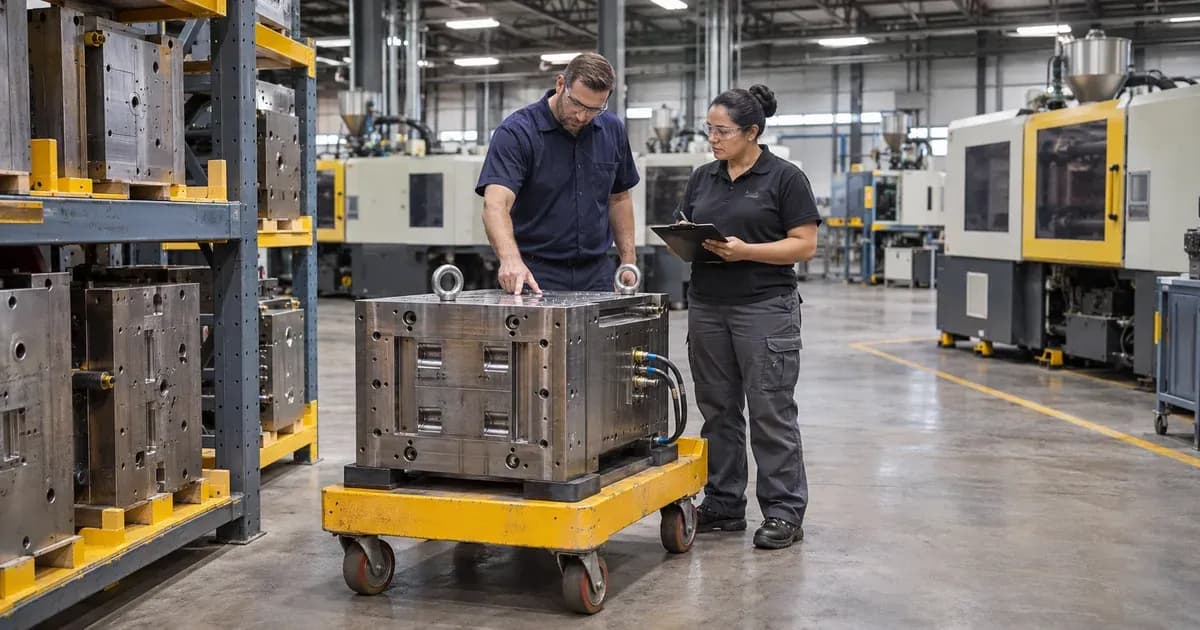
The next production run is scheduled, but the molding machine is waiting. The setup technician walks to the storage rack, finds an empty position and calls maintenance. The mold has already moved through the toolroom to a staging area beside the machine. By the time everyone agrees where it is, the downtime log simply says “changeover delay.”
Consider a hypothetical US plastics plant where tooling, maintenance and production share responsibility for changeovers. Location tracking can help explain the movement of a mold. It needs production and maintenance records alongside it to explain whether that mold was ready.
I. Divide the changeover into observable events
A single downtime figure hides several different activities. Agree on events such as the request to retrieve the mold, its arrival at staging, the start of installation and approval of the first acceptable parts. Define who records each event and which clock supplies the timestamp.
| Evidence | What it establishes | What it does not establish |
|---|---|---|
| Assigned storage position | Where the mold should be | Where it moved after the last update |
| Tag location history | Observed movement and presence | Maintenance release or correct job assignment |
| Setup and quality records | Recorded preparation and approval | Continuous physical location |
A mold that arrives early but waits for maintenance approval has a different problem from a released mold that nobody can find. Increasing transport capacity would not address both. Keep unclassified intervals visible instead of assigning every unexplained minute to the retrieval team.
II. Track the right physical unit
A mold set, an individual half and a transport cart are different assets. Decide which one the tag represents. If the cart carries several molds during a shift, record when its association with each mold begins and ends. A returning empty cart cannot prove that the mold returned with it.
Test the attachment in realistic storage and transport conditions. Metal structures, stacked tooling and the chosen mounting position can affect observation. Check device ratings and the mold maker’s handling requirements before selecting a mounting point. A tag approved for ordinary storage should not be assumed suitable for a hot process or a position that interferes with clamping or lifting.
III. Review movement in ORBRO alongside the job timeline
ORBRO OS Zone Manager lets a team define storage, maintenance and machine staging areas on the site map. Keep through routes separate from the places where tooling actually waits. Test whether the location performance supports the proposed boundaries; drawing smaller zones alone does not establish finer measurement.
Record supports storage and replay of UWB and AoA location data. Review the relevant interval, then compare observed movement with retrieval requests and maintenance release records. This gives the team a practical way to distinguish a search problem from a mold waiting to move. Joining those records automatically requires a defined mold identifier, common time basis and an agreed integration.
IV. Give arrival and approval different meanings
A mold entering staging still needs the checks required by the setup procedure. Correct job assignment, tooling condition and installation readiness remain separate questions. Condition-based Zone Effect indications may help draw attention to an area, but an “arrived” indication should never be labeled “approved for installation” without the supporting workflow.
Schedule changes also matter. Tooling staged for a canceled run might remain beside the machine and appear ready for the next job. Retain the production order association and record the change rather than inferring the job from proximity. Location does not certify tooling condition or product quality.
V. Compare changeovers that have similar work
Start with one machine group and representative molds. Collect the map, tooling list, attachment method, transfer route and approval sequence. During a trial, compare physical arrival with observed arrival and document missed observations, incorrect zone assignments and manual corrections.
Assess search time, waiting before movement and preparation after arrival separately. Compare jobs with similar mold size, maintenance scope and setup requirements. Otherwise an apparently faster changeover may simply involve easier work. A missing location interval is an evidence gap, not proof that a person delayed the task.
Closing thoughts
Finding a mold and finishing its preparation are linked activities with different evidence. Combining observed movement with setup and maintenance events helps a team identify where the next practical improvement belongs.
For an ORBRO discussion, bring the tooling list, layout, representative changeover sequence and mold-to-cart association rules. Those details support a useful review of attachment conditions, observable routes and the records that need integration.