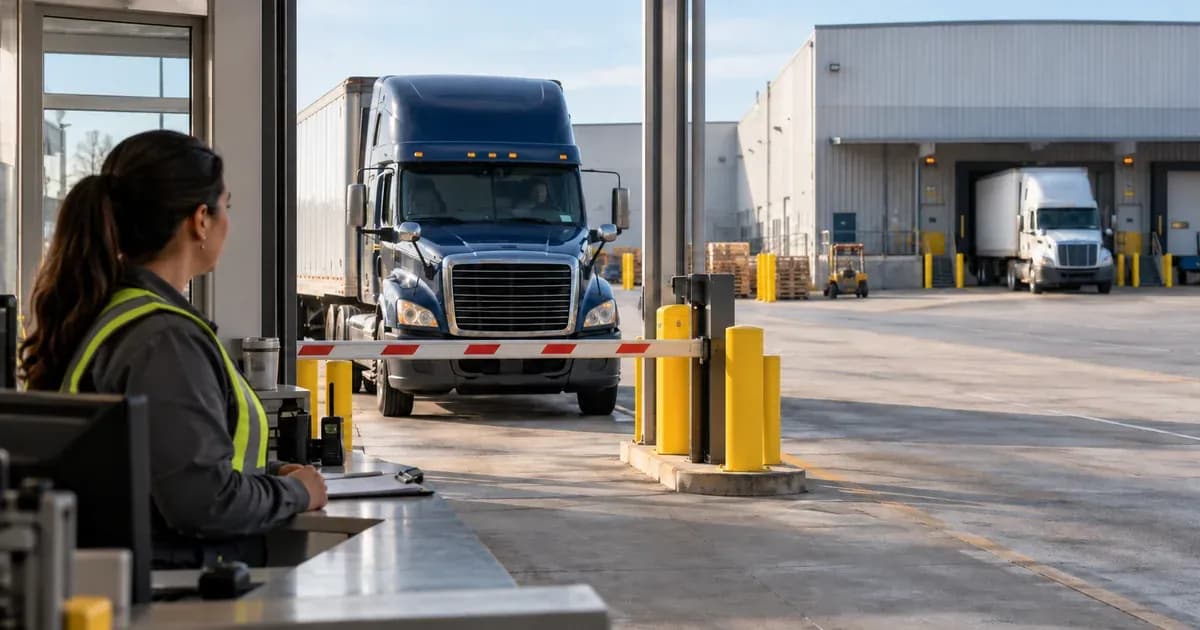
Dispatch sees a truck on the morning entry list and assumes loading has taken hours. The dock team reports that it waited in the yard and only recently reached the door. Treating the entire gate-to-gate interval as loading time hides where the delay occurred.
At a hypothetical US distribution center, the tractor may also change while its trailer remains on site. This makes the relationship among a recognized plate, a visit and a load especially important. The objective is to give each timestamp a clear operational meaning.
I. Define the visit separately from the vehicle
A gate recognition establishes that a plate was read at a particular camera and time. Dock assignment, arrival, work start and completion require their own evidence. A vehicle visiting twice in one day needs two visit records, not a single continuing job.
| Stage | Example evidence | What remains unconfirmed |
|---|---|---|
| Gate observation | Plate, camera and recognition time | Dock arrival and work start |
| Dock arrival | Physical confirmation or validated zone event | Order and loading activity |
| Loading start and finish | Responsible team's work record | Final shipment approval |
Total site dwell and loading duration are both useful, but they need different boundaries. Decide which interval supports the operating question before building a performance report.
II. Keep recognition context with the plate
ORBRO AI LPR records recognized plates with dates, times, cameras and locations. Searches by plate, period or camera help dispatch retrieve the relevant observations. Preserve the supporting image and any manual correction needed for the actual vehicle.
Trial the local plate formats, approach angles and lighting used by the site. A plate obscured by equipment needs an exception route. Do not quietly attach a questionable recognition to an existing visit. Supported formats and deployment conditions need confirming for the selected configuration.
III. Join the dock record through an agreed identifier
Relate the visit to the vehicle, trailer where relevant, assigned door, work instruction and responsible team. Decide which source confirms each field. A plate observation does not identify every order in a mixed load or automatically post inventory.
In a tractor-swap example, record which identifier belongs to the power unit and which follows the trailer. Preserve effective association times. Otherwise the departure of one tractor could incorrectly close work still involving a parked trailer.
Check time references across the gate, yard and dock systems. Distinguish observation from receipt and late manual entry. Without that distinction, a delayed message can reverse event order or create an impossible negative waiting interval.
IV. Test re-entry, repeated reads and door changes
A truck backing within the entrance can produce another observation without beginning a new visit. Test this separately from a genuine departure and return. Establish merging rules from confirmed movement, not merely from similar plate values.
Include a door reassignment, a missed exit and a manually confirmed arrival. An open visit with missing evidence should reach an operator's review list. Do not describe it as continuing loading indefinitely, or close it simply because the vehicle disappears from the latest display.
V. Give each waiting interval a next action
Separate arrival-to-assignment, dock-arrival-to-work-start and work-end-to-departure. Attach the relevant owner and evidence to each interval. An unavailable crew needs a different response from a truck that has not reached the assigned door.
Prepare approach and dock layouts, vehicle types, visit rules and work-record samples. Test day and night conditions and include unreadable plates in the assessed population. Normal examples alone do not establish overall performance.
Closing thoughts
Passing the gate is not the start of loading. A distinct visit identifier and separate evidence for arrival, dock work and departure make the waiting stages understandable. Re-entry, trailer changes and missing records must remain part of that same account.
Bring camera positions, vehicle approaches, plate formats and dock records to ORBRO. Those details help define the vehicle-recognition scope and the fields that need connecting to dispatch and work systems.