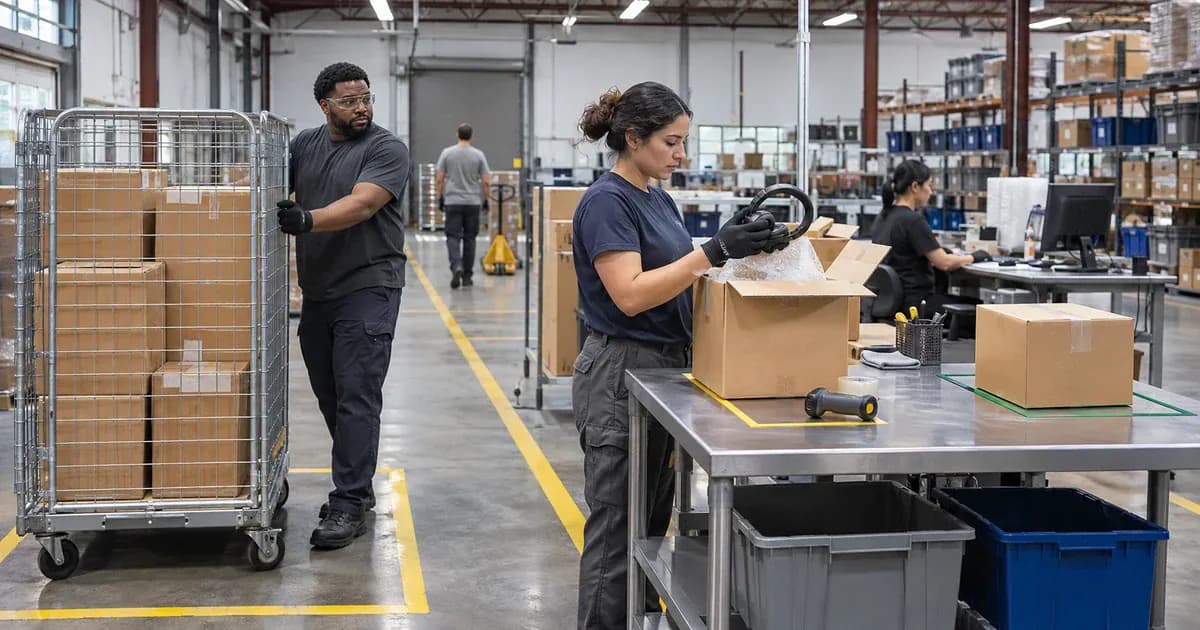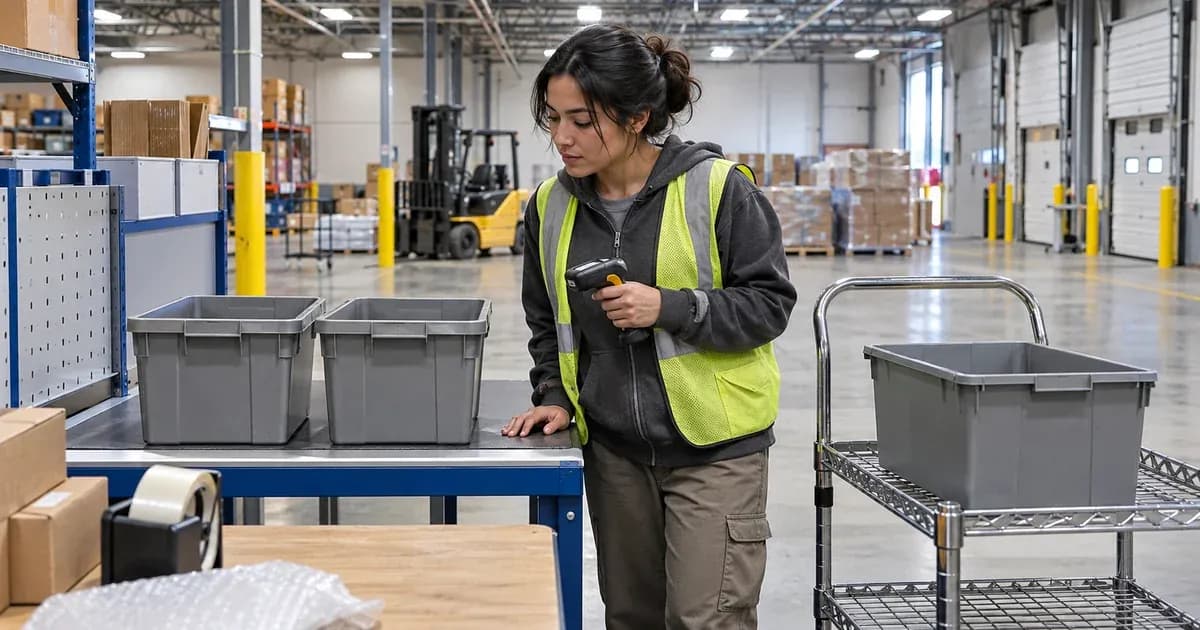
The order is nearly ready for packing. Two totes are at the consolidation bench, but the third is missing and the carrier cutoff is approaching. A supervisor can see that picking was recorded, yet nobody knows whether the last tote is beside a different bench or still waiting for collection.
An October US holiday retail forecast provides a timely reason to review this exception before peak demand. This hypothetical distribution-center example connects tote location with the order evidence needed to finish consolidation. A forecast is not evidence of an individual warehouse’s workload.
I. Define what “missing” means
A missing tote may be physically absent, observed in another area or present without a current order association. Those conditions need different actions. Keep the order’s expected tote list in the fulfillment system and identify which physical unit each tracking tag represents.
| Evidence | Question answered | Remaining check |
|---|---|---|
| Order record | Which totes are expected? | Current tote association |
| Location observation | Where was a tote observed? | Observation time and physical presence |
| Consolidation confirmation | Were the required goods joined? | Quantity and packing authorization |
A location in the consolidation area does not establish that the contents belong to this order. A completed pick transaction does not establish present location. Check both without turning either into an automatic packing approval.
II. Search the physical exception in ORBRO
ORBRO OS Zone Manager can define collection, consolidation and exception areas on the warehouse map. Use actual parking positions rather than including the entire through aisle. Test whether observations distinguish adjacent benches before making bench-level promises.
For UWB and AoA deployments, Record supports location replay. Review the period around the expected transfer and compare it with the picking event. The point is to narrow the physical search, not to infer what was packed. Automatic matching with the fulfillment system requires separately agreed identifiers, interfaces and exception rules.
III. Give the search an owner and an endpoint
Assign one person to the missing-tote exception and retain the order reference. Otherwise several teams may move different totes while believing they are resolving the same problem. End the search with physical identification and a recorded handoff, not merely a point appearing on a map.
If the tote has no recent observation, mark its location unconfirmed. Use the data freshness checks before directing a worker to an old coordinate. Detachment, reassignment and an emptied tote all need investigation.
IV. Handle splits and last-minute changes
A picked quantity may be divided into two totes, or one tote may serve several related orders. Update those relationships when contents change. Moving an empty container away from the bench cannot close the outstanding goods requirement.
Order cancellation and priority changes also need recorded decisions. Keep a missing tote out of an automatic “complete” rule while its association remains unresolved. If an authorized substitution is made, retain the changed contents and approval in the order workflow.
V. Trial the final twenty meters
Test a tote parked at the neighboring bench, a partial split, a detached tag, a stale observation and a tote found after the order was canceled. Compare observed location with the actual search and the verified end of consolidation.
Measure time to physical recovery and repeat searches alongside incomplete orders. Compare similar order size and staffing conditions. Faster map searches alone do not establish fewer missed carrier handoffs or a guaranteed improvement in throughput.
Closing thoughts
Peak-season order consolidation needs both the expected tote list and a trustworthy way to find the physical exception. Location can narrow the search; identification and an approved handoff finish it.
For an ORBRO review, bring the consolidation layout, tote-to-order rules and a few unresolved examples. These support a practical scope for observed areas, retrieval checks and fulfillment-system integration.