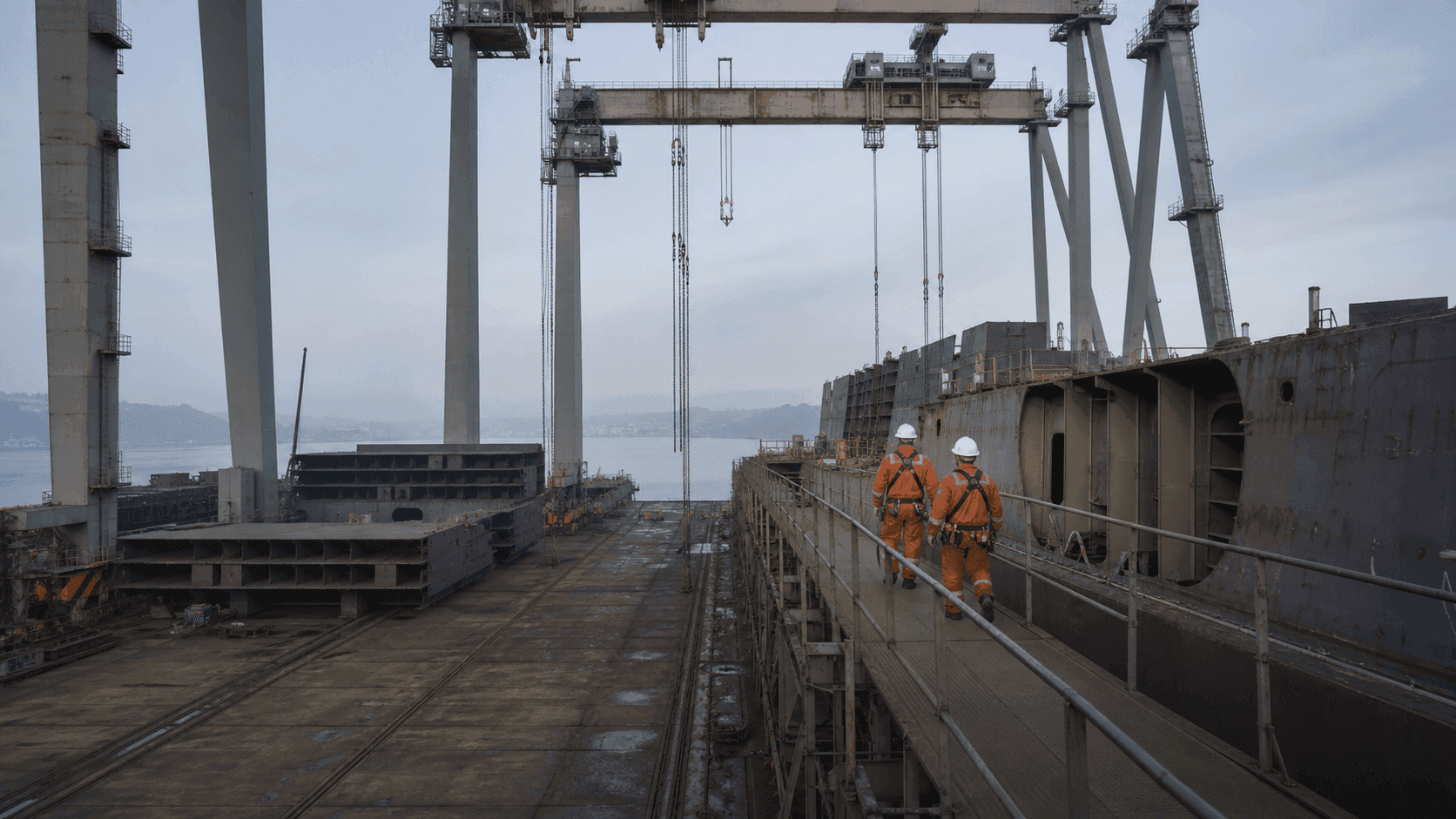
At eight in the morning, a block that was not there yesterday stands beside the dock. A steel structure several times the height of a person has settled into place overnight, and the crews scatter into its shadow. Ask over the radio and an answer usually comes back. It just takes a few minutes, and those are the minutes you miss most when something is urgent.
Finding a person in a shipyard is hard for more reasons than size. The dock, the quay, the fabrication shop and the storage yard sit on one site, and the line between indoors and outdoors moves a little every day. A passage that was open yesterday is closed by a block today. Satellite signals stop inside a hull, and a design drawn on indoor assumptions meets a different set of conditions in front of columns spaced ten-odd meters apart with steel filling the gaps between them.
The makeup of the workforce sits on top of that. Direct employees and subcontractor crews work on the same block. When something goes wrong, the manager has one question to answer. Who was in that area at that moment. It has to be one answer no matter whose payroll people are on, and when entry records and work assignments are split by company, reconciling them alone takes half a day.
The first thing to settle in shipyard location monitoring is not an accuracy number. On a site where signals get blocked several times a day, the first question is whether the design keeps position continuous when they do.
I. A shipyard is neither indoor nor outdoor
1. One site holds spaces with different characters
The fabrication shop has a roof and columns and counts as indoor. The storage yard is open to the sky. The dock and the quay sit between them, and the inside of a hull is closed off by steel plate on every side. One worker passes through all four within an hour. A method that leans on satellite signals stops inside the hull, and an indoor-only method loses its reference points out in the yard. What the site needs is one system that stays continuous across those boundaries.
2. The radio environment changes with the schedule
A distribution warehouse keeps its racks where they are, so an as-built drawing still holds years later. A shipyard works differently. As blocks come and go, the shielding condition at the same spot changes week to week. An area that read well last month sits behind two blocks this month. A layout measured once and frozen is a photograph of one moment.
3. What blocks the signal is large and moves often
Columns stand ten-odd meters apart, and blocks weighing hundreds of tons move between them with the cranes. One pace behind a column is enough to remove the signal in one direction. This is not an equipment problem. It is a condition of the space itself. The condition cannot be removed, so the answer is to design with it assumed.
| Condition | Typical indoor site | Shipyard |
|---|---|---|
| Character of the space | Indoor, single type | Indoor, outdoor and hull interior mixed |
| Obstructions | Racks and equipment, fixed in place | Columns, blocks and cranes, always moving |
| Radio environment | Mostly fixed after handover | Changes week to week with the schedule |
| Workforce | Mostly one employer | Direct and subcontractor crews together at all times |
| Satellite signal | Not applicable | Received in the yard, lost inside the hull |
II. Placing anchors on the assumption of blockage
1. Split the height above and below the column
If TwinTracker UWB anchors all sit at one point on a column, the moment a block moves in between that column and a work area, the view in that direction disappears at once. Splitting them high and low on the same column changes that. When the lower one is behind stacked material, the upper one still sees the tag over the top of the block. When a crane passes overhead, the lower one takes over. It is a layout where blockage at one point does not spread into the loss of a whole direction.
2. Measure again with the hull actually in place
Numbers taken in an empty shop are not numbers from operating conditions. So the survey runs twice. The first pass sets a baseline with the space empty, and once blocks and hull sections are actually in place, the same points are measured again to fix the layout. An area that looked comfortable in the first pass sometimes becomes a reinforcement item in the second. Finding that difference during installation is far cheaper than finding it after operations start. Why catalogue accuracy and field numbers diverge is covered in why positioning accuracy changes in the field.
3. Plan for spare anchors, not the minimum count
The quality of a position calculation depends on how many anchors see a tag at the same time and how different their directions are from one another. Meeting the minimum exactly, or lining anchors up in a row, means the calculation wobbles the moment one of them is blocked. Spread the angles and leave overlap, and position carries on through the remaining combinations when a few drop out. How geometry changes the result is explained in anchor placement and angular diversity.
III. Keeping subcontractor crews on the same screen
1. One screen, whatever the employer
The workforce is divided by company, but an incident does not care whose badge someone carries. The ORBRO OS screen tells subcontractor crews apart by color and label while keeping them on the same map. A manager sees how many people are in an area right now and how many of those are subcontractor crew in one look. Showing them apart is not the same as keeping them apart.
2. One badge links the office building and the dock
Handing a worker two cards makes operations wobble. With the badge-type UWB Tag, the same card used to enter the office building is read as a location tag at the dock. Gate records from Access Pro and position inside the dock connect as one history, so there is no stretch where someone has entered the site and nobody knows which area they went to.
3. Records are what make it useful for safety review
What you need after an incident is not the screen now but the screen at that moment. With position history, you can go back and see who was inside the radius at that time and when people entered and left. It serves incident investigation and routine safety review alike. How the same problem is handled on construction sites is set out in worker location monitoring on construction sites.
IV. Cutting the time spent looking for equipment
1. In use matters before where it is
Tracking down a large tool and then finding another crew is using it is no help. So the equipment list marks whether an item is in use or idle alongside its position. Filtering to what can actually be collected right now cuts the walk around the yard.
2. Send the move request from the same screen
The step after finding equipment was always a radio call or a phone call. In ORBRO OS the move request goes out from the same place the equipment was selected, and who requested it when, and when it was moved, stays in that item's history.
3. List the equipment past its dwell limit
Equipment gets quietly forgotten in the yard. Days pass with nobody moving it. Set a dwell limit in days for each area and anything past the limit appears on a list by itself. Instead of scanning the yard by eye, the manager works through that list.
4. Cover areas without power over the mobile network
Every shipyard has places where cabling does not reach, such as the far end of the yard or a temporary laydown area. Those areas send their data over the mobile network so monitoring extends to them. When the same configuration goes into a shipyard abroad, local radio regulations and permitted frequency bands have to be checked first.
V. Worth settling before you start
1. Match installation to the production schedule
The period when a dock is empty is the easiest time to install and the time you cannot see the real radio environment. Put the baseline survey in the schedule while the space is empty and the confirming survey after blocks are in place. Without access time secured for the second one, the layout stays tied to its initial numbers.
2. Decide first what will not be tagged
There is plenty you could tag, and tagging all of it makes the screen unreadable. Narrow the first phase to people entering hazardous areas and to large tools that move often, and leave consumable tools and fixed equipment to a later phase. What you leave out decides early operations more than what you put in.
3. Look at wearing method and shift patterns together
The badge type hangs around the neck, so it needs almost no training. Types that attach to a helmet or a harness have to be looked at alongside work patterns and shift cycles. Charging and collection points are better decided early.
4. Start in one area and widen
A plan that covers the whole site at once scales without verifying anything. Start in one fabrication shop or one dock, collect real data for a few weeks, and use the result to set anchor density for the next area. Conditions differ area by area, so experience in one becomes the design basis for the next.
Closing thoughts
Knowing where things are in a shipyard is less about obtaining coordinates than about making sure people and equipment do not vanish from the screen at the moment they are blocked. Anchors split above and below the column, a second survey after the hull is in place, a workforce gathered onto one screen across employers, and an equipment list with use status attached each carry part of that work.
ORBRO builds the TwinTracker UWB anchor, the badge-type UWB Tag, the ORBRO OS monitoring platform and the Access Pro entry system in one company and connects them into one screen. Because everything from tag to monitoring comes from the same hands, layout and screen can be adjusted together on a site as demanding as a shipyard. The configuration is on the shipyard location monitoring solution page.
Send us a site plan and a production schedule and we will work through which area to start in and what heights to split the anchors across. If you are considering a rollout, please get in touch.