Construction Site Safety, Matching Infrastructure to a Site That Changes Daily
2026-08-21
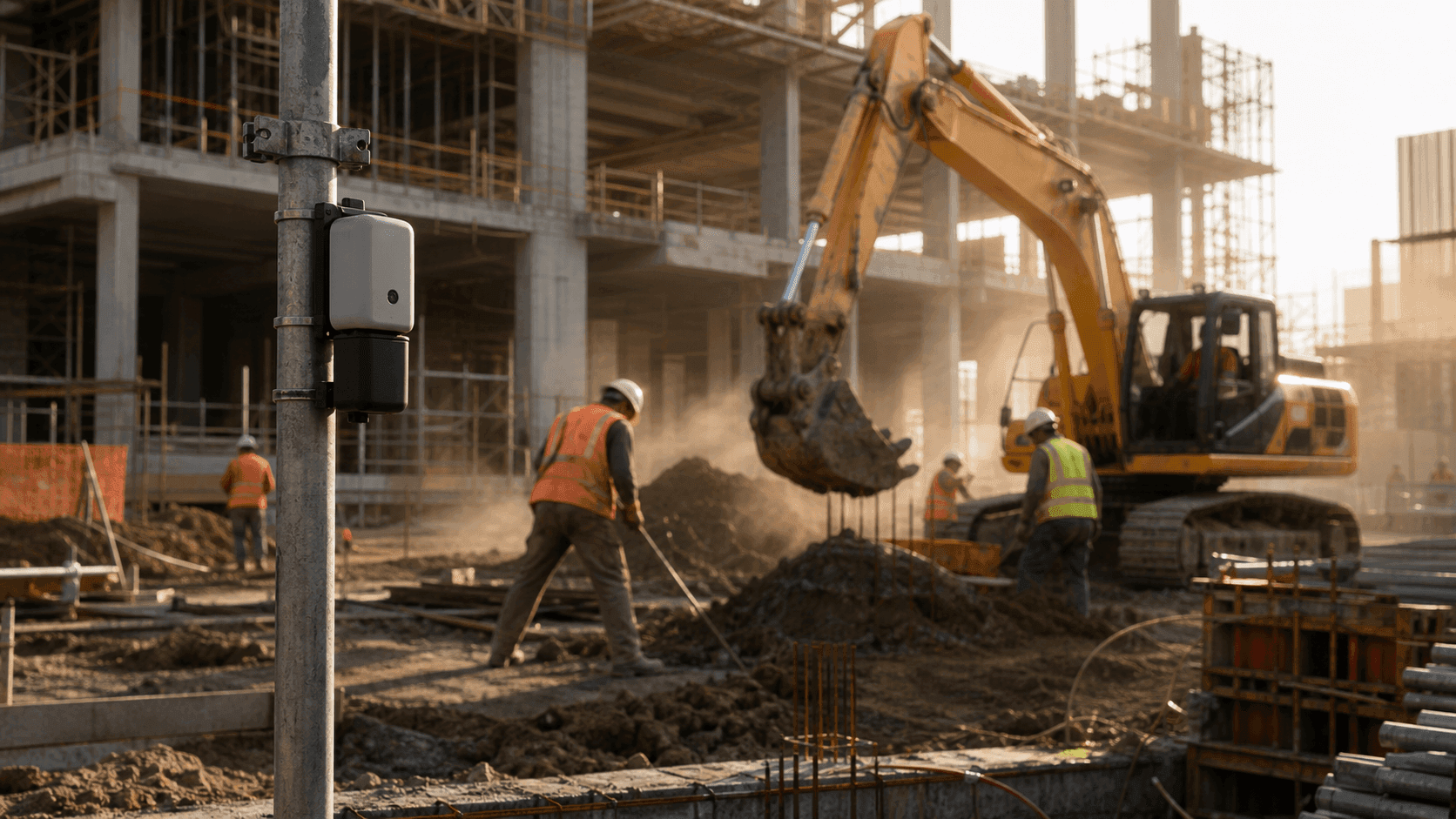
Factories and construction sites start from different premises when it comes to location tracking. A factory has a fixed floor plan, a ceiling, and power and network already run. On a construction site all three are in motion.
What was a material laydown area last month becomes a traffic route this month and a standing structure the next. Some sections have no mains power. Some places, underground or in tunnels, have no wireless reach at all. A safety system designed around fixed installation loses its place on a site like this within weeks.
And yet the safety requirement is stronger here. Workers and heavy equipment share the same space, incidents happen in an instant, and legal responsibility is heavy.
This article covers what has to be decided first when designing location based safety for a site that keeps changing.
I. Three conditions that defeat fixed design
1. Power and network are not always available
On a temporary work face you cannot assume mains power, and a wired network even less. Installing equipment means starting with electrical work, and a few weeks later that location is gone. So how far battery operation and wireless backhaul can carry you becomes the starting point of the design.
2. The work face moves with the schedule
A hazard zone is not a fixed point but today's situation. When the excavation section moves, the hazard zone has to move with it. Whether that means changing a boundary in software or physically relocating equipment determines the operational burden. If equipment has to move, how many hours the relocation takes matters more than the construction schedule.
3. Crushing and collision happen in an instant
An alert appearing on a control room screen is too late. When a worker enters the swing radius of a machine, that worker and the operator both need to know immediately. This is why on site alerting comes before control room alerting.
II. Designing for relocation
On a changing site, how you take equipment down and move it matters more than where you mount it. The design criteria shift.
| Fixed site criteria | Changing site criteria |
|---|---|
| Ceiling mounted, permanent placement | Temporary mounting on poles and scaffolding |
| Mains power supply | Battery runtime |
| Wired backhaul | Wireless or LTE backhaul |
| Design from drawings | Rearrangement by construction phase |
| Install once | Relocation cycle and time required |
Seen this way, what needs verifying also changes. Before accuracy, confirm how many hours the equipment runs continuously in a section with no mains power, and whether data survives a network dropout.
III. Alerts that reach the field immediately
In construction safety, location data does three jobs.
1. Restricted zone entry
Separate work zones from restricted zones, draw the boundary, and entry by an unauthorized person leaves a record and raises an alert. The important part is that the boundary must be easy to change. If every schedule change requires calling in a vendor, the boundary ends up stale.
2. Proximity between people and equipment
Excavators and forklifts have wide blind spots. When a person and a machine close inside a hazard distance, alerting through the helmet or a wearable with vibration and a buzzer shortens reaction time. The distance at which to alert varies with machine type and work pattern, so it has to be tuned on site. Too short and the warning arrives just before contact; too long and the alarm runs all day until nobody responds.
3. Headcount during an emergency
Routine zone occupancy counts carry straight into evacuation verification. Comparing headcount at the assembly point against last confirmed zones narrows the list of unaccounted people. That is a different timescale from having someone run around a large site counting.
IV. What to check before deployment
1. Selecting a representative section
Covering an entire site at once is not realistic. Choosing the points where heavy equipment and pedestrian routes cross, and where restricted zone entry repeats, makes it clear what you are verifying.
2. Battery and backhaul
How many hours it runs in a section without mains power, and who recharges or swaps units and when, is what keeps operations sustainable. Wireless backhaul also shifts as the structure rises, so initial measurements will not hold unchanged.
3. Wearing acceptance
Mounting to the helmet is the least intrusive option on site, because anything carried separately gets left behind. Weight, snagging and discomfort in hot weather should be verified through actual wear testing.
4. Environmental durability
Confirm the specification withstands dust, rain and temperature swings. Equipment selected on indoor criteria starts failing after one season outdoors.
V. Safety data as a record
As important as the field alert is the record of what was done about it. Who detected which hazard, when, and what action followed is what demonstrates safety activity. The absence of an incident leaves no record, but the process of detecting and responding to a hazard can.
ORBRO OS overlays worker and equipment positions, restricted zone entries and proximity events on a layout suited to the site type, whether a bridge, a tunnel or a plant. Because alerts, acknowledgements and outcomes accumulate as one history, the same data serves for drills and audits. Since tags, collection devices and the control screen are designed in one place, configurations can differ site by site.
Closing
A construction safety system is judged on survivability more than precision. Does it run without power, can it move when the site moves, will workers keep wearing it. Solve those three and the rest becomes an operational matter.
Conditions vary widely by site type. Bridges and tunnels differ in radio environment, and plants differ in steel structure density. Checking battery endurance and proximity alert conditions in one representative section where equipment and pedestrian routes cross makes the later expansion scope clear. ORBRO can review a configuration matched to your site.
Recommended Blogs
OSHA Heat Rule 2026: What Is Proposed, What Is Already
2026-08-31
Struck-By Hazards in Construction, Managing the Distance Between Workers and Heavy Equipment
2026-09-04
Shipyard Worker Tracking, Finding People and Equipment Across the Dock and the Yard
2026-09-09
Crane Proximity Alerts, Why Distance Alone Is Not Enough
2026-09-10
Safety Grants and Workers' Comp Premium Credits: How Contractors Fund Construction Safety Technology
2026-09-23

Contractor Safety Management, How to Record When Contract Workers Arrived and Where They Worked
2026-10-02