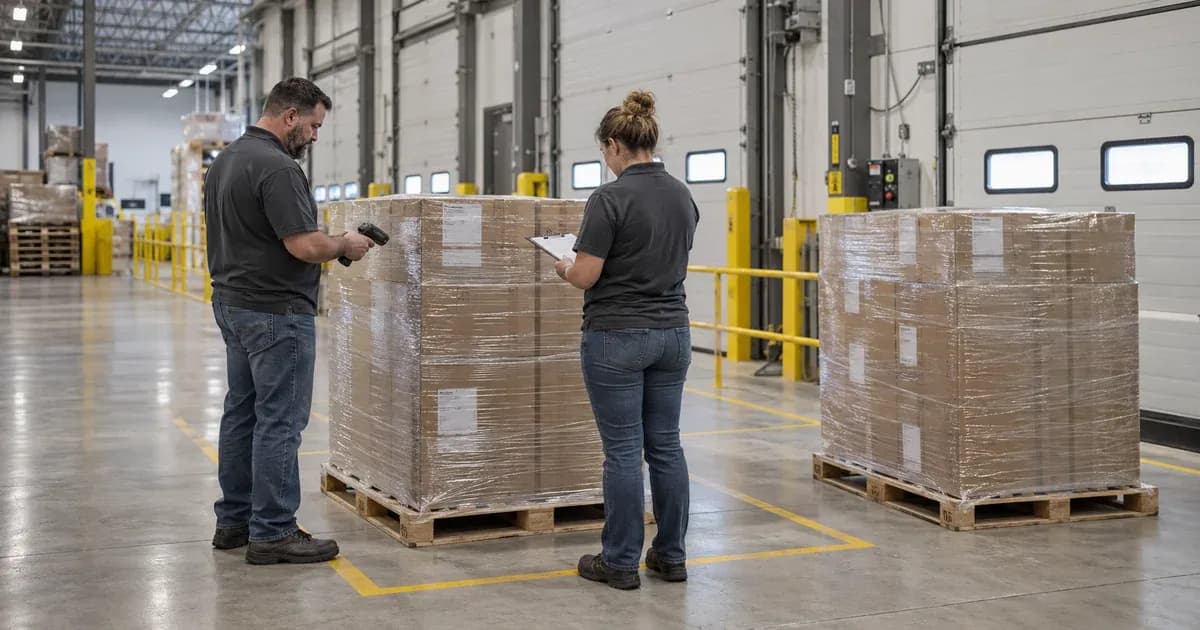
A wrapped pallet stands at the dock, so the shipment looks ready. It might belong to the neighboring order, contain only part of the required quantity or still be on quality hold. Its location does not establish that it is the right load or approved to ship.
RTLS can help locate a shipping unit and review its movement. Order records describe what should leave. Their identifiers and confirmation steps must agree before location becomes useful evidence for dispatch. Shipment approval and inventory posting remain separate workflow decisions.
I. Define the pallet-to-order relationship
Determine whether one pallet serves one order or several. A tag on a pallet or reusable carrier tracks that object; it does not verify every carton on it. Maintain the relationship among order, shipping unit, quantity, pallet and tag over the relevant period.
At a US distribution center, similar cartons may be prepared for different destinations. Compare order identifiers and quantities rather than appearance. If cartons are split onto another pallet or the load is rebuilt, record the new association. A tag being present does not prove the load identity is correct.
| Record | Evidence obtained | Check before dispatch |
|---|---|---|
| Dock observation | The pallet was observed at a place and time | Physical load, order and dock agree |
| Pallet–order association | The recorded shipping unit and quantity | Association remains valid after a split or rebuild |
| Inspection and approval | An authorized business confirmation | No later order or hold change invalidates it |
Location supports dispatch verification when all three records describe the same shipping unit. Do not infer the order from the dock, or use an old approval to clear a changed order. Separating the discrepancy also identifies the team that should resolve it.
II. Separate staging, loading and completion
An observation at dispatch is evidence of an observed arrival. Loading, order completeness and release from hold need their own checks. Define which records establish prepared, inspected, staged, loaded, approved and cancelled states. A marker disappearing from the map should not silently complete a shipment.
Review whether temporary storage, inspection and dock staging are distinguishable on the layout. Where space cannot be separated, use an explicit order-and-state check. If the observation is stale or the tag has already been removed, it may no longer describe the actual load. Keep that case unresolved until confirmed.
III. Connect records within verified capabilities
ORBRO RTLS offers configurations for asset location and movement. Matching order or inventory information requires reviewing common identifiers, available fields and update timing. Automated order matching, stock posting or shipment blocking are requirements to verify, not assumed defaults.
Specify shipping-unit identifier, order, quantity, intended dock, observed zone and time, inspection result and hold status. Location and order state may update at different times, so retain each timestamp. After an order changes, an unchanged position should not preserve an obsolete approval. Define how unmatched records reach a responsible operator.
IV. Give each exception a clear next action
Distinguish the wrong order, missing quantity, quality hold, wrong dock and unconfirmed location. Assign the responsible team, evidence needed and release condition. Shipping staff should not remove a quality hold simply because a pallet is nearby. A moved pallet requires both its new staging position and order relationship checked.
For a last-minute split shipment, identify the departing and remaining quantities separately. When a cancelled load returns, verify whether its old association still applies. Link tag recovery to a confirmed handoff. Reused tags need effective association periods so historical shipments do not acquire the new order's identity.
V. Test similar loads and reversals
Include a normal shipment, another order with similar packaging, a split quantity, a wrong dock, a movement before hold release, missing observations and cancellation followed by return. Compare the physical load, order record, location history and operator confirmation for the same shipping unit.
VI. Keep the remaining quantity visible after a split
At the hypothetical US distribution center, only one of two pallets for an order may leave first. Confirm its identifier and departing quantity, while keeping the other pallet as an open shipping unit. Completing the entire order from one pallet's handoff can hide the remaining work. Order completion and individual shipping-unit completion need separate definitions.
If the vehicle or intended dock changes, recheck the applicable approval as well as location. During a data interruption, retain the physical confirmation, the version or time of the order information and the responsible person. After service returns, reconcile those records before repeating completion or inventory processing. Include this exception path when defining the actual integration with the order system.
Closing thoughts
A pallet at the dock becomes useful dispatch evidence only when its load identity, quantity and current approval state agree. Splits, cancellations and tag recovery must leave the remaining goods traceable. Keeping those relationships and confirmation times clear enables the next shift to continue the shipment check without inferring completion from location.
Review time to identify exceptions, unresolved items, association errors and verification after reassignment. Include the evaluated population and test conditions. A pilot does not establish that mis-shipment is impossible. At shift handoff, retain unresolved orders, remaining quantities and tag-removal times. Bring the dock layout and load-identification process to ORBRO to review tracking scope and integration conditions.