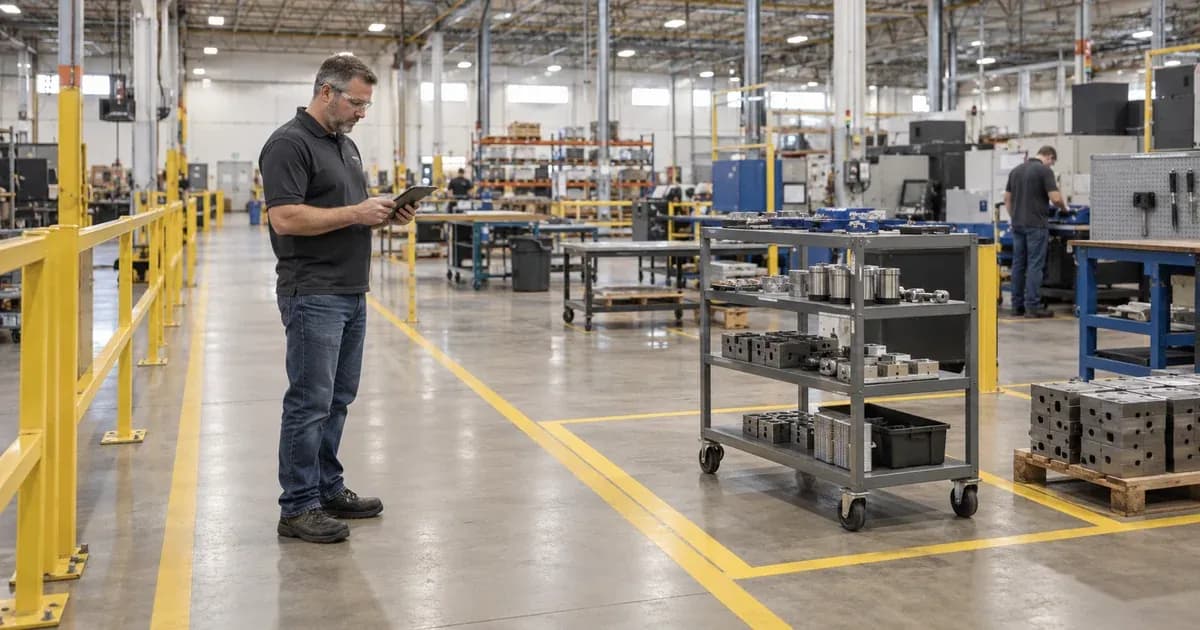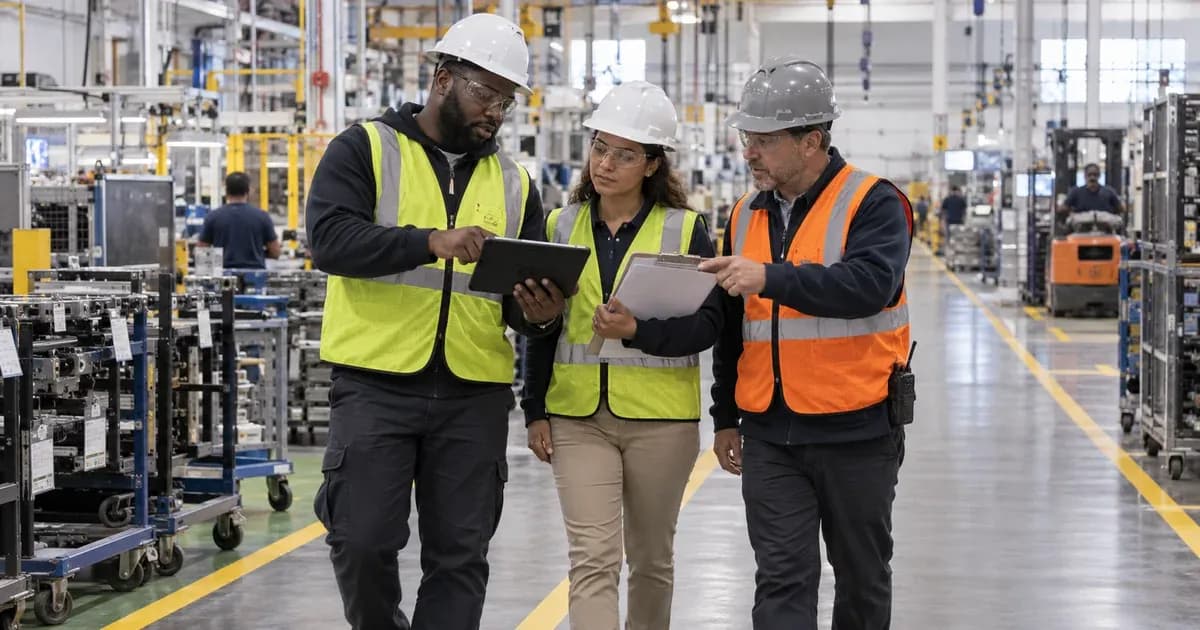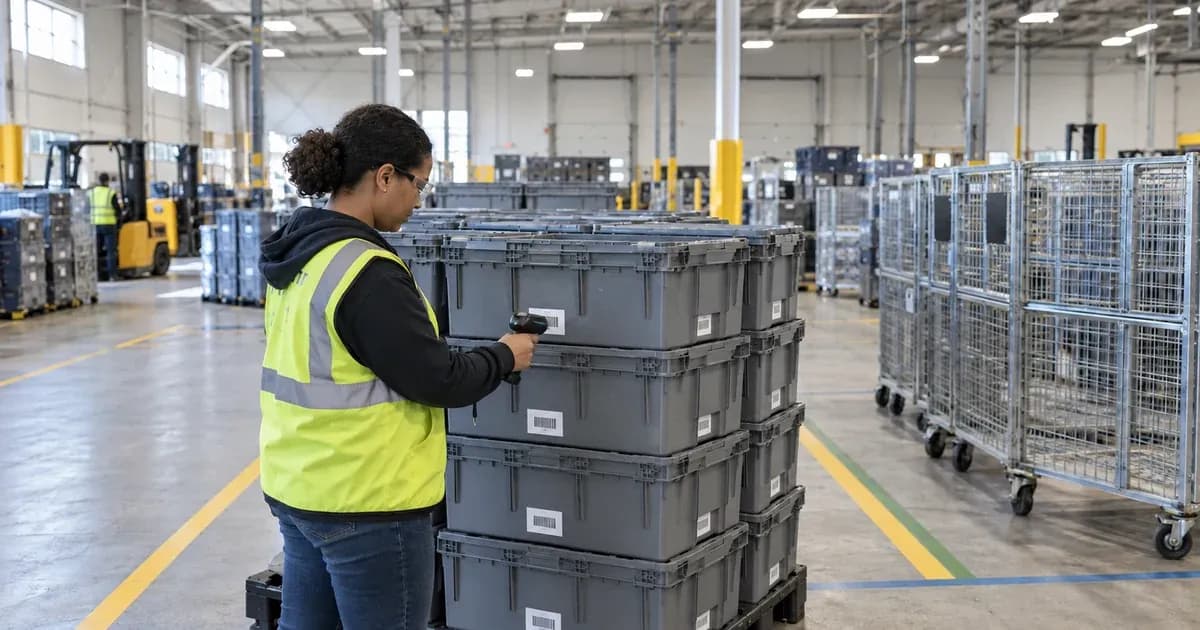
Imagine standing in the middle of a Mega Fulfillment Center or a massive manufacturing plant during peak operating hours. Forklift sirens echo relentlessly, heavy machinery roars, and dozens of transport vehicles weave through towering racks of inventory. Amidst this chaotic environment, countless workers are rushing to fulfill their daily quotas.
From a production manager's perspective, this is a highly dynamic and efficient assembly line working like a well-oiled machine. But through the lens of a Health, Safety, and Environment (HSE) Director, it looks like a minefield riddled with fatal risks.
A split second where a fatigued worker steps out from a blind spot, a brief moment a forklift driver is blinded by glare, or an instance where a warning beep is drowned out by the deafening factory noise—that is all it takes for a tragic industrial accident to occur.
For decades, industrial sites have relied heavily on "passive" safety measures: painting yellow lines on the floor, installing convex mirrors at intersections, putting up warning signs, and mounting dozens of CCTV cameras. But we must face reality: paint fades, humans get tired, and CCTV cameras do not prevent accidents—they merely provide a video recording of how the tragedy happened after the fact. As safety regulations become increasingly stringent globally, reactive patching is no longer acceptable.
It is time for manufacturing and logistics enterprises to embrace a completely new paradigm: shifting from passive reaction to proactive prevention. The technological key helping smart factories turn this into reality is the Real-Time Location System (RTLS) based on UWB positioning.
1. The Real Pain Points Behind Occupational Safety Management
Anyone who has worked in an industrial setting deeply understands the term "Near-miss." For every major accident that occurs, hundreds of near-misses have likely been ignored. Traditional safety methods are exposing severe limitations in catching these warning signs:
Physical Blind Spots Are the #1 Enemy: No matter how many convex mirrors you install at warehouse intersections, a driver operating a heavy forklift loaded with towering pallets will always have massive blind spots.
Alarm Fatigue: In excessively noisy factories, workers must wear hearing protection. The constant "beep-beep" of reversing forklifts quickly devolves into background white noise. The human brain subconsciously begins to ignore these repetitive alarms, neutralizing their warning effect.
The Limitations of Legacy Tech: Want to use GPS smartwatches to protect workers? Unfortunately, GPS becomes entirely useless the moment you step indoors. Alternatives like Wi-Fi or Bluetooth Low Energy (BLE) suffer from high latency and positioning error margins of 2 to 3 meters. In industrial safety, where every second counts, a 3-meter margin of error is the boundary between life and death.
2. UWB and AI: How the "Invisible Shield" Works
To overcome these challenges, UWB (Ultra-Wideband) technology has emerged as a revolution in industrial safety. Unlike Wi-Fi or Bluetooth, UWB transmits data by emitting billions of nanosecond-short pulses across a very broad frequency band. This grants it superior ability to penetrate obstacles (like metal racks) and, most importantly, delivers an astonishing positioning accuracy with an error margin of just 10 to 30 centimeters.
When this technology is deployed, a highly intelligent safety ecosystem operates relentlessly:
Digitizing Workers and Equipment: Every worker on the floor is issued a compact UWB Tag (worn as a badge or attached to a hard hat). Simultaneously, all forklifts, AGVs (Automated Guided Vehicles), and heavy machinery are equipped with tags.
The "Anchor" Surveillance Network: Signal transceivers (Anchors) are strategically installed across the facility's ceiling and pillars, continuously exchanging radio signals with the tags below in real-time.
The Central AI Brain: The massive influx of coordinate data is sent to a central server. Within milliseconds, Artificial Intelligence (AI) calculates the directional vectors, speeds, and closing distances of all objects.
Instead of passively waiting for danger to strike, the system predicts the future by 2-3 seconds and proactively intervenes.
3. Four Daily "Lifesaving" Scenarios in the Factory
To understand how seamlessly and effectively this positioning system protects workers, let's explore four core scenarios frequently encountered in industrial environments:
Scenario 1: The "Death Intersection" and Anti-Collision
A distracted new worker, focused on a barcode scanner, walks out of a narrow rack aisle into the main corridor. At the same time, a fully loaded forklift approaches rapidly from the right. Obscured by high pallets, neither can see the other. In a fraction of a second, the AI detects that their trajectories will intersect within a dangerous radius. Three seconds before impact, the tag on the worker's vest vibrates violently and flashes red, prompting them to step back. Simultaneously, a piercing siren blares from the forklift's dashboard. In deeply integrated systems, the forklift's control unit will automatically trigger forced deceleration before the driver even hits the brakes. A devastating accident is neutralized by technology.
Scenario 2: Restricted Zones and Geofencing
Advanced factories always have restricted danger zones: areas where robotic welding arms swing wildly, hazardous chemical storage rooms, or high-voltage testing zones. Instead of relying on flimsy warning tape, managers use the Digital Twin map to draw invisible "Geofences." If an untrained temporary worker or unauthorized personnel accidentally crosses this invisible boundary, an on-site siren sounds immediately, and the machinery in that zone can be temporarily halted. Emergency alerts instantly pop up on the safety manager's smartphone and control room monitors, allowing for immediate intervention.
Scenario 3: The Silent Hero for Lone Workers (Man-Down Alert)
Consider the maintenance crew patrolling the factory outskirts alone at 2:00 AM, or technicians working on high scaffolding. What happens if they slip and fall, or suddenly collapse from a heart attack? If no one finds them, the "golden time" for emergency rescue slips away. UWB tags equipped with built-in accelerometers can instantly detect if the wearer experiences a free fall or remains abnormally motionless for a set period. Immediately, a red SOS signal flashes on the control room screen, transmitting the exact 3D coordinates (building, floor, and aisle) of the worker. Rescue teams do not have to waste time searching a massive facility; they can head straight to the exact location with a stretcher.
Scenario 4: Panic-Free Emergency Evacuation
When a fire alarm rings, chaos usually ensues. Managers run to the assembly point with paper rosters, shouting names and breaking into a cold sweat wondering: "Is anyone still trapped inside? Did someone pass out in the warehouse corner?" The integration of positioning technology and the Digital Twin (a 3D virtual replica) completely ends this panic. By glancing at a tablet, a manager knows instantly: 145 people have safely reached the assembly point, but 2 red dots (isolated employees) remain in the far corner of Plant 3. This vital data is handed directly to firefighters, allowing them to navigate through thick smoke straight to the targets.
4. Beyond Safety: Data-Driven Optimization and ESG Culture
Some might raise privacy concerns: "Isn't putting positioning tags on workers a form of excessive surveillance?" Modern B2B solutions handle this elegantly. The system can be designed to operate entirely on anonymized ID codes rather than real names. The ultimate purpose of the system is not to micromanage bathroom breaks, but to unconditionally protect lives. Once workers realize this tiny tag is a powerful "amulet" keeping them safe, they develop greater trust in the company and actively participate in the safety culture.
Furthermore, the massive Heatmaps generated from "Near-miss" data become a goldmine for the enterprise. A plant manager can look at the map and realize: "Wow, the corner of Warehouse B triggered 50 anti-collision warnings just last week. We need to redesign the traffic flow here to one-way and remove the racks blocking the view." This is true Proactive Risk Management.
Finally, aggressively adopting advanced IT to protect human lives is the strongest proof of a company's commitment to ESG (Environmental, Social, and Governance) principles. A title of a genuinely safe Smart Factory easily passes strict audits from global partners, serving as a powerful weapon to secure massive contracts and attract top-tier talent.
Conclusion
The lives and health of workers are a company's most precious asset, impossible to quantify with any number. The initial investment required to deploy an intelligent UWB positioning system is minuscule compared to the massive financial losses, legal penalties, and irreparable brand damage a tragic fatal accident would cause.
Do not wait until you hear the terrifying sound of an ambulance siren echoing through the factory to look for solutions. The technology is ready, and Artificial Intelligence is smarter than ever. The most crucial decision for leadership today is to proactively raise this massive, "invisible shield" to protect the very people dedicating their days and nights to the company's growth.