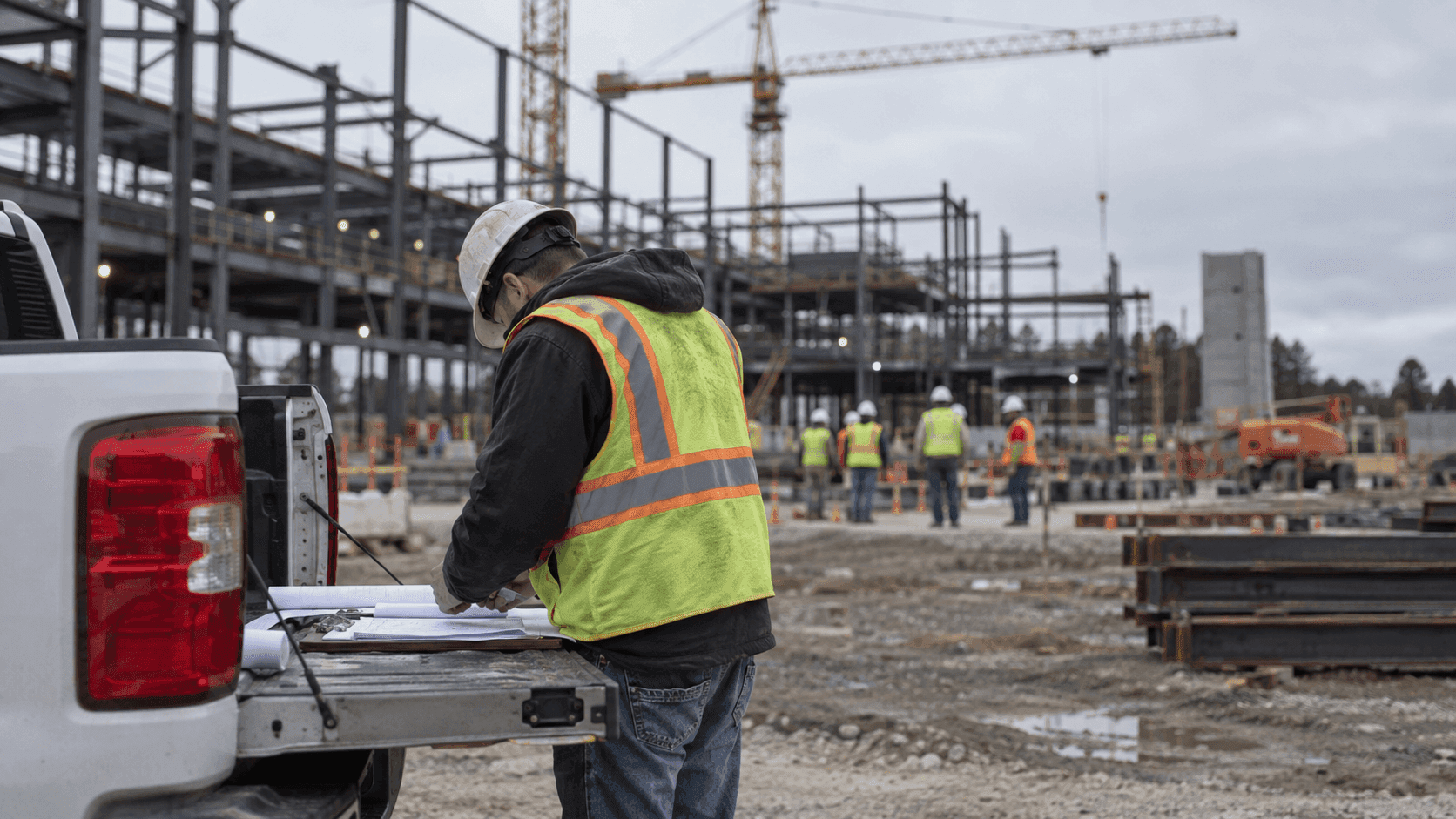
Struck-By Hazards in Construction, Managing the Distance Between Workers and Heavy Equipment
2026-09-04
Every OSHA 10 and OSHA 30 class in construction teaches the same four words: falls, struck-by, caught-in or between, electrocution. The Construction Focus Four. Falls get the stand-down and most of the budget. Struck-by gets a toolbox talk.
Part of the reason is that the other three answer to something you can install. Falls answer to a guardrail, caught-in to a trench box, electrocution to a de-energized line. Struck-by answers to a distance between a person and a machine, and that distance changes minute to minute.
That is why construction proximity detection has turned into a purchasing question rather than a research topic. Heavy equipment blind spots do not shrink because a contractor has a strong safety culture, and a work zone safety plan on paper does not keep a laborer out of an excavator's tail swing while the operator is watching the bucket.
The scale is not in dispute. CPWR, the NIOSH-funded construction research center, states that struck-by incidents are the second leading cause of death among construction workers and the leading cause of nonfatal injuries in construction. BLS released its 2024 Census of Fatal Occupational Injuries on February 19, 2026, the most recent as of this writing: 5,070 fatal work injuries nationally, 1,034 of them in the construction industry, roughly one in five, at a rate of 9.2 per 100,000 full-time equivalent workers. That rate is down from 9.6 in 2023 and was reported as the lowest since 2011.
This article covers one slice of the problem: contact between a worker on foot and a machine under power. It is orientation, not an interpretation of any standard for your site. Where the answer matters, the authority is the standards that apply to your work, 29 CFR 1926 Subpart O on motor vehicles and mechanized equipment among them, and your own counsel.
I. Why struck-by stays near the top of the list
NIOSH's figures for one recent year show the shape of it. In 2020, struck-by incidents caused 168 construction worker deaths and roughly 14,000 nonfatal construction injuries. The deaths get the headline. Those 14,000 are the injuries that land on OSHA 300 logs, move DART and TRIR, and show up in the prequalification packet a general contractor reads before you bid.
CPWR puts Focus Four hazards at about 65 percent of construction deaths across 2011 to 2021, with struck-by averaging roughly 165 deaths a year, in the range of 15 to 17 percent of construction fatalities. If you remember a lower share for the Focus Four, somewhere near 59 percent, that was OSHA's retired Fatal Four calculation, which left out the highway incidents CPWR counts. CPWR also warns that a BLS event-coding change makes pre-2023 and post-2023 Focus Four estimates non-comparable, so read those as period figures rather than a trend line.
The 2024 census reports construction by event group instead. Falls, slips, and trips took 389 of the 1,034 deaths. Contact incidents, the event family that holds struck-by together with caught-in and caught-between, took 161. Pulling struck-by alone out of that family takes the finer BLS event tables, so any figure quoted to you as struck-by deaths in 2024 deserves a source check before you repeat it.
The topic resurfaces every spring. The National Stand-Down to Prevent Struck-By Incidents, a voluntary week run by CPWR, NIOSH, and the NORA Construction Sector Council, ran April 20 to 24, 2026, alongside National Work Zone Awareness Week.
II. Four kinds of struck-by, and the two this article is about
NIOSH groups struck-by hazards into three families: vehicles, falling or flying objects, and heavy equipment such as crane swing hazards. On site the conversation usually splits four ways.
1. Struck by a vehicle or mobile equipment
A worker on foot is hit by a truck, loader, roller, or haul unit. CPWR reported transport vehicles as the most common cause of fatal struck-by injuries, 48 percent in 2020.
2. Struck by a falling object
Tools, material, or debris from an elevation. Toeboards, netting, tethers, and keeping people out from under the work.
3. Struck by a swinging or slewing load
A suspended load, a slewing counterweight, or a boom moving through an arc the operator cannot fully see.
4. Struck by a flying object
Discharged material from a saw, nailer, grinder, or pressurized line. Guarding and PPE.
Falling and flying objects are guarding problems. Vehicles and swinging loads are geometry problems, and geometry is what sensors are good at.
III. The physics of a blind spot
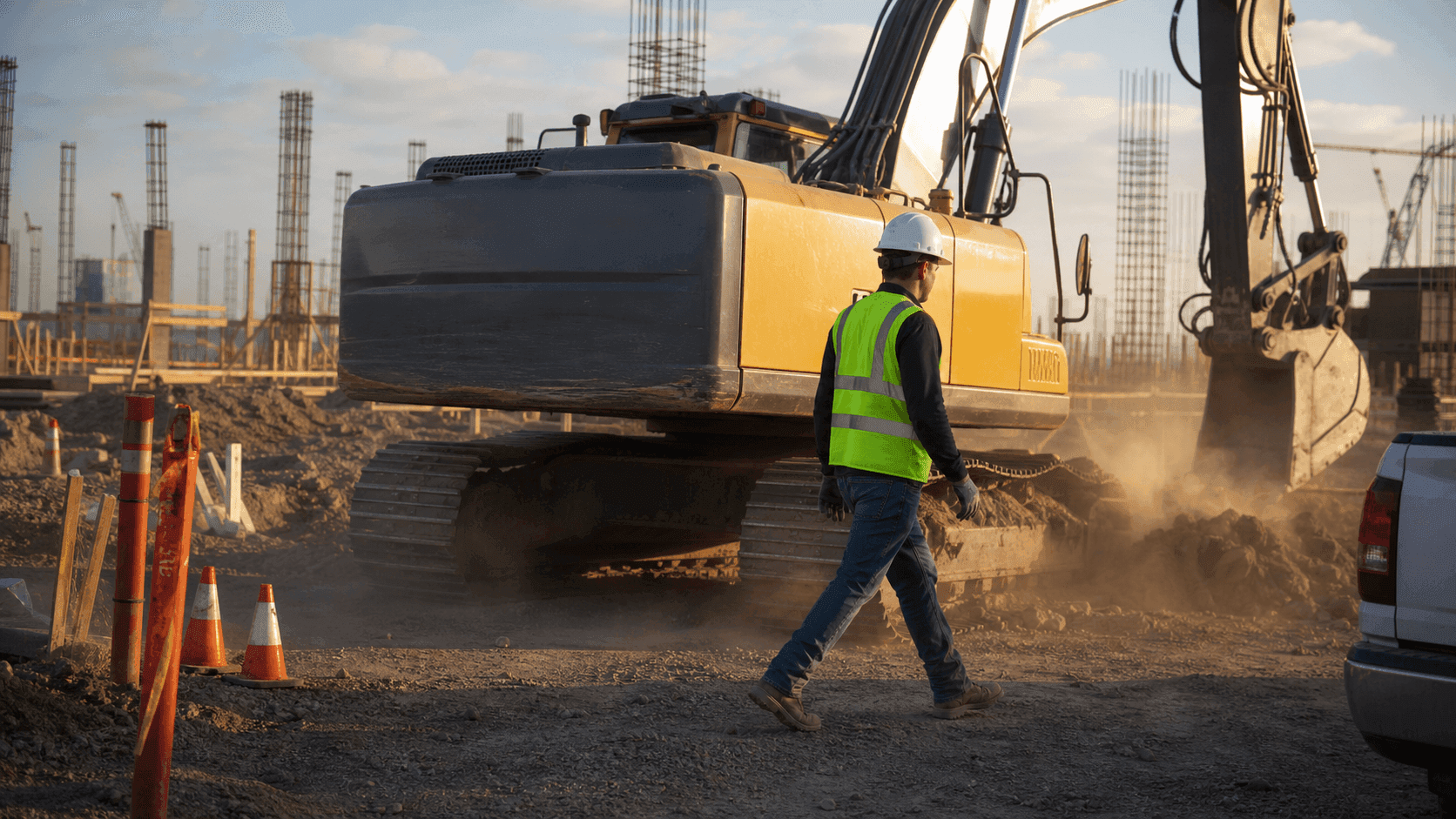
An operator's field of view is a fixed property of the machine, and it narrows as the machine gets bigger. The blind area behind and off the rear quarters of large earthmoving equipment is deep enough to hide a standing worker from the seat, and on an excavator the tail sweeps a circle nobody in the cab has any reason to watch.
Every procedural control layered on top has a failure mode. Mirrors and in-cab monitors work only if the operator is looking at them in the second that matters, which is usually the second the load is demanding attention. Backup alarms depend on the alarm still carrying information, and on a site with a dozen machines cycling they are ambient sound under hearing protection. Hand signals need a person in the operator's line of sight, and an operator who looks.
Then there is the spotter, the control everyone reaches for when the others run out. It keeps people out of the machine's path by putting a person beside that path, which is why CPWR promotes internal traffic control plans as the first-order fix. The goal is not a better spotter. It is fewer occasions when anyone has to stand there. Proximity detection belongs inside that logic: it does not replace the traffic plan, it covers what the plan cannot.
IV. Four ways to detect proximity, and where each one breaks
Each approach answers a different question and fails in its own direction. The table reads from the failure side, because that is the side you live with.
| Approach | What it measures | Where it holds up | Where it breaks |
|---|---|---|---|
| AI camera vision | Classifies a person in the image, infers distance from image geometry | Sees untagged people: visitors, drivers, the public at the work zone edge. Leaves reviewable video | Needs light and line of sight; dust, rain, glare, and a muddy lens degrade it, and a worker behind a material stack is not in the frame at all |
| Radar | Range and closing speed to anything that reflects | Works through dust, rain, and darkness; measures closing rate directly | Object-agnostic: a wall, a rebar bundle, and a worker all return echoes, so congested sites alert constantly |
| RFID or magnetic-field zone tags | Whether a tagged person crossed a field generated at the machine | Magnetic fields pass around steel and bodies where line-of-sight radio struggles | Answers in or out, not how far and closing how fast; zone shape is fixed and coarse, and anyone untagged is invisible |
| UWB two-way ranging | Actual tag-to-machine distance, by time of flight | Measures distance instead of inferring it; fine time resolution resists the multipath errors that spoil signal-strength methods | Every person needs a tag; heavy metal reflects and blocks, and a body between tag and anchor attenuates the signal |
The market splits into a tag camp and a camera camp, and the two fail in opposite directions. Tags measure distance for everyone enrolled and see nothing of the delivery driver who arrived twenty minutes ago. Cameras see everyone but cannot hand you a number you would set a stop threshold on. Where both matter, pair them: cameras on fixed pinch points, ranging on what moves.
V. The alarm is the easy part
Any of these systems can make noise. What decides whether the investment survives its first quarter is how often it makes noise for nothing. Alarm fatigue is the normal failure mode here. An alert that fires on every routine pass gets muted, taped over, or tuned out, and once a crew learns the system cries wolf, the alert that mattered arrives with no credibility.
Designing that out is a threshold problem, not a sensor problem. Three variables do most of the work.
1. Zone
A haul road where people and equipment are separated by design should tolerate far less intrusion than a laydown yard where they legitimately mix. One global radius means nuisance alerts in half the site and silence in the other half.
2. Speed
Range alone is a poor trigger. A parked machine with a worker beside it is normal. The same range with a closing rate attached is the event you want.
3. Task context
Backing under a spotter's direction, loading a truck, and tracking across open ground are three risk profiles at the same range and speed. A system that cannot be told which one is happening will over-alert in at least one.
One threshold is rarely enough either: an advisory to the operator at range, a tighter one that stops the movement, and a haptic buzz on the worker's own tag, because the person on foot is often the one who can still step back.
What turns a warning device into a safety program is what gets written down. An alert that only beeps gives you nothing to act on next week. An alert logged with location, time, machine, and duration produces a near-miss map, and that map is an argument for redrawing the traffic plan. It gives next Tuesday's toolbox talk a gate and an hour instead of a reminder to stay alert.
That records layer is where ORBRO OS sits: zones drawn against the site plan, rules attached to the zone rather than to one global radius, and every crossing kept as filterable history. ORBRO's UWB RTLS supplies the measured distance those rules act on, and AI Event Manager works the camera side, catching the visitor no tag will ever cover. One site map, so a supervisor can answer what was where and when.
None of this makes a site compliant with anything. It carries out the procedures you have already written and leaves evidence that they ran. Recordkeeping stays a separate obligation, from the OSHA 300 log to the eight-hour window for reporting a work-related fatality. Near misses appear on none of those forms, which is exactly why they are the part still available to act on.
VI. What to evaluate before you buy
1. Start with the traffic plan
If people and equipment share ground because nobody drew the separation, a sensor will spend its life announcing a hazard you designed in. The plan also has to be redrawn as the build moves, a problem we took on in Construction Site Safety, Matching Infrastructure to a Site That Changes Daily.
2. Decide who will never be tagged
Visitors, delivery drivers, inspectors, and the public at the work zone edge are the least likely people on the job to be carrying a tag. A tag-only architecture has a hole exactly where they stand.
3. Pilot on your worst corner, not your cleanest
Steel, dust, night work, and rain separate demo performance from site performance.
4. Ask what a normal day looks like in alert counts
Not detection accuracy from a spec sheet. Alerts per machine per shift on a live site, what the crew did with them in week four, and whether those events can be pulled back out by zone, machine, and time.
5. Price it against the incident, not the sensor
OSHA's business case page cites employers paying more than $1 billion per week in direct workers' compensation costs for disabling non-fatal injuries, drawing on the 2025 Liberty Mutual Workplace Safety Index. That is not your invoice. But an experience modification factor below 1.00 and a clean TRIR are screening criteria that owners and general contractors impose through prequalification rather than anything OSHA writes, and for most contractors those sit closer to home than a citation does.
VII. Closing thoughts
Proximity detection does not remove a struck-by hazard. It buys a second. Everything else in this article is about whether that second arrives with any credibility attached: whether the thresholds match the zone, whether the crew still trusts the alarm in month six, and whether anyone can reconstruct what the site looked like at 10:42 that morning.
That is the case for putting ranging, cameras, and zone rules on one map instead of three disconnected boxes. ORBRO's UWB RTLS provides the measured distance, AI Event Manager reads the camera feeds for the people no tag will cover, and ORBRO OS holds the zones, the rules, and the history where a safety manager can open them. If you are scoping a struck-by program for next season, or your crews have stopped listening to the system you already have, we are glad to walk the site with you.