What an Indoor UWB Location Tracking System Is Actually Made Of
2026-08-14
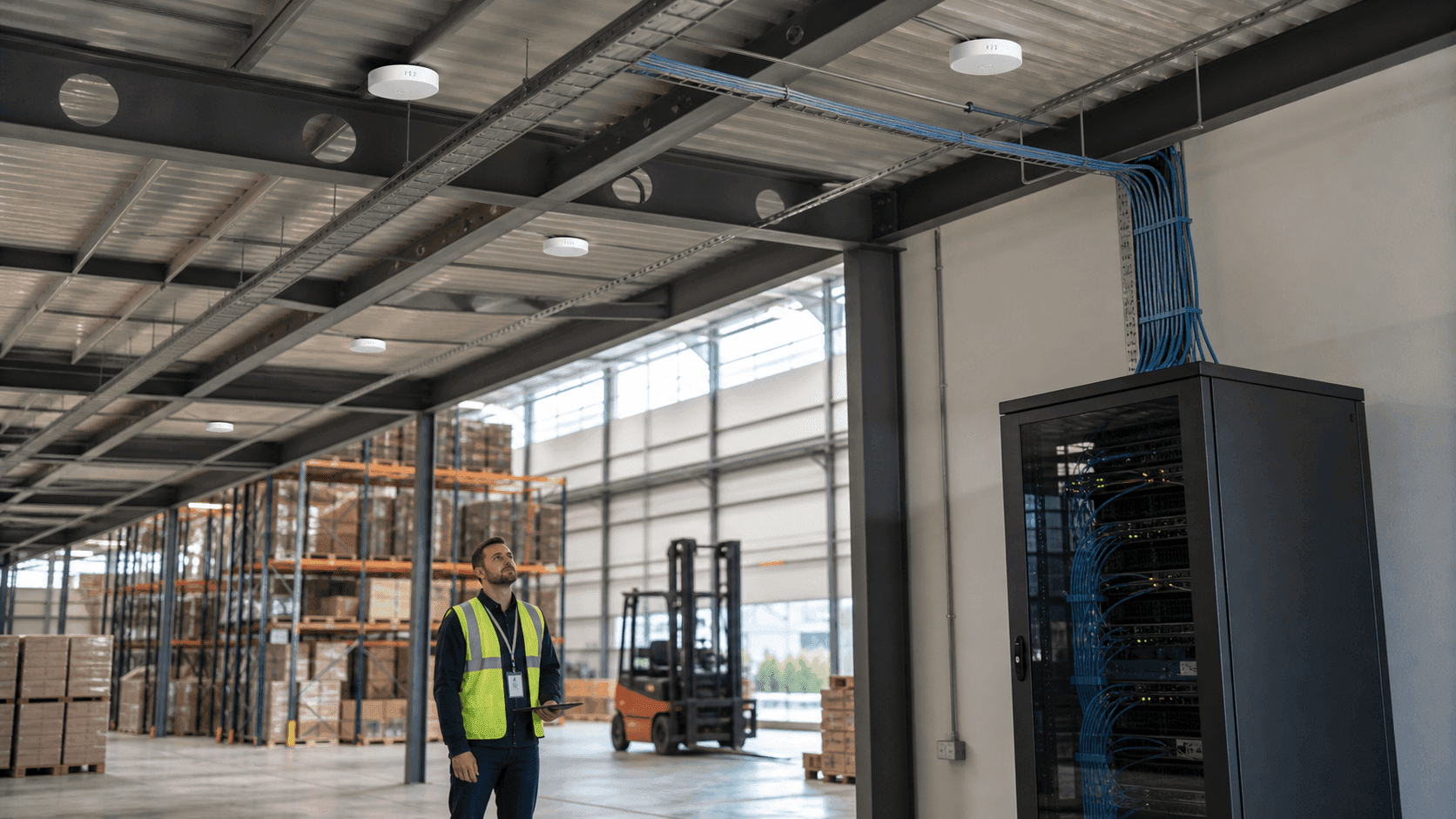
Most people begin evaluating location tracking by asking for a quotation. But the quotation just lists names with quantities beside them: anchors, tags, gateway, edge server, PoE switch. If you cannot tell what is essential and what is optional, or why there are four anchors but only one server, you are stuck before you can even lay two quotations side by side.
In practice, enquiries regularly ask us to go back over what each device does, item by item. Is the tag the side that transmits and the anchor the side that receives? Do you need both the edge server and the PoE switch? These look like basic questions but they are actually the most important ones. Location tracking works as a combination rather than as the performance of any single part, and without knowing the combination you cannot judge which line item can be trimmed and which one, if trimmed, brings the system down.
This article sets out what a UWB based indoor positioning system is made of, what each part does, and how many of each you need. Read it before you receive a quotation and the quotation becomes readable; read it after and you will see what to ask back.
I. The Five Pieces
1. The tag, attached to whatever you want located
A tag is a small wireless device attached to the subject you want to track. For people it takes the form of an ID badge or a lanyard, for forklifts and trolleys a mounted type, for tools and assets a compact type. It runs on a battery and emits a signal at a set interval.
That is all a tag does. It does not compute its own position, nor store it. In a location tracking system the tag only announces that it is here. Which is why the crux of tag design is not computing power but size, weight, mounting method and battery life.
Quantity equals the number of subjects. Track 200 workers and 20 forklifts and you need 220 tags. As we will see later, the share this number takes of total cost is usually larger than expected.
2. The anchor, receiving the signal and recording the time
An anchor is a receiving device fixed to a ceiling or wall. At ORBRO it goes by the name TwinTracker. It receives the signal a tag sends, records the time of arrival very precisely, and passes that value to the server.
A misunderstanding arises often here. Anchors do not compute position. The computation is done by the edge server, coming next. What an anchor does is measure time accurately, and the precision of that time measurement is what ultimately determines positional accuracy. The reason UWB can claim to be more accurate than other methods also rests on nanosecond scale timing.
Anchors come in UWB, BLE and AoA variants depending on the positioning method. Which anchor you fit in the same place changes accuracy and required quantity at the same time.
3. The PoE switch, power and data on one line
Anchors do not get a separate power adapter. A single network cable carries both power and data. That method is called PoE, and the device that provides it is the PoE switch.
Think about mounting anchors on a ceiling and the advantage becomes clear. Instead of running a new power outlet to every anchor position you only cable network, and when you later move an anchor no electrical work follows. You can also switch power to an individual anchor on and off at the switch port, which makes remote checks easier.
4. The edge server, where coordinates are computed
This is the computer that takes the timing data anchors send and turns it into actual coordinates. At ORBRO, ORBRO Edge Pro sits in this position. It is equipment placed on site, and the computation finishes there.
That the computation finishes on site rather than in the cloud is not a mere implementation detail. Positioning does not stop when the internet does, and location data does not leave the site. At semiconductor plants, power facilities and security controlled areas, where exporting data is itself subject to review, this condition decides whether deployment is possible at all. Response speed differs too. Functions that must react immediately, such as collision avoidance and hazard zone warnings, are better served without a round trip.
5. The monitoring software, turning coordinates into a screen
Nobody can work from coordinates alone. You have to put points on a floor plan, draw zones and attach rules before it becomes monitoring.
At ORBRO this splits into two stages. The installation stage, registering devices and setting anchor coordinates and positioning options, is handled by RTLS Manager, while actual operation and monitoring is handled by ORBRO OS. Zone setup, dwell time aggregation, alert rules and retracing past movement live here.
One router joins this list, because the edge server, the PoE switch and every anchor have to sit on the same network to find one another.
II. From Signal to Coordinate
UWB positioning derives position from differences in arrival time. When a tag emits one signal, the time it arrives differs slightly at each anchor: sooner at a near anchor, later at a far one. Multiply that time difference by the speed of light and you get a difference in distance; collect the points where that distance difference is constant and a surface forms. Where the surfaces from several anchor pairs meet is the tag's position.
One condition attaches for this to work. The anchors' clocks have to agree precisely. In a computation dealing in nanoseconds, a clock that drifts shifts the whole position by that much. So one anchor in a zone takes the reference role and the others synchronise to it. The installation requirement that the reference anchor and the others must be in sight of one another comes from here.
In short, the order is this. The tag emits a signal. Several anchors each record the arrival time. The edge server gathers the time differences and computes a coordinate. The monitoring software puts that coordinate on a floor plan. Miss any one of the four and no dot appears on screen.
III. How Many Devices Do You Need
This is the question we get most and the hardest to answer, because it does not compute from floor area alone. There are clear baselines all the same.
UWB needs a minimum of four anchors per positioning zone. The four are placed so they surround the zone in a rectangle, and spacing between anchors is recommended to fall between a minimum of 2 to 3 metres and a maximum of 20 metres. Mounting height is kept within a 2 to 15 metre range and as equal as possible. One more important condition attaches: from wherever a tag will be, four or more anchors must be visible. At any point where fewer than four are visible, the position there becomes inaccurate.
Quantity diverges sharply by method for the same area. BLE is planned at roughly one device per 20 by 20 metre area and AoA at one per area. Against UWB's four per zone, that is a several fold difference in device count. That difference is the difference in build cost, and it is also why you have to decide how much accuracy you are asking for first.
One addition: laying anchors out generously rather than just meeting the minimum produces better results. The more anchors are received from a tag position, the more combinations become available for the position computation, and the more room there is to pick the geometrically favourable ones. ORBRO's positioning architecture uses this principle head on, evaluating every combination of received anchors and then using only the good ones. The relationship between anchor placement and accuracy is covered in detail in a separate article.
IV. The Cabling Is Simpler Than Expected
The whole connection summarises in one line. Connect the edge server to the router, connect the router to the PoE switch, and connect each anchor to a PoE switch port with one network cable each. There is no separate power line running to the anchors.
The core rule is single. The edge server, the router, the PoE switch and every anchor have to be on the same network. Because the process of discovering and registering devices runs on that condition, a divided network blocks you at the very first installation step. This is exactly the part to discuss with site IT in advance.
V. Worth Preparing Before Deployment
Secure the building drawing first. The drawing is the backdrop for the screen, and the scale has to match real dimensions for coordinates to mean anything. An image file is sufficient.
Measuring anchor coordinates comes next. After installation, each anchor's actual position has to be measured and entered in centimetres. If those values are inaccurate every coordinate computed afterwards is skewed with them. This plain work with a tape measure is the point that decides installation quality.
The location of metal structures is worth looking at in advance too. Steel walls, large columns and stacked metal stock block and reflect signals. Placement has to be arranged so such structures do not sit between anchor and tag, or between anchor and anchor.
Last is network and power. Confirming where the PoE switch and edge server will sit, the cabling route to that point, and the relationship with the existing corporate network makes installation day considerably shorter.
Closing
A UWB location tracking system consists of tags, anchors, a PoE switch, an edge server and monitoring software. The tag emits a signal, the anchor measures the time, the edge server computes the coordinate, the software builds the screen. Know the structure and you can see which position each quotation line corresponds to, and ask back about why the quantities came out as they did.
ORBRO builds all of it, from hardware such as tags and anchors, through ORBRO Edge Pro placed on site, to the monitoring software ORBRO OS. It is not an assembly of parts gathered from several companies but a combination designed together from the start, so everything from device registration to screen layout continues inside the same tool. If you would like to know the configuration and quantities that suit your site conditions, send us the drawing and what you want to track and we will review it.
Recommended Blogs

Semiconductor Fab Personnel Tracking: Why Location Is Stored Only by Floor and Zone
2026-09-14

Forklift Collision Avoidance When AMRs Share the Aisle: Pass UWB Coordinates, Let the Robot Decide
2026-09-16

RTLS for Senior Living: Filling the Daily Care Log with Resident Location Data
2026-09-18