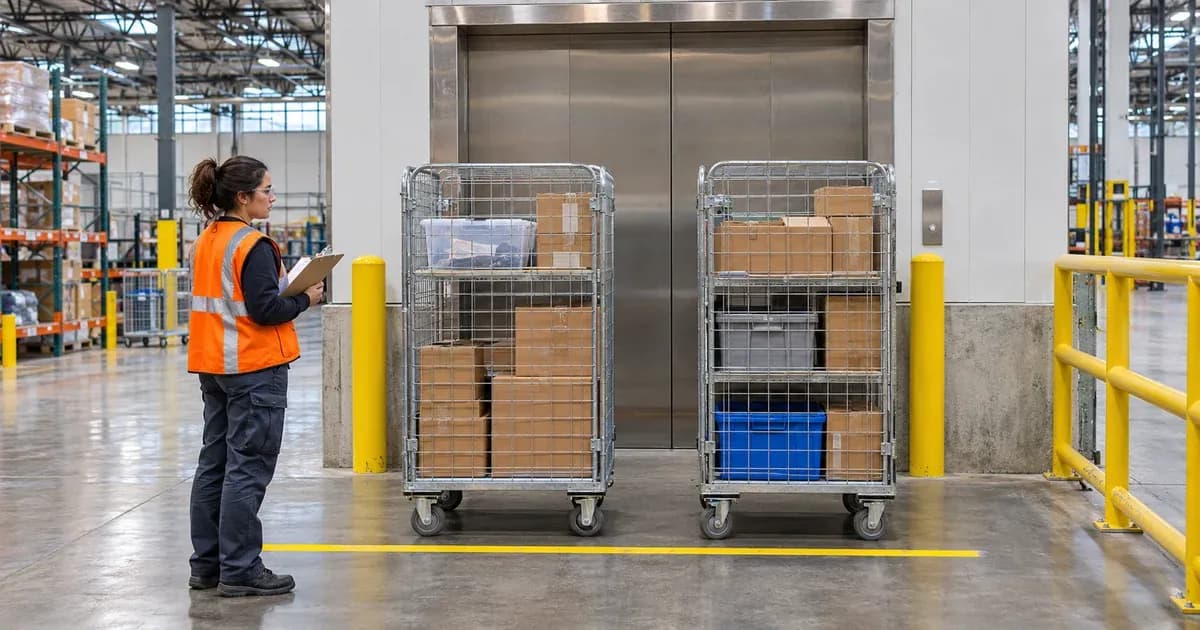
A US warehouse with two operating levels has several cages waiting beside a freight elevator. The supervisor sees a queue and considers increasing elevator trips. Yet one cage is not ready to move, while another has already reached the destination floor and is waiting for collection. Freight-elevator waiting analysis needs separate stages before a visible queue becomes an equipment-capacity conclusion.
Seasonal planning around the 2026 US holiday forecast makes this a useful workflow to examine. This imagined multilevel facility is one possible site arrangement, not a description of every US warehouse. The article concerns material movement and does not assume elevator control or safety integration.
I. Separate readiness, waiting and collection
Material ready, arrival at the waiting bay, loading, travel, unloading and destination receipt are different events. A cage remaining beside the elevator may be waiting for a call or missing stock. Observation on the upper floor does not establish that the receiving team accepted it.
Connect the cage identity, movement request, origin, destination, contents and quantity. Keep readiness and receipt decisions separate from location observations. When one trip carries several cages, preserve each request so partial unloading and different destinations remain understandable.
II. Compare the available evidence
| Evidence | What it helps explain | Remaining question |
|---|---|---|
| Elevator call and operation log | Requests and equipment movements | Which cage was loaded and ready? |
| Origin and destination scan | Identified load and handoff | Where did it wait between scans? |
| RTLS location history | Observed floor-level waiting and movement | Unobserved cabin interval and actual acceptance |
Without equipment logs, time near the elevator is not automatically proof of insufficient elevator capacity. Readiness and collection can still be investigated. Frequent trips with requests left open instead call for checking the actual loads and handoff records. Define conclusions around the evidence available.
III. Define ORBRO zones around real parking positions
Use Zone Manager to distinguish departure holding, unloading holding and receiving positions on each floor. Including the whole doorway approach in one waiting zone may count passing traffic as queued work. Test where cages are actually parked and how movement is distinguished from holding.
Operators check the tag's observed floor and time, then review recorded movement in Record. If observations disappear during travel, retain the interval between the last departure-floor observation and first destination-floor observation as unknown. Do not invent a path through the cabin. Compare equipment logs or scans where available.
Prepare maps and devices in RTLS Manager. Validate floor identification separately from horizontal position, including closed doors, loaded cages and tag orientation. Multifloor validation addresses a different question from measuring a queue.
IV. Use three cages to distinguish different delays
Suppose cage A is ready, B lacks one carton and C is waiting for the destination team to accept a delivery. Counting three cages creates one apparent queue; the requests have different next actions. Location helps find them while business status identifies work eligible to move.
If A reaches the destination floor but remains uncollected, investigate the receiving owner and placement area. Counting that period as elevator travel could justify the wrong improvement. B needs stock preparation, while C may need coordination before a call is placed. Operators determine sequencing under the site's rules.
Displaying readiness, call and receipt together requires shared request identifiers, time conventions, update timing and cancellation handling. That is a separate integration scope. A location application should not be assumed to call an elevator or change its operating sequence automatically.
V. Keep observation gaps separate from congestion
A tag disappearing when doors close may indicate the limit of coverage. Check delayed destination observation, a detached tag and alternative routes before assigning the whole gap to cabin dwell. A missing observation is not a measured equipment interval.
For multistop unloading, update remaining contents and the next destination rather than closing the whole request at the first floor. When an urgent load intervenes, retain the next action and owner for displaced requests. Boundary fluctuations also require testing so a short movement around a zone edge does not create several waiting episodes.
VI. Compare stages before considering expansion
A pilot records readiness, entry into departure holding, destination observation and physical receipt. Loading and travel events unavailable from location need equipment records or field measurement. Compare similar loads, floor combinations and staffing, retaining incomplete requests.
If collection dominates, improve receiving responsibility and staging first. If delay is concentrated in documented equipment operation, review it with the equipment team. Use the same stage definitions before and after changes. A long stationary point on a map alone does not establish the benefit of another elevator.
Closing thoughts
A freight-elevator queue includes preparation, travel and destination collection, each with different evidence and responsibilities. ORBRO location history can help separate observed stages while request and receipt records explain the remaining work.
Prepare floor plans, cage routes, sample requests and available call or receipt logs. Discuss ORBRO to establish observation points, unknown intervals and the integration needed for a useful pilot.