Mold Tracking: How to Locate Tooling Where Metal Is Densest
2026-08-04

In most factories, the most expensive movable asset is tooling. A single mold runs from a few thousand to several hundred thousand dollars and weighs anywhere from a few hundred kilograms to several tons. It stays in service for years — as long as the product generation it produces — and in that time it travels between the storage rack and the molding machine dozens of times.
And yet the current location of that asset usually lives in someone's memory and a paper ledger. The mold number is recorded precisely. What is not recorded is whether the physical tool carrying that number is on the second-floor rack right now or already down beside the press. The only way to find out is to walk over and look.
This is not a small inconvenience. When an urgent production order lands, the time spent hunting for the mold becomes line downtime. If there is no record of who moved it yesterday and where, a missing tool can go unnoticed for days. And any attempt to manage repair history or cycle counts rests on nothing, because there is no record of when the mold was actually out on the floor.
This looks like a problem real-time location tracking should solve. It does. But a mold warehouse is one of the least forgiving environments an indoor positioning system will ever meet. This article explains why, and what you need to verify under those conditions for a deployment to succeed.
I. Three Ways to Lose a Mold
On the floor, "we don't know where the molds are" is really three different problems bundled under one complaint. They have different fixes, so it is worth separating them.
1. You know the number but not the location
The most common case. The ledger has the mold number and the supervisor knows it. But in a warehouse of several thousand square meters, which row and which level that number actually sits on is not tracked separately. Even when it is tracked, what is recorded is the assigned location, not the current one. A mold that did not make it back to its home position after a job is the moment the ledger and reality split apart.
2. The record breaks while it moves
Nobody carries a mold by hand. A hoist, a crane, or a forklift moves it. It is lifted off the rack, crosses the aisle, goes down a level, and lands beside the machine. If the middle of that journey is blank, all you have is an origin and a destination. But the middle is exactly what you want. Where did it sit waiting? Did it leave the designated path? Was it set down somewhere temporary along the way?
3. Coordinates wobble between slabs of steel
Try to solve the first two problems with location tracking and the third one appears. A mold warehouse is a room packed with steel. Even with tags attached, coordinates jump, disappear for a few seconds, or place the tool one row over. Adding more tags does not fix this. It is a radio problem.
The third is the crux. The first two are questions about what to record. The third is a question about whether the record can be trusted at all.
II. Why a Mold Warehouse Is the Hardest Room for Indoor Positioning
UWB (Ultra-Wideband) measures distance from nanosecond-scale time differences and computes a position from the distances reported by several anchors. Under good conditions it is accurate to tens of centimeters. Good conditions means the space between tag and anchor is empty.
In a mold warehouse that condition breaks in two ways at once.
Steel plate reflects signal like a mirror. Radio bounces off metal surfaces. What an anchor receives is a mixture of the signal that came straight from the tag and the signal that ricocheted off the face of the mold next to it. The reflected copy travelled further, so it arrives later, and the tag is computed as being further away than it is. This is multipath.
Stacked molds block signal like a wall. When tooling is piled several deep, the direct line between tag and anchor is cut. Either nothing arrives, or only the detoured reflection does. This is NLOS — non-line-of-sight.
When a system that performed well in the lab collapses on site, these two are usually the reason, not the limits of the algorithm. And one practical constraint compounds them. The theoretically ideal anchor layout surrounds the target generously; in a real warehouse, ceiling structure, equipment interference, and cable routing mean you cannot mount anchors where you would like.
So raising the accuracy of the coordinate is not enough. The system has to judge for itself how much a given coordinate can be trusted.
ORBRO's positioning engine approaches this in three layers.
First, rather than picking a single anchor combination, it evaluates every viable combination exhaustively. When some combinations are contaminated by reflection or blockage, the statistical consensus of the majority dilutes the outliers. This is also why more anchors sharpen the position rather than merely extending coverage.
Second, the standard for "a good geometry" is not one global threshold across the whole space but a separate baseline per zone. Corners and aisles are inherently worse, and normal variation there should not be misread as error.
Third, a computed coordinate is not emitted as-is; it carries a confidence grade. Coordinates that pass verification on three axes — geometric consistency, temporal continuity, physical plausibility — can drive safety and control directly. Borderline coordinates are for reference only. Coordinates that fail verification are blocked from output and logged as environmental analysis data instead.
Why grading matters is especially clear in a mold warehouse. Read one wobbling coordinate as "it moved" and the movement history now contains a journey that never happened. With grades attached, you can separate the coordinates you act on from the ones you hold, and zones that repeatedly produce low grades are automatically flagged as places to revisit the anchor layout.
Two companion articles go deeper on this. GDOP and anchor geometry are covered in Understanding GDOP with Two Fingers, and the confidence grading system in Coordinates Have Confidence Grades Too.
III. Five Things to Measure Before You Deploy
If you have decided to put location tracking into a mold warehouse, there are things to confirm in a pilot zone before going wide. The accuracy figure on the datasheet is a good-conditions number, and a mold warehouse is not good conditions. What you need is not the average but the behaviour under the worst conditions.
| What to measure | What you are looking at | How to judge it |
|---|---|---|
| Static position error | Difference between surveyed and displayed coordinates for a mold at a known spot | Is it fine enough to distinguish row and level? |
| Trajectory continuity | How many coordinates drop out while a hoist moves the tool | Measure stationary, straight, and turning segments separately |
| Recovery time after blockage | How long until the tag reappears after passing through a shadow between molds | How many seconds, and how much does it vary by zone? |
| Coordinate delivery rate | Actual coordinates received against those expected per unit time | Only meaningful when broken down by confidence grade |
| Zone entry/exit timestamp accuracy | Gap between actual crossing time and logged time | This decides the credibility of the entire movement history |
These five have to be measured with the same procedure, repeatedly, before you can calculate the scope of a rollout. "It works well" and "in this zone it recovers in an average of N seconds after blockage" are different sentences. If you are evaluating vendors, ask for the second. UWB accuracy is usually quoted at roughly ±10–30 cm by specification, but the real figure depends on the metal density of the site and the anchor layout. Which is why agreeing on the measurement procedure matters more than writing down a number.
IV. Where Coordinates Become Mold Management
Accurate coordinates alone are not a workflow. What a tooling manager needs is not an X/Y value but "where is that mold now, and what time did it leave the floor yesterday." Bridging that gap is the job of the control platform.
Bind mold ID to tag ID one-to-one. This is the first step and everything downstream is meaningless without it. A system that displays tag numbers does not get used. The numbers from the existing tooling ledger have to appear on the map as they are.
Draw zones to create history. Define storage areas, work areas, staging areas, and transfer aisles as zones on the floor plan, and a stream of coordinates becomes entry and exit events. The moment they are events, they can be searched and aggregated. In ORBRO OS, Zone Manager defines the zones while In-out Tracking and Timeline handle the resulting history.
Make it replayable. Playing back one mold's past movement in chronological order, and the reverse — querying what was in a given zone at a given moment. When something goes missing or gets mixed up, this is the function people actually use.
Make missing data visible. This matters more than it sounds. If an anchor goes offline or a tag battery dies, that mold sits at its "last known position" on screen indefinitely. It has not disappeared; the updates stopped. On screen the two look identical. That is why anchor online status and per-tag last-seen time belong on the same screen as the position.
Hand it to the system you already run. If tooling management already lives in an MES or an in-house ledger, the location data has to go in there. Passing mold ID, current zone, and zone event timestamps over an API is the usual approach. Adding one more screen is less effective than adding one location column to the screen people already open.
V. Mounting Conditions Decide the Tag
The place teams get stuck most often comes last. A mold is not a good surface for a tag. It is metal, it carries oil, it takes impact while moving, and depending on the process it gets hot.
Metal is the enemy of an antenna. Press a tag flat against the body of a mold and performance drops. Metal has to be kept away from the antenna, so lifting the mounting surface or choosing a spot with less metal around it comes first. This is not something software can correct.
The fastening method sets the service life. Adhesive mounting does not survive oil and vibration. Bolting or steel-tying the tag down physically is the right answer on tooling.
Update rate and battery are a trade. Update position every second and the battery drains fast. Fortunately a mold does not move continuously the way a person or a forklift does. It spends most of its life stationary on a rack and moves only in short bursts. So a configuration that uses the accelerometer to distinguish stationary from moving, and stretches the interval while stationary, fits well.
It is better to use different tags for different mounting conditions. ORBRO's tag line splits like this.
| Tag | Update rate | Battery | Mounting / form | Best fit |
|---|---|---|---|---|
| ORBRO Tag | 1 sec – 1 min | ~1 month (Li-po) | Bolt or steel tie, 66×55×20 mm | Molds, helmets, forklifts, containers — anything needing fixed mounting |
| ORBRO Tag mini | 1 min – 10 min | ~1 year (replaceable CR2032) | Small disc Ø31.9×8.0 mm, IP67 | Tools, pallets, carts — assets where a low rate is enough |
| ORBRO Tag ID | 10 sec – 10 min | ~3 months (Li-po) | Badge form 39×74×10.2 mm, NFC and SOS | Staff, contractors, visitors (links access ID to position) |
| Sticker Tag | BLE transmit only | Built-in battery | 0.8 mm ultra-thin, sticks to the surface | Boxes and equipment that do not need precise coordinates |
The anchor side is comparatively simple. Fix a ceiling anchor level at a reference point and let PoE carry power and data on one cable. ORBRO's TwinTracker supports PoE 802.3af and draws around 3.2 W, so one Ethernet run finishes the job with no separate electrical work. Two things to check at design time: whether the line of sight between anchors gets blocked by stacked tooling, and whether ceiling structures and equipment obstruct the cable route.
Closing
Mold tracking does not need new technology. It needs two things. Positioning that does not collapse under the worst radio conditions, and a control screen that translates those coordinates into the language of the tooling ledger.
The first is not a question of how many tags you attach but of how coordinate confidence is judged. The second is not a question of how attractive the screen is but of how tightly it binds to work that is already running.
ORBRO builds the whole stack — tags and anchors, edge positioning computation, and the ORBRO OS control layer. In a site as unforgiving as a mold warehouse that means there is nobody to hand the problem off to, and it also means a problem created at the positioning layer does not get hidden at the screen layer.
Start with a pilot zone. Measure the five items above with a handful of molds and a handful of anchors, and the configuration the full warehouse needs falls out as arithmetic. For ORBRO real-time location tracking, site condition review and pilot zone design are things we work through with you — get in touch.
Recommended Blogs

A New Era of Logistics: Smart Warehouse Management Powered by GPT-6 and Real-Time Positioning
2026-09-12

Patient Elopement Detection, Start With the Exit Routes, Not the Whole Ward
2026-09-11

Crane Proximity Alerts, Why Distance Alone Is Not Enough
2026-09-10
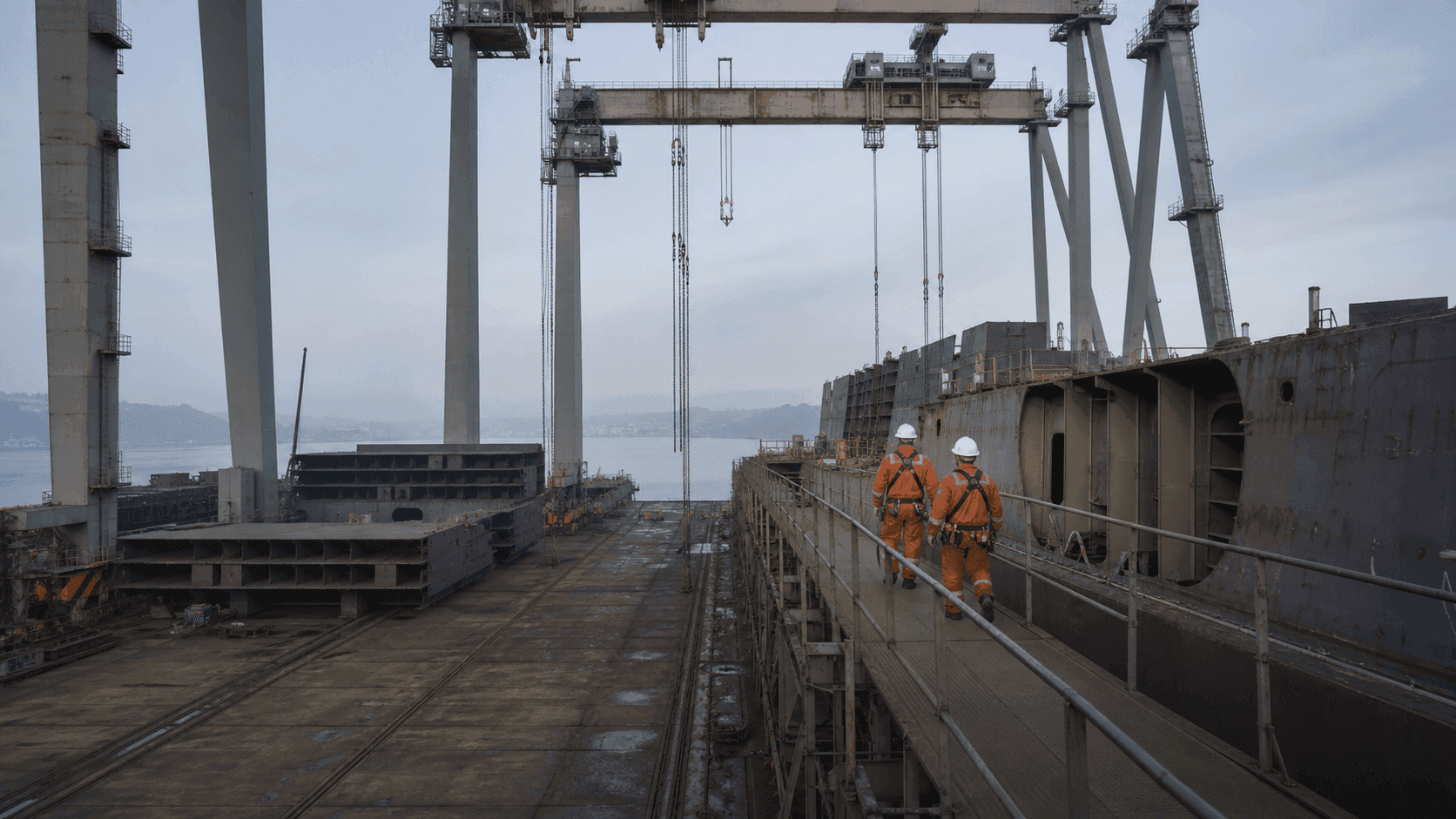
Shipyard Worker Tracking, Finding People and Equipment Across the Dock and the Yard
2026-09-09