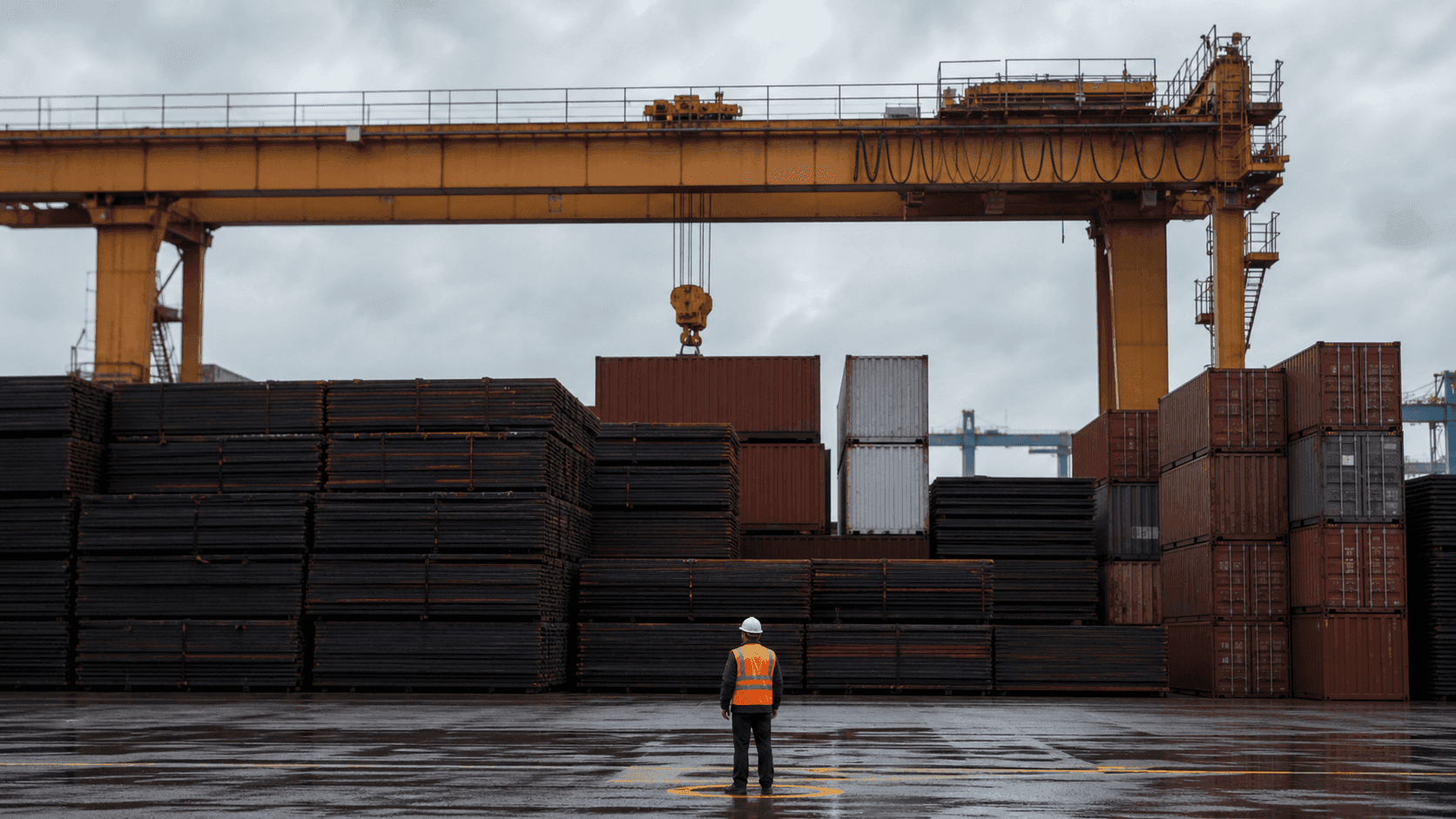
The most dangerous thing in a yard where a crane is working is not the crane. It is the radius that appears on the ground while the boom and the load move, and then disappears. That radius is invisible, it changes place within seconds, and anyone standing inside it has a hard time telling whether they are inside or outside. This is not work that leaves room to look up and check, and the noise makes it hard to judge by sound.
So sites post a signal person. A human being watches the radius on everyone's behalf, cuts off approach with hand signals and a radio, and a trained signal person judges faster than any device. The limit is not judgment. It is field of view. A signal person is one person, and one person looks at one place at a time. When cargo is stacked three tiers high, even that one place is cut in half.
At a container terminal, or anywhere with a lot of equipment, the structure of the problem shows more plainly. While one crane slews, a yard truck passes alongside, a subcontractor crew comes in through the walkway, and another machine works the same path in the next bay. It is rare for all three to fall inside one person's view at the same time.
A proximity alert system goes in to cover that gap. What decides success is not the distance calculation. That part is already solved. It splits on two things. How you mount positioning hardware in the middle of a lot of metal, and when you decide to let the alert stay silent.
I. Where the signal person cannot see
The situations where a signal person loses sight generally come down to three.
First, direction. The crane undercarriage, a work area on the ground and an incoming vehicle are in different directions. While one person turns, the other two directions are unwatched.
Second, obstruction. Stack height changes with the season and the volume. A bay that was in plain view last month is behind three tiers this month. The signal person has not moved. The visible range has shrunk.
Third, gaps. Shift changes, the few minutes spent moving to another bay, the time spent waiting for a radio reply. The radius keeps turning through all of them.
Video analysis covers the first and the third well. A camera does not change shift and looks in several directions at once. That is the position AI camera detection of collisions and hazard zones aims at. Video is strong inside its field of view. From the moment cargo stands between the camera and the ground, another axis is needed.
Position measurement is that other axis. A tag on the ground keeps producing coordinates behind stacked cargo, and with a tag fitted to the crane undercarriage, the distance between the two coordinates is calculated independently of sight lines.
II. Where to mount anchors in the middle of metal
Wherever there is a crane there is a lot of metal, without exception. Gantry structures, steel stock, containers and yard trucks reflect the signal. Take an installation drawing made on indoor office assumptions out to that yard and it is wrong from the first day.
The anchor ORBRO uses on this kind of site is TwinTracker UWB. In an open indoor environment its precision is on the order of ±10cm. In a yard with heavy metal reflection we do not promise that number as it stands. We measure on site and confirm it there. That order decides installation quality.
1. Mount away from the gantry structure
The highest and sturdiest looking place is the gantry crane structure. That place is also where the signal reflects most, and the structure itself moves. Anchors go on fixed structures, away from the gantry.
2. Take the fullest stacking condition as the baseline
Mounting positions chosen in an empty yard fall apart in peak season. The survey runs with the yard full, and anchor count and positions are confirmed against the reflection conditions of that state.
3. Secure spread in the anchor layout
When anchors cluster in one direction, coordinates drift along one axis. Spread in the layout moves precision more than anchor count does. This principle is covered in detail in anchor placement and positioning accuracy.
4. Mount without drilling, and move them when the layout changes
TwinTracker UWB attaches with magnets and clamps. No holes go into the structure, so approval from the facilities department takes less time, and when the stacking layout changes the same unit comes off and goes up somewhere else. In a yard whose layout differs from year to year, that condition weighs more than installation cost.
| Installation decision | Open indoor environment | Metal structure yard |
|---|---|---|
| Precision baseline | On the order of ±10cm | Confirmed after on-site measurement |
| Anchor position | Even spacing per the drawing | Fixed structures, away from the gantry |
| Baseline condition | The same at all times | Yard at maximum stacking |
| Mounting method | Bracket fixing | Magnet and clamp, no drilling |
| Readjustment trigger | Layout change | Stacking layout change |
III. Designing an alert that stays alive
Failure in proximity alerting has one shape. It goes off so often that people stop listening. The root of it is in how the judgment is made. Judging on distance alone is structurally hard to escape. With one rule that says alert when a person comes within five meters, it goes off while the crane is parked, it goes off for someone walking a designated path normally, and it goes off for the signal person who stepped in to manage the radius. Distance is a value the judgment needs. Distance alone does not complete the judgment.
So the conditions get split.
1. Split the rules by zone
The same five meters inside a lifting radius and on a designated walkway are different in character. Divide the yard into work zones, transit zones and standby zones and movement along a walkway drops out of the alert set.
2. Split the rules by equipment type
Entry into a hazard zone is detected separately by vehicle type. A yard truck entering a lifting radius is normal work. A passenger vehicle in the same place is an exception.
3. Take approach direction and equipment state together
A track that grazes the edge of a radius and one heading for its center are handled differently. Whether the crane is stopped or slewing goes into the conditions as well. With those two in place, the alert count falls while the situations that should raise an alert stay.
4. Split the alert into layers
Separate the stage that only appears on the monitoring screen, the stage that reaches the person involved through a field buzzer and tag vibration, and the stage where a response procedure runs automatically when an incident occurs. With the layers separated, people trust the alert at the highest layer.
The judgment is only whole when subcontractor crews working inside the dock are on the same screen too. If there are people who never appear, that direction goes back to depending on the signal person's eyes alone.
IV. What changes once alerts become records
Design the alerts well and one more output appears. When, where, how close something came to which piece of equipment, and for how long. That record turns out to be useful to the operations manager before the safety manager.
A heat map lays that record over the yard plan, and the control room and the field look at the same screen. Overlay a month of it and the alerts often turn out to be concentrated at one corner of one bay, usually a place where the aisle is narrow or the stacking sequence is tangled. The way to cut alerts at the root is not to loosen the threshold. It is to change the traffic pattern at that corner.
Crane utilization figures come out of the same data. Time the equipment actually moved, time it waited, and time it was stopped for maintenance accumulate by themselves. When a system approved out of a safety budget also produces equipment operating figures, next year's budget discussion takes on a different character.
At ORBRO this record gathers on one ORBRO OS screen. Coordinates, alert history, zone settings and heat map sit in the same place, and overlaying video events from AI Event Manager brings up the screen from the moment the alert fired. How to run a site whose infrastructure changes often is covered in the same vein in construction site safety management.
V. Things to consider before rollout
Listed in the order that decides schedule and satisfaction.
- Time the survey for the busiest stacking period. A survey in the off season is likely to be done again. If the schedule makes that impossible, put the readjustment date into the contract scope up front.
- Decide first who carries a tag and where. Helmet or vest, and how tags are issued to and collected from subcontractor crews, has to be settled as an operating rule to get through the first month.
- Treat thresholds as something to be adjusted, not an initial setting. Secure a slot from the start to open the alert history after two to four weeks of operation and reset the thresholds zone by zone.
- Check the power and network route for the anchors. Mounting without drilling frees up the fixing method, but bringing in power is a separate item. Look at yard lighting poles and existing distribution boards during the survey.
- Start in one bay and widen to the yard. It is faster to refine thresholds and zone rules in the bay that needs alerts most and then replicate.
Closing thoughts
A crane proximity alert is not a system that sets out to replace the signal person. It is a layer that watches the other directions while the signal person watches one, and keeps what happens behind the stacks as coordinates.
ORBRO builds the TwinTracker UWB anchors and tags and the ORBRO OS monitoring screen in one place. Fixing anchor positions by survey, designing the alert rules, and getting heat maps and utilization figures back all run through one system. Where video events are needed, AI Event Manager goes on the same screen.
Anchor layout and alert rules change with stacking conditions and equipment mix. See the configuration and connected products on the crane safety solution page, and send us a yard plan and an equipment list and we will work through survey scope and rollout schedule with you.