The First Number the Fire Service Asks For at a Distribution Centre
2026-08-12
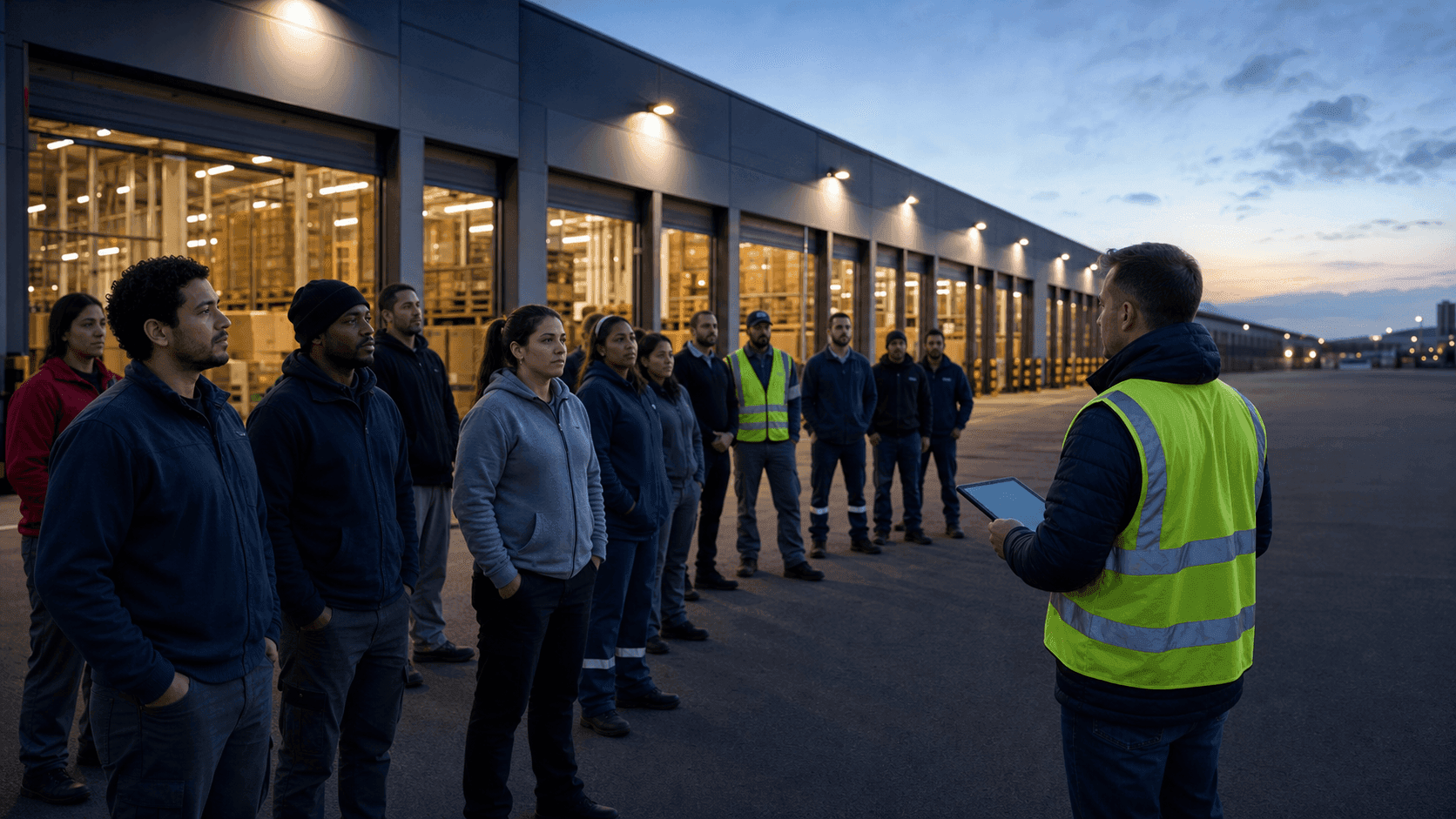
In July there was a major fire at a large distribution centre in the Seoul metropolitan area. Full extinguishment took 109 hours, and the fire service committed personnel numbering in the eight hundreds cumulatively along with more than 200 pieces of equipment. The 121 people who had been inside the building evacuated under their own power.
That there were no casualties is the most important fact about the incident. And behind that fact sits one question. At the moment the fire started, how many sites could have answered immediately with exactly how many people were inside the building?
When fire command arrives on site, the first piece of information they confirm is occupancy. Whether to enter or to defend, how much manpower to assign to search and rescue, which floor to sweep first: all of it turns on that number. Yet producing that number at a large distribution centre is harder than it sounds. The floor area is vast and there are multiple levels, permanent staff mix with day labour, agency workers and drivers, and during shift change two crews overlap.
A roster exists everywhere. Position exists nowhere. How large the difference between those two becomes in an emergency is the subject of this article.
I. An Access Log Only Knows Who Came In
Most sites have an access control system. So they know how many people came in today. The problem is the people who left.
Access gates are strong at recording entry and weak at recording exit. Several people pass through on one door opening, anyone leaving by a goods entrance or an emergency stairwell leaves no record, and some people go home without returning their tag. This margin of error causes no trouble whatsoever in normal times. It only becomes a problem in an emergency.
The second method is a roll call at an assembly point. When the alarm sounds, people gather at a designated spot and are counted. This method is reliable but slow, and decisively, it does not tell you where the people who did not come are. In a wide automated centre divided into floors and zones, finding the one person missing from the list turns immediately into a search. A search takes time, and the responders who entered during that time are also at risk.
So what is needed is not a more accurate roster. It is a different kind of information.
II. What You Need Is Not a Roster but a Number on a Drawing
Solve this with location and the shape of the information changes.
Aggregating the positions of tags worn by workers at zone granularity produces occupancy per zone in real time. Twelve people in zone A on the third floor, two people in the automated equipment zone on basement level one. Capture the values at the moment the alarm is raised as a snapshot, and those numbers fall as evacuation proceeds. The numbers that do not fall are the people who have not evacuated, and those numbers have positions attached.
Go one step further and it becomes individual. Last confirmed coordinate, direction of travel, zones recently passed through. Replay the last few minutes with the retrace function and a sentence forms: "this person was moving from the third floor rack zone toward the stairwell". The search area narrows from the whole building to one zone.
The response procedure has to run automatically as well. When the alarm condition is met, zone announcements, calls to responsible staff, evacuation guidance and manager notifications execute in a set order, and that history is recorded automatically. The procedure has to start before anyone has time to look up a manual.
Finally, this information has to be in a form you can hand over. Whether by sharing the monitoring screen or by immediately printing zone occupancy and a list of non evacuated people, it has to be handable to the arriving fire commander to have value. A number that is accurate only inside our own screen changes nothing in that moment.
ORBRO's integrated monitoring platform ORBRO OS starts from drawing zones on a site floor plan. Draw a zone and occupancy and access history for that zone are aggregated, and you can attach warning conditions and response procedures to it. Emergency evacuation is just one special use of that structure; in normal times the same data serves movement analysis and access management. Given that a system existing only for emergencies tends not to work when the emergency comes, this is the more realistic arrangement.
III. In a Fire, the Server and the Circuit Are at Risk Too
This is the item most often dropped when reviewing emergency response systems. Fire does not only threaten people. It cuts power and communications with them.
If position computation and event judgement are handled in an external cloud, the moment the centre's circuit is cut or power drops, the screen dies with it. Precisely when that number is needed most.
So it is safer for judgement to finish inside the site. ORBRO supports a configuration in which position computation and event judgement run on ORBRO Edge Pro, an on premise edge server installed at the site. Monitoring survives an external network outage, and the condition set by clients who do not want video leaving the site is satisfied at the same time.
There is one more thing to settle at design stage: what goes on uninterruptible power. Including the monitoring server and some anchors in key zones in the emergency power circuit means that even after a power cut, headcount at minimum stays alive. This is a matter of site design rather than product specification, and it has to be raised during the deployment review.
IV. What Changed Once Robots Entered the Warehouse
Automation has also changed the risk structure of distribution centres.
Recent reporting has pointed out that when the lithium batteries used by several hundred logistics robots gather on one floor, the aggregate capacity is equivalent to dozens of electric vehicles. The government has also formed a task force with relevant agencies and private experts to review safety management standards for automated logistics facilities. It has been reported alongside that major overseas logistics operators run fire detection, robot control, battery charge management and initial suppression as one bundled operation.
What stands out there is that detection, control and response are treated as one body. Underneath sits the judgement that adding more detectors alone is not enough.
The role location data plays in that structure is clear. Automated equipment zones are spaces where people are not normally present. So the very fact that a person is inside such a zone is information. It usually means maintenance or fault response is under way, and it is also the first position to check when an emergency is declared. Entry history and dwell time for battery charging and storage zones, kept as records, also have value in a subsequent investigation.
Video takes a different share. ORBRO's video event detection product AI Event Manager catches events such as smoke and flame, a person falling, and restricted area entry from footage. When that event is displayed at the same coordinate on the same drawing, one sentence forms: "smoke event in the third floor automated zone, two people in that zone". That is a different speed from cross checking a camera screen against a personnel roster on two separate monitors.
V. Five Things to Check When Reviewing
- Wear rate and return rate. If tags are handed out in the morning and collected in the evening, actual coverage is decided by the return rate. On a site where only 70 of 100 tags come back each day, occupancy is 30 percent hollow. Start by asking whether tags can be made permanently worn, in badge form.
- What appears within how many seconds of the alarm. Occupancy per zone, the list of people not evacuated, last known position. And whether that is a screen or a printout. Decide the form you will hand to the fire service in advance.
- What survives when communications and power are cut. Whether position computation happens on site, and whether the monitoring server and anchors are on the emergency power circuit.
- Whether contractors and day labour are included. A system that only captures permanent staff is most wrong exactly during shift change and peak season. Who issues and recovers guest tags, and how, is the practical gate.
- What form the record takes. Whether you can replay occupancy per zone and movement for that moment afterwards, and whether it exports as a report. Root cause analysis and prevention start from that record.
Closing
Fire is not something to predict. It is something to prepare for. And the minimum unit of preparation is not an equipment list but a single number. How many people are in this building right now.
A site that always knows this number in normal times needs no separate procedure in an emergency, because it is already on the screen. A site that does not know it in normal times does not know it in an emergency either. The alarm bell does not change that fact.
ORBRO builds everything from worker and asset location tags through the edge server placed on site, up to ORBRO OS, the monitoring platform that gathers this data onto one drawing. If you would like to know how this is configured for a distribution centre or warehouse environment, get in touch. Site scale, floor composition, and how you currently determine headcount is enough for us to begin.
Recommended Blogs

Emergency Action Plan Requirements, Accounting for All Employees After Evacuation
2026-09-02
Lone Worker Safety and OSHA Requirements, Closing the Gap Between Check-Ins
2026-09-03

Semiconductor Fab Personnel Tracking: Why Location Is Stored Only by Floor and Zone
2026-09-14

Warehouse Labor Tracking: Why the Shift Plan and the Actual Headcount at Each Process Differ
2026-09-17