School Mapping Data and the Annual July 1 Verification in Georgia
2026-09-07
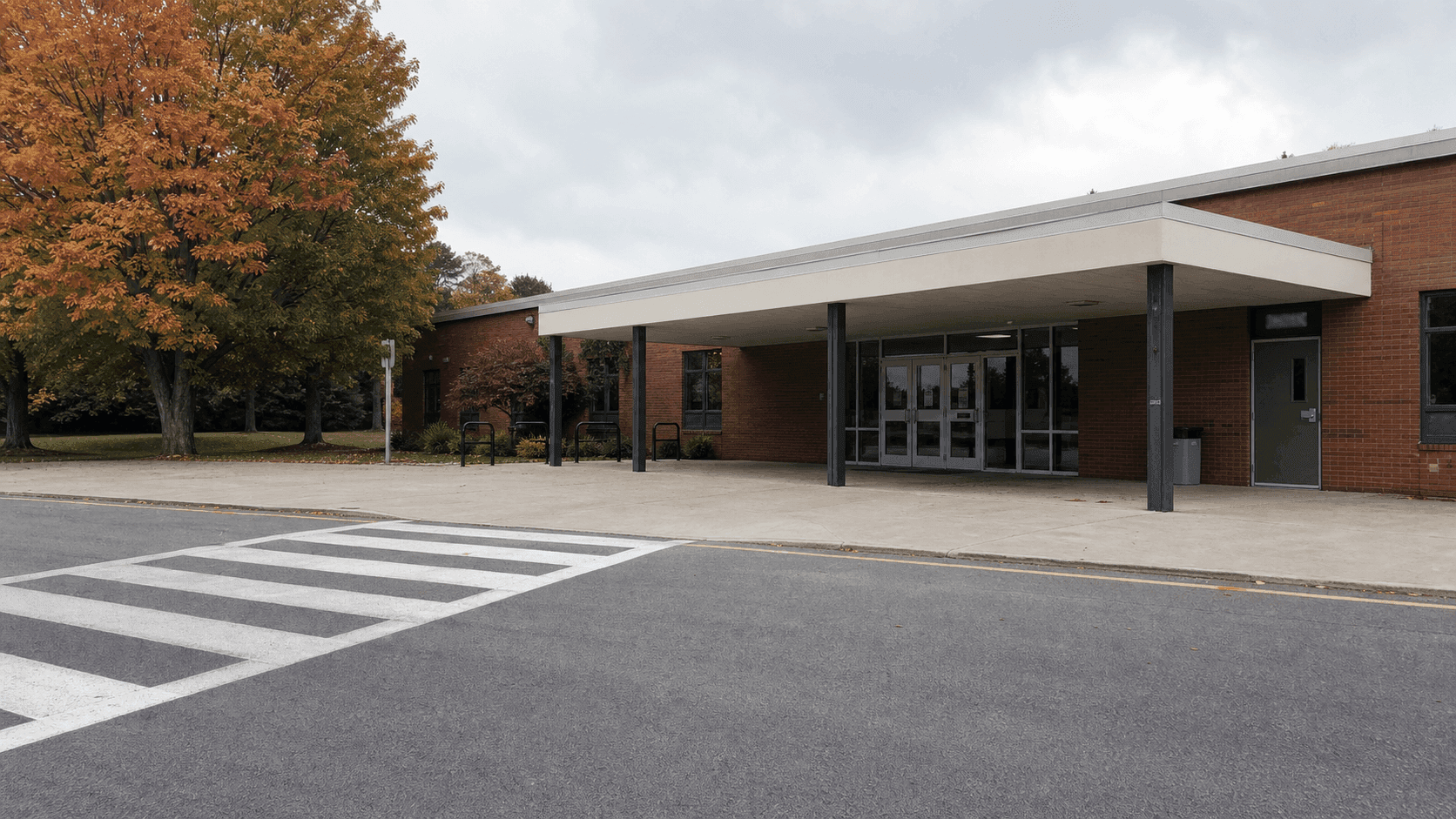
The door on the north side of the gym is numbered 14. Last August it was numbered 12, because two doors came with the addition and the district renumbered the whole east elevation at once. The AED that used to hang outside the front office moved to the cafeteria corridor when the office was remodeled over spring break. Room 208 is drawn on the floor plan as a science lab. It has been the testing room since October, and every adult in the building calls it the testing room.
None of that is unusual. That is simply what twelve months look like inside an occupied school building.
Georgia's deadline for procuring school mapping data was July 1, 2026. That date has passed. For a district that bought, the useful question is no longer whether to buy. It is what happens next July, and the July after that, because the statute does not ask for a file. It asks for the file to be checked against the building, in person, once a year.
That is a different kind of purchase. A floor plan is a deliverable with a delivery date. An annual verification is an operating routine, and operating routines land on people who already have jobs.
I. What the statute asks for
House Bill 268, signed on April 28, 2025 and effective on approval, carries the short title Ricky and Alyssa's Law. Two pieces of it matter here.
The first is a definition added at O.C.G.A. § 38-3-151(4). "School mapping data" means "building information, floor plans, and aerial imagery of any public or private school." Three things, not one. A set of drawings is part of it, not the whole of it.
The second is a new code section, O.C.G.A. § 38-3-154. Subsection (a) reads, in part, "Not later than July 1, 2026, each public school shall procure school mapping data," and then lists what that data has to do. Six items, and they are worth reading as operating requirements rather than as a product spec.
- It has to open in the software that local public safety answering points and responding agencies already use, "and that do not require such agencies to purchase additional software or provide payment in order to view or access such data." The buyer is the school. One of the users is a dispatch center that did not buy anything.
- It has to be printable, shareable electronically, and, if requested, capable of being "digitally integrated into interactive mobile platforms."
- It has to "be verified for accuracy by July 1 each year by the entity producing such school mapping data by means of an in-person inspection of each school."
- It has to label the access points of every building interior, "including, but not limited to, rooms, doors, stairwells, and hallways, each of which shall include any identifiers or names utilized by staff and students."
- It has to label critical utilities, key boxes, automated external defibrillators, and trauma kits or other emergency response aids.
- It has to label what is around the school, including parking areas, athletic fields, surrounding roads, outbuildings, and neighboring properties.
Three more subsections shape how this actually runs. Under (d), a local school system has to collaborate with and receive concurrence from its primary local law enforcement agency before procuring the data. Under (c), the state agency is authorized to develop rules and regulations covering standards for use, encryption, and secure transmission to responders. Under (e), information provided to the agency is exempt from public disclosure to the extent provided in O.C.G.A. § 50-18-72, and under (f) local boards, systems, schools and governments are given immunity from civil liability for damages arising out of the creation and use of the data.
Alongside it sits O.C.G.A. § 20-2-591, which reads, "Not later than July 1, 2026, each public school shall implement a mobile panic alert system." The system is named Alyssa's Alert, it has to integrate with the technology used in each local public safety answering point including Next Generation 9-1-1, and it has to integrate with the mapping data required by § 38-3-154. Subsection (c) says a local school system is not required to procure new capabilities if it already had a functioning system meeting those requirements as of July 1, 2026.
Georgia is not alone in having put a date on this, and the dates differ. In Texas, Education Code § 37.118, added by Senate Bill 838 in the 88th Legislature and renumbered from § 37.117 effective September 1, 2025, says each school district and open-enrollment charter school "shall provide each classroom in the district or school with silent panic alert technology," and the bill states that it "applies beginning with the 2025-2026 school year." That statute also contains a sentence worth pausing on. Subsection (b) says the silent panic alert technology "does not satisfy the requirement under Section 37.108(a)(2) for the district or school to ensure employees have classroom access to a telephone or another electronic communication device." A legislature wrote down, inside the statute, that one system does not stand in for another one.
At the federal level, the Uniform School Mapping Act was introduced in the 119th Congress as H.R. 3113. Introduced is where it stands. It is not law, and nothing in it is an obligation today.
You will see counts of how many states have adopted something in this family. Published counts disagree with each other depending on what is being counted, so we are not going to put a number on it. What matters to any one district is the statute of its own state and the date attached to it.
II. What makes a map go stale in twelve months
Requirement three is the one that turns this from a purchase into a program, and it exists because of what the other five requirements point at. Every one of them names something that moves.
Rooms change what they are. A science lab becomes a testing room. A storage room becomes an intervention office when a new staff position is funded. The floor plan keeps the old label, and requirement four asks for more than the label. It asks for "any identifiers or names utilized by staff and students," which means the map is supposed to carry the name people actually say out loud. Informal names drift faster than signage does, and nobody files a change request when they start calling 208 the testing room.
Doors change. Hardware gets replaced. A door goes out of service and gets chained. A door that was exterior becomes interior when a canopy is enclosed. Renumbering happens after construction, and it happens across a whole elevation at once, which means a single summer project can invalidate a column of the map rather than a single row.
Equipment moves. AEDs, trauma kits, key boxes and utility shutoffs are exactly the items requirement five asks to be labeled, and they are also the items most likely to be relocated by someone who was solving a different problem. A remodel moves an AED twenty feet and nobody thinks of it as a mapping event.
The outside changes on its own schedule. Requirement six covers parking areas, athletic fields, surrounding roads, outbuildings and neighboring properties. Portables get set on a back lot. A neighboring parcel gets built on. Aerial imagery ages whether or not the school touched anything.
The common thread is that none of these produce a notification. There is no moment at which a system announces that the map is now wrong. The building simply drifts, quietly, in the direction of whatever the people in it needed that week. That is why the statute asks for a walk rather than an attestation.
III. What the annual inspection is made of
The text assigns the walk to "the entity producing such school mapping data." So the vendor comes. But a vendor walking a building it saw once a year ago is doing rediscovery, and rediscovery is slow and expensive and misses the things that only a building's own staff would notice.
The second year should be a difference, not a survey. That only works if somebody was keeping the difference.
Decide who holds the change log. Not a document that gets created in June. A place where a change gets written the week it happens: a door taken out of service, a room renamed, an AED moved, a portable delivered. The cheapest annual verification is the one where the school hands over a list and the walk confirms it.
Treat the naming crosswalk as the hard part. The facilities office knows room numbers. Staff know nicknames. Responders will hear whichever one the caller uses. Requirement four asks for both to be on the map, which means somebody has to maintain the correspondence between them through the year. If that correspondence lives only in the vendor's file, the school has no way to fix it between walks.
Look at when the walk happens against when the building changes. July 1 sits inside the season when a school changes most. A walk completed in late June describes a building that may be different by the second week of August. Deciding with the vendor what the walk is measured against, and what happens to changes made after it, is a conversation worth having before the first renewal rather than during it.
Keep the law enforcement relationship past procurement. Subsection (d) puts concurrence at the procurement stage. The practical version does not stop there. The agencies that will open this data are the ones best placed to say whether a label is useful, and the annual walk is a natural occasion to ask.
IV. The responders' data and the school's own screen are two different objects
This is where districts most often merge two purchases that should stay separate.
The data described in § 38-3-154 has a specific audience. It is built to be opened by a public safety answering point and by responding agencies, in formats they already run, without buying anything. It is produced by whichever entity the district procures it from, with the concurrence of the local law enforcement agency, and it is handled under the disclosure and transmission provisions the statute sets out. ORBRO does not produce that data and does not transmit it to public safety systems. That is not our lane.
What a school looks at on an ordinary Tuesday is a different object entirely. On an ordinary Tuesday nothing happens. The whole value of a screen on a day when nothing happens is that it keeps the picture current, so that the picture is current on the day something does.
| Comparison | Responder facing mapping data | School facing operations picture |
|---|---|---|
| Audience | PSAP and responding agencies | Front office, facilities, school administration |
| Used | Rarely, under pressure | Daily |
| Update cadence | Annual in person verification | Continuous, as the building changes |
| Contents | Building information, floor plans, aerial imagery, labeled access points and equipment | Floor plan, zones, door state, events, history |
| Maintained by | The producing entity, with law enforcement concurrence | The school, in the course of running the building |
The school facing side is what ORBRO builds. Four pieces, and they are ordinary pieces.
A floor plan you can maintain. ORBRO's digital twin work starts from what a district already has. Existing 3D models, CAD drawings and floor plans are reused rather than resurveyed, and the result is an indoor map that the school can edit when the building changes. The approach is described in more detail in Digital Twin: Implementation of Building and Indoor Information.
Zones on that plan, with rules and history. In ORBRO OS, a corridor, a stairwell, a gym and a bus loop are drawn areas with their own rules and their own record. Events land on the plan at the place they happened, and the history is queryable by area rather than by camera number. Zone based monitoring covers how areas are set up.
Door state. Access Pro reports which doors are secured and which are held open right now. A propped exterior door is a daily operations fact and a mapping fact at the same time, and it is the kind of thing a building learns about faster from a list than from a walk.
Video analysis built for corridors and stairwells. ORBRO's school risk behavior detection watches for falls, for a person who has gone down and is not moving, and for running at hours when the building should be quiet. It works from posture change, not from faces, and it does not track individual students. Analysis runs on ORBRO Edge Pro inside the building, so video stays on site rather than leaving it, which is discussed in Edge and on premise monitoring. What to do with a detection once it exists is its own problem, covered in What you need after AI video detection.
Here is the connection back to the July walk. A screen that building staff use every day accumulates the change log as a byproduct. When a door goes out of service, the door list stops matching the building and somebody notices within a day. When an area is renamed, it gets renamed in one place. The annual in person inspection still happens, because that is what the statute asks for and a screen is not a substitute for it. It just stops being an act of rediscovery.
V. Points to check before buying
Ask what year two looks like, in writing. Who walks, in what window, with what deliverable, and what happens to changes made after the walk. A quote that covers year one and goes quiet about year five is describing half the cost.
Ask what the school has to supply. An escort, keys, access to locked mechanical spaces, and someone who knows what changed. Those are staff hours in July, and July is not an empty month for a facilities director.
Ask where the informal names live and who can edit them. If the only copy of "everyone calls 208 the testing room" is inside a vendor deliverable, that line will be wrong for eleven months at a time.
Keep the two systems on separate budget lines. Responder facing mapping data and a school facing operations picture have different renewal cycles, different owners and different failure conditions. Buying one does not produce the other, and a proposal that blurs them is worth a second read.
Decide the video and access question before the board meeting, not during it. Where footage is analyzed, where it is stored, how long it is kept and who can view it are questions that come up in front of parents. They are easier to answer when the answer was a design decision.
Inventory what is already installed. Most schools already have cameras and already have electronic locks on some doors. Checking coverage, mounting height and door hardware before specifying anything usually changes the shape of the project, and almost always in the direction of less spending.
In closing
Georgia picked a date and a method. July 1, and a walk through the building. It did not pick who keeps track between the walks, and that is the part that determines whether the second inspection is a morning or a week.
The renumbered gym door will keep being renumbered. Somebody will keep moving the AED. Room 208 will be the testing room until it is something else. A map is only ever accurate on the day it was checked, which is exactly why the statute made the check recurring.
ORBRO builds field hardware, edge servers and control software in house. That is why a floor plan, door state, camera events and alert routing can be one structure in ORBRO OS instead of four integrations that each have to be maintained separately. What we build sits on the school side of the line, next to the responder facing data rather than in place of it.
Every building is different, and so is every district's starting inventory. If you are working through what the school side of this should look like, we are glad to look at your floor plans and camera coverage with you.
Recommended Blogs

AI-generated illustration of the selected local environment; not a photograph of a customer site.
2026-10-13

Asset Tracking Across the Warehouse Door: Joining Indoor and Yard Records
2026-10-12

Forklifts Queue at Dispatch. Look at Dwell Time.
2026-10-08

Found the Medical Equipment. Is It Ready to Use?
2026-10-07